



HYBRID METHANOL FUEL CELL SYSTEM BEING TESTED FOR MARINE AUXILIARY POWER
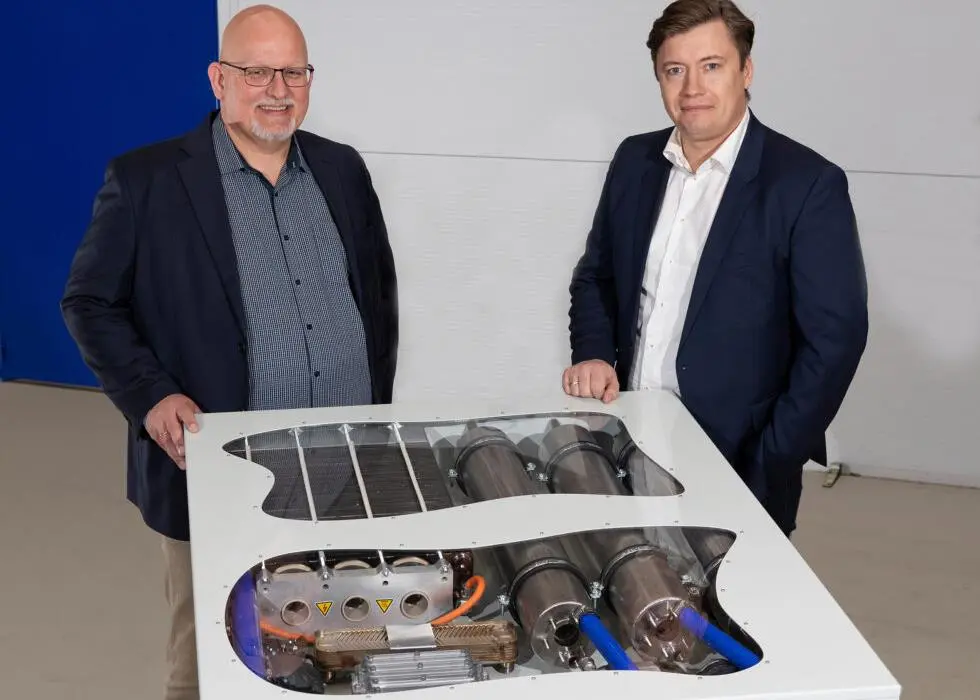
The aim of the project is to establish an efficient and cost-effective fuel cell solution that could become a realistic alternative to combustion-based auxiliary power on ships. The fuel cell test setup will have a power of 200kW, but the fully developed and modular design should be possible to scale up incrementally to 5MW, and beyond, only limited by space.
Blue World Technologies designs, develops and manufactures methanol fuel cell systems primarily for automotive and mobility applications. The company’s fuel cells are combined with batteries in hybrid configurations: the battery is suited to short high power needs and the fuel cell to the extended need for energy. By combining the two technologies both can be downsized considerably so only a relatively small battery pack and fuel cell is required compared with a single technology scenario.
The fuel cells operate at 160-180°C and have a high resistance to impurities. High Temperature PEM fuel cells have a higher tolerance for thermal cycling than other fuel cell types, which makes them well suited to the variable power production needed from a genset, says Blue Water Technologies. However, the technology will need a lifespan comparable to that of combustion technologies to be feasible for use on board ships, which will mean addressing various sources of performance degradation.
The durability of the system will therefore be tested at the Alfa Laval Test & Training Centre in Aalborg, Denmark, with funding provided by the Danish Energy Technology Development and Demonstration Program. Alfa Laval Test & Training centre is essentially a land-based version of a vessel’s machine room, offering 2800 m2 of testing space equipped for oil and gas fuels and, since late 2020, also biofuels and methanol.
“We believe that fuel cell systems will have a larger role to play in the future X-to-Power landscape. However, there are a number of potential fuel (X) pathways, so we need to have a broad perspective on this area,” says Sameer Kalra, President of the Marine Division at Alfa Laval.
The fuel cell system will use renewable, carbon-neutral methanol as fuel, enabling clean operations with very limited emissions. “Fuel cells have the potential to expedite the green transformation of shipping. The technology will enable a new generation of very simple and reliable ships that will be much easier to digitize than the ships we have today,” says Jakob Steffensen, Innovation Lead at DFDS.
The project will run until 2023. Headquartered in Aalborg, Denmark, Blue World Technologies is already ramping up for the mass production needed to bring fuel cells into cost parity with combustion-based solutions. In February, it took over an 8,500m2 production building on the Port of Aalborg.
Related Articles
 ALTERNATIVE FUELS & LUBRICANTS
 ALTERNATIVE FUELS & LUBRICANTS
 ALTERNATIVE FUELS & LUBRICANTS