



HYBRID POWER FOR SELF-DISCHARGERS
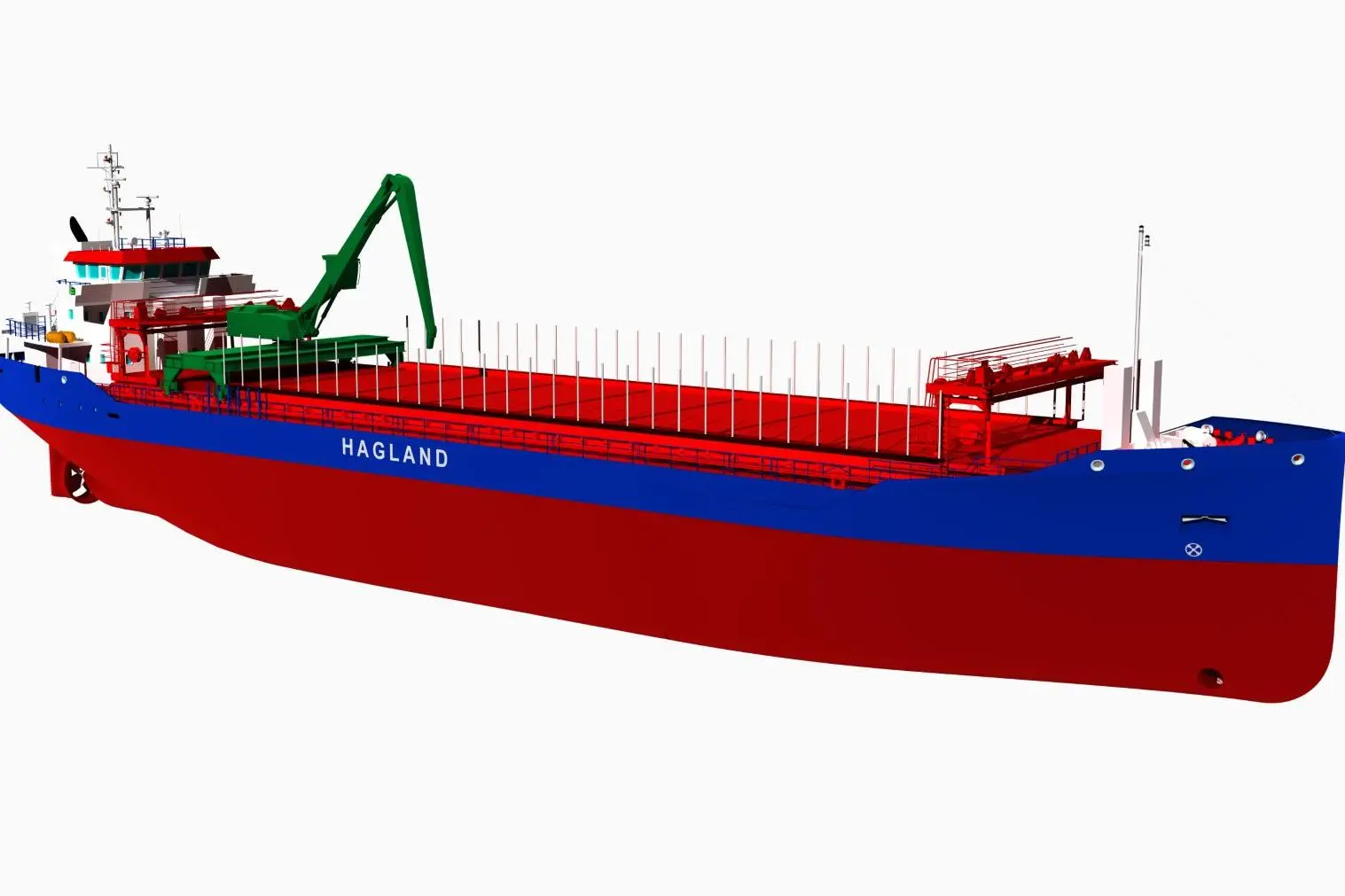
The NOK280 million (US$33.4m) deal with Royal Bodewes calls for two 5,000dwt vessels, each fitted with a travelling gantry-mounted excavator, and scheduled to be phased into European service during the first and second quarters of 2023, respectively. Options have been taken out on third and fourth sisterships.
The newbuilds will replace older, conventionally-powered tonnage, introducing an optimised design incorporating a plug-in hybrid battery solution that satisfies IMO Tier III emission requirements. Furthermore, by drawing electricity from the shore grid when alongside, rather than running on diesel gensets, both exhaust and noise emissions will be reduced in port. Shore power will cover the shipboard load when alongside, including that for cargo handling using the electric excavator-type unloader, and will also recharge the batteries.
Haugesund-based Hagland currently operates 14 self-dischargers in the 3,700-5,000dwt range, mainly transporting stone, timber and industrial bulks. Relative to existing tonnage, the incoming vessels are expected to immediately cut CO2 emissions by 30%-plus and slash NOx by 90-95%. Furthermore, the design has been prepared to facilitate future adaptation for zero-emission performance.
Describing the contract as a milestone in the firm’s history, Hagland stated that “The investment in these newbuilds is a major step forward for the company and the transition to low- and zero-emission vessels within our segment. The new vessels represent the start of a renewal of the fleet that is also necessary to reach the ambitious climate goals set by the shipping industry.”
The project has attracted financial support from the Norwegian government on the strength of its environmental credentials, and this is acknowledged as having been instrumental in bringing the scheme to the contractual stage. A subsidy of NOK26.8 million (US$3.2m) has been authorised via ENOVA, an agency of the Ministry of Climate and the Environment, under the ‘Electrification of Maritime Transport’ initiative. The primary goal is to make zero-emission vessels competitive. The shipowner has also received an offer of long-term financing from state-owned Innovation Norway.
Hagland earlier demonstrated a corporate commitment to ‘greener’ bulk cargo trading when it announced a NOK30 million (US$3.6m) plan in 2018 to retrofit an existing vessel with hybrid battery power. The enterprise was launched in cooperation with Norwegian compatriot NOAH, which processes and stores hazardous waste at its premises in the Holmestrand area of Oslofjord.
Work is under way in Poland on the conversion of the selected ship, the 4,700dwt self-discharger Hagland Captain. It is claimed that she will be the world’s first battery hybrid vessel in her category. Wartsila has been engaged to provide the hybrid battery system, which will allow the 2012-built singledecker to operate with zero emissions near shore and in port. Included in the solution are a shore power connection to deliver power for cargo handling and battery charging, a new reduction gear with PTO/PTI (power take-off/power take-in) technology, and a proprietary NOx Reducer.
Experience with the Hagland Captain modification has helped inform the engineering design for the newbuilds from Bodewes, which is a prominent player in the short-sea vessel construction stakes.
Related Articles
 PROPULSION
 GENERAL NEWS
 HYDROGEN