



Hybrid square riggers – the ultimate green ships?
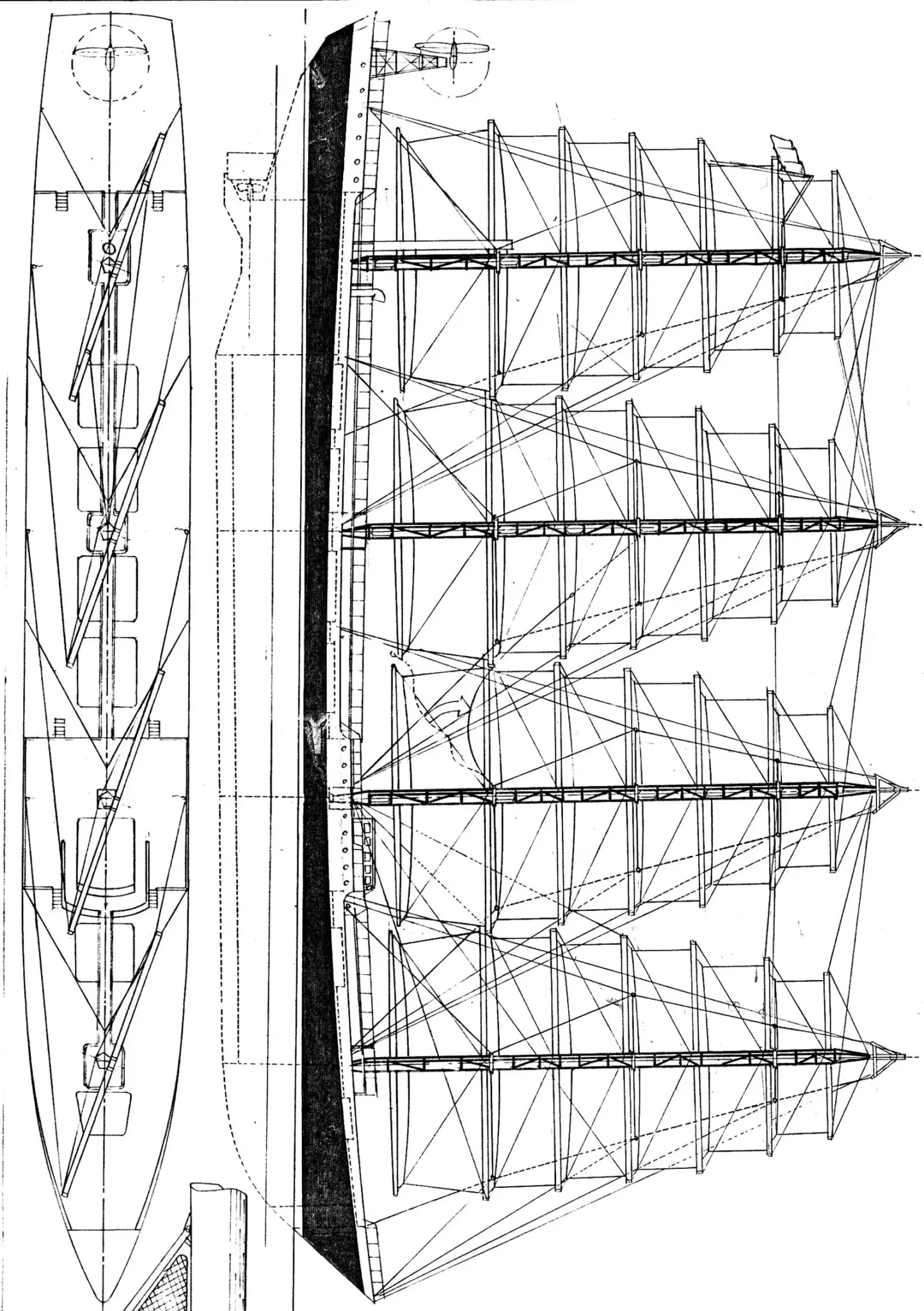
Stayed Dyna-rig option
A new concept for sailing vessels has been developed by Philip Goode, which claims to overcome the shortcomings of current rig designs.
Most practical proposals for sailing cargo vessels today are based on the Dyna-rig developed for that purpose in Germany in the 1960s and brought to outstanding culmination in the rig of the 2007 built Maltese Falcon. This rig is based on a rotating mast, the yards being fixed to the mast and rotating with it. This means that the masts had to be unstayed, leading to enormous cost not only in the bearings at heel and deck partners, but also in producing a spar strong enough to bear the bending load.
What brings Goode’s design into the realm of commercial viability is that, instead, it utilises a rotating mast stepped on deck and supported by wire rigging. The spar can thus be much lighter and, aside from a thrust bearing at head and heel, there are three simple bearing collars along the mast’s length. Practical experience of the 226gt sail training vessel Pelican of London has shown that lateral staying of the mast can be safely carried out by backstays which are anchored much further aft than usual and do not hinder horizontal yard swing until the yards reach 20º from ship’s centreline. Because none of these backstays hinder the yards, there can be as many of them as required. Even the conventional lower shrouds, which would normally be in the ship’s transverse plane, can be replaced by backstays to the lower hounds.
Use of the Sky-Link principle enables the wire elements which come in to the mast to approach it perpendicularly instead of angling up from deck level. This has two effects which are fundamental to this proposal. One is that the forestays do not limit the rotation of yards because they pass horizontally between the foot of each sail and the yard below. Secondly, vertical (axial) loading on the bearing collars is avoided, which means that quite simple bearings will do. Should the Sky-Link assembly go slack through failure of any component, there are light backup stays from masthead bearing to deck.
To save manpower and running rigging, yards are clamped to the foreside of masts and rotate with them while, to stiffen the yardarms, these are linked to the aft side of the mast by wire spans.
The sails are roller-furled inside the yards, as is the practice on Royal Clipper, and rotation of the mast is effected by a reduced number of braces acting through electric/hand Jarvis brace winches. The mast’s lattice structure is optimised for torsional strength to cope with accidental over-tightening of a brace.
Inside the mast there is a service channel for the sails’ sheets, electrical cables, vent ducts and it also houses a Jacob’s ladder plus a tube housing the counterweight for the personnel elevator bucket. This would have stations at every yard, ending at the lower topgallant.
To facilitate access by crane jibs for unloading purposes, the lowest backstay can be released from the deck by a cam lever and hauled up out of the way (see drawing, between main and mizzen masts). This allows a free height of 13m over the hatch coamings.
The drawing shows a generic ship of 10,000 dwt on a waterline length of 145m, with 20.3m beam, 13.0m depth, 10.0m loaded draught, prismatic coefficient 0.70 and load displacement 18,000 tons and sail area 4,687m2. The 1903 Preussen had five masts carrying 4,663m2 of sail on a waterline length of 120m and could sail at 15 knots in a fair breeze, a very modest speed-length ratio. This proposal has proportionately less sail area but would have an auxiliary engine to take her through belts of calms, a unit minimally sized to be effective in a strong head wind. The electric turbine on the stern should relieve the diesel generators of most of the ship’s electrical service load.
Depending on cargo delivery requirements, preferred routeing would take advantage of the strongest following winds. The ship’s weatherly ability (45º to the apparent wind), while a strong safety feature, would not dictate any departure from traditional routes.
Cargoes would need to be fairly flexible as to delivery dates but since they would not be containerized this would tend to be associated with a type of terminal more amenable to this procedure. Carrying 15 or 20 adventure seeking passengers would help defray costs.
Dyna-rig option
B9 Shipping in the UK is developing the design of a 3,000 dwt coastal sailing vessel that is fitted with a spark ignition engine designed to burn bio-methane. About 60% of the thrust will come from soft sails and 40% will come from the engine (carbon neutral).
A free standing and free rotating Dyna-rig system, originally designed in the 1960s by Wilhelm Prolls, has been chosen as the sailing rig and the bio-gas will be produced by the anaerobic digestion of food waste and other commercial and industrial organic waste streams. The biogas is processed to produce bio-methane, which when liquefied exhibits all the characteristics of LNG, allowing use of off-the-shelf equipment for storage and handling.
The design is from naval architect Rob Humphreys, best known for Dame Ellen MacArthur’s Kingfisher, and B9 Shipping has collaborated with Rolls Royce, Graig Investments, Corus Steel, International Paints, Southampton University’s Wolfson Unit and the Met Office to develop the new vessel. About 60% of the thrust comes from conventional soft sails and, in calm conditions or to manoeuvre in port, the bio-methane engine is used.
As conventional ships have increased in size, to improve economies of scale and to amortize ever more unpredictable fossil fuel prices, small islands have become increasingly isolated. So B9 hopes to make available a technology transfer package to small island states, incorporating the sail-powered cargo ship design, the lean manufacturing technology offering efficient, rapid build at any suitably-sized yard, and the anaerobic digestion technology for bio-methane fuel. The company claims that the small ships should be simple to build and operate and will create local jobs in construction, maintenance, crewing and operations, so island states will be better placed to engage in economic activity and stimulate sustainable development.
Related Articles
 PROPULSION
 GENERAL NEWS
 HYDROGEN