



Hybrid surface effect ship classed by BV
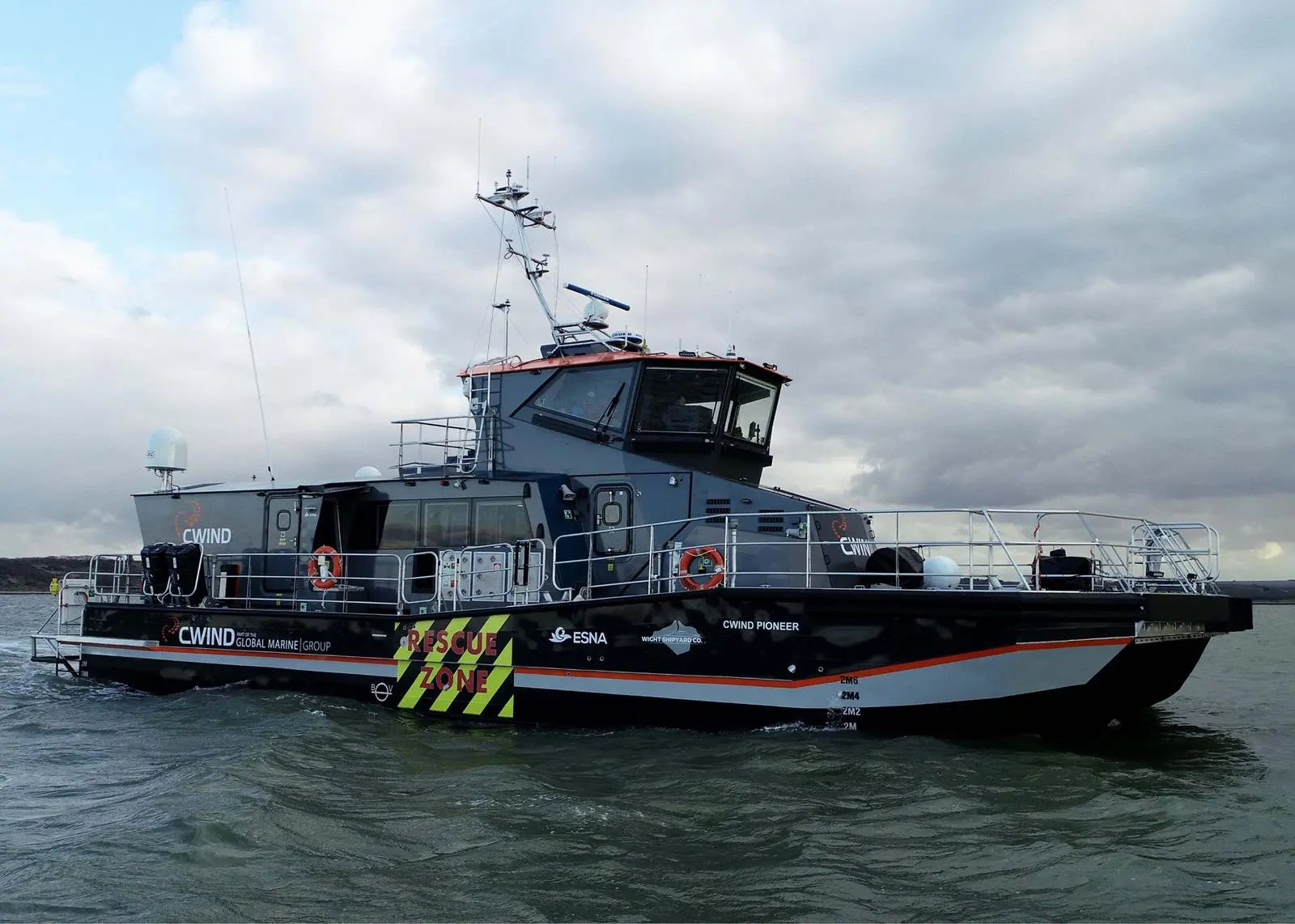
The CWind Pioneer can operate at speeds exceeding 43 kts, and can transfer personnel safely and comfortably even in extreme weather conditions with significant wave heights up to 2m, permitting greater operational windows.
Its air cushion motion control system provides significant advantages, with smoother and more comfortable conditions on-board and increased operational days offshore. The CWind Pioneer is being used at the Borssele 1 and 2 offshore wind farms in the Netherlands.
The vessel is the world’s SES to be equipped with a hybrid diesel and battery electric power system, and is intended to meet the needs of the offshore wind industry. The vessel is claimed to be over 20% more fuel efficient than conventional CTVs running at 24kts on a mile for mile basis, without taking into account the savings generated by the hybrid system when operating purely on battery power alongside or at slow speeds.
While the electric hybrid technology reduces engine wear, noise and vibration levels, its implementation comes with a good level of complexity that needs to be managed carefully. BV’s notation ‘Electric-Hybrid’ addresses the complexity of these systems, defining requirements for storage, power distribution, control and instrumentation, as well as tests that must be carried out especially when it relates to power management and critical safety considerations, such as thermal runaway.
Bureau Veritas was involved with the project from its early design stages. Close cooperation with the designers, ESNA – a Norwegian Naval Architecture company, and Global Marine Group’s in-house Engineering Department and shipbuilders, Wight Shipyard Co., enabled Bureau Veritas experts to provide their technical and regulatory expertise.
In order to ensure that CWind Pioneer can take full advantage of the Electric Hybrid technology in a safe manner, Bureau Veritas has assigned the notation Electric Hybrid (PM, ZE). This notation provides a comprehensive framework for the safe implementation of this technology while achieving the client’s objectives of working at zero-emission mode, at port or at standby in the offshore wind farm, as well as enhancing speed performance in boost mode to reduce transfer time between shore and the offshore wind farms.
Related Articles
 BATTERIES, SUPERCAPACITORS, FUEL CELLS AND OTHER ENERGY STORAGE TECHNOLOGY
 BATTERY HYBRIDS & FULL-ELECTRIC VESSELS
 BATTERY HYBRIDS & FULL-ELECTRIC VESSELS