



Hydrogen blends offer CII certainty
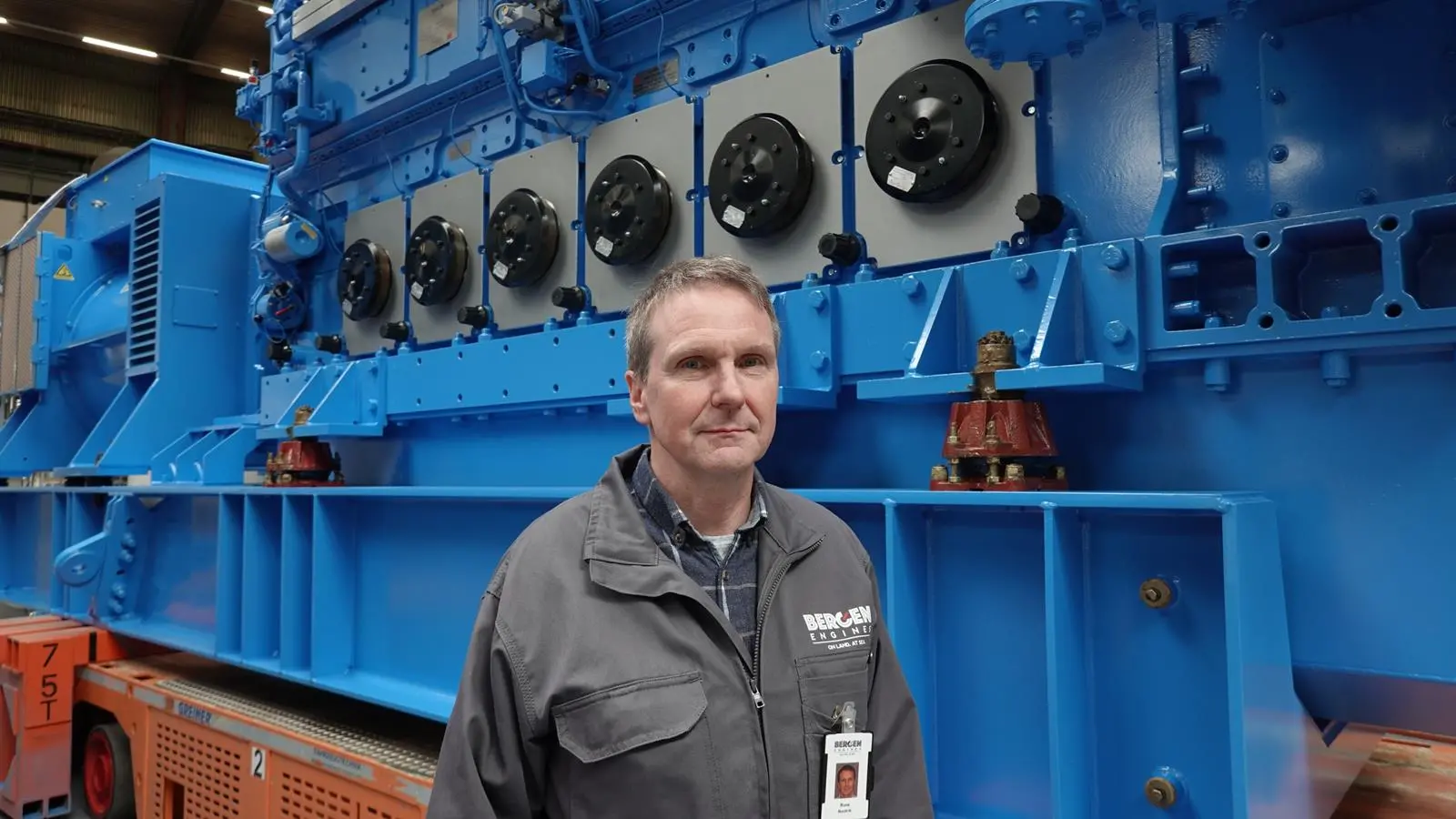
Hydrogen-fuelled lean-burn gas engines could satisfy IMO’s upcoming requirements for both EEXI and for the gradual reduction of CII, believes Rune Nordrik, Senior Principal R&D Engineer at Bergen Engines.
He was speaking to The Motorship in mid June, after the first phase of tests using hydrogen/natural gas blends in one of the enginebuilder’s B35:40 gas engines (see box) and pointed out that a lean-burn gas engine has 18% lower CO2 emissions than a diesel reference engine while blending hydrogen with the LNG fuel “will further decrease the CO2 footprint”.
With a mixture including 60% hydrogen by volume, CO2 emissions would be 30% lower than a diesel engine, rising to 50-100% improvement once the hydrogen ratio rises above 80%, Bergen Engine’s analysis suggests.
Enquiries have been received from the marine sector but the first application for the technology will be in land-based power generation plants, which have access to green hydrogen produced using wind and solar energy when there is a surplus from those generators.
Tests began in January, prompted by a specific enquiry from a land-based user, with immediate positive results. A statement issued on 1 February reported that initial tests using a blend of 15% hydrogen and 85% natural gas, by volume, were completed without any hardware adjustments and said that the engine’s output was “maintained according to specification at all load levels”. Emissions of CO2 and CO were also reduced, as too were unburned hydrocarbon levels and methane slip, the statement said.
Bergen Engines confirmed that it had signed a contract with Italian energy supplier Edison Next to delivery two 11.7 MWe hydrogen-ready gensets to a power plant in Italy. The engines will be built specifically to use a hydrogen/natural gas blend, with shipment from Bergen scheduled for December 2022. These will be 20 cylinder variants of its B36:45V specification.
Although its tests were run with 15% hydrogen, Bergen Engines has committed to just 10% hydrogen for this first order, although it is confident that the performance it reported can be sustained for higher proportions of hydrogen.
Its February comments described the fuel blend as “a first step towards zero carbon emissions” and said that “Bergen Engines is aiming to have a commercial solution in the market that will accept hydrogen content of up to 60%, and solutions that can be further developed to accept 100% for new engines to come”.
It is too early to say when those milestones will be reached, Dr Nordrik said, but its test engine has already been run with an 80% hydrogen blend, although that was at part-load. At full load, a hydrogen ratio of 40% has been tested, which is at the physical limit of the test assembly’s hydrogen-dosing equipment.
Engine upgrades planned
Bergen Engines has ambitious plans for its hydrogen research. While its immediate aim is to confirm that its current gas engine designs can operate with low levels of hydrogen without any hardware changes, its intention is eventually to offer upgrades to enable other engines to operate on hydrogen, according to a statement issued on 1 February after initial testing with a 15% blend of hydrogen, by volume.
These upgrades will initially be available for Bergen Engines B-Series engines. Bergen Engines Senior Principal R&D Engineer, Rune Nordrik explained that this series has long been available as a diesel engine and the engine block is the same for both that version and for the gas-fuelled alternative.
As a result, “a rebuild will not be that comprehensive”, he believes. Components such as turbochargers, pistons, cylinder head, fuel injectors and possibly the camshaft would need replacing, but that work could be done during a main engine revision, he said.
Initially, Bergen Engines is launching the B36:45V engine for hydrogen use but if there is market demand, this could be extended to its C engines and older B35 models, he said.
However, because of hydrogen’s lower energy density, even when it constitutes 80% of the gas volume delivered to the engine, it represents only 50% of the energy delivered, so if the engine’s rated output from LNG were to be met using 100% hydrogen, the volume flow would require the fuel supply’s dimensioning to be reviewed to deliver both sufficient hydrogen and the excess air that would be needed, Dr Nordrik said.
Efficiency and stability
Adding hydrogen into the fuel mix speeds up its combustion, which delivers “a significant improvement in engine efficiency” that “becomes increasingly prominent for leaner mixtures”, Dr Nordrik added. This would also increase its NOx emissions, so the engine has different ignition timing settings from the standard gas engine.
Engine stability is more challenging with hydrogen blends. Stability is measured by assessing its coefficient of variance (CoV), which takes account of variations in parameters such as firing pressure and indicated mean effective pressure. A conventional diesel engine has a very low CoV, while a normal Otto-cycle gas engine has a larger value. But in its tests, Bergen Engines has found that the CoV increases as more hydrogen is added to the fuel.
This can be controlled, Dr Nordrik said, for example by reducing the compression ratio and advancing the timing; tests have been run with different engine set-ups to find the best way of controlling CoV and Dr Nordrik reported that stability had been achieved at full load with 25% hydrogen and at part load with up to 75% of the gas.
Alongside the benefits of better efficiency and lower emissions, other factors are relevant considering hydrogen’s potential as a fuel.
Storage and handling are two such considerations, not only because of the volume required to hold the fuel, but also because of its diffusivity, which causes its molecules to enter the metallic lattice of its containment and cause embrittlement.
Based on its inspections during its tests, this is not an issue at the ratios currently being proposed, Dr Nordrik said, but it would be more significant at higher proportions, especially if 100% hydrogen fuel is used. Bergen Engines is exploring solutions to this, which could include new materials or coatings to prevent hydrogen from entering the metal.
Marine market potential
While land-based applications are set to provide Bergen Engines initial market for hydrogen engines, there is the potential for marine applications, although its extent is difficult to predict. As mentioned above, hydrogen fuel blends provide an effective route to complying with EEXI and CII requirements, which is likely to underpin the engine’s marine market.
On the other hand, other fuels – such as ammonia and methanol – can serve as lower-volume hydrogen carriers, Dr Nordrik said, and class rules do not yet reflect hydrogen use, he said.
Ship size and operating areas are likely to affect an owner’s fuel choice, he suggested, with hydrogen being attractive on shorter routes where fuel storage volume is less of a consideration. “The energy and the technology is there and is affordable”, he said.
It would be especially relevant for ships that already use lean-burn gas engines or for owners considering using hydrogen fuel cells as energy sources. For them, “an alternative would be to mix the hydrogen into the existing [supply] to the natural gas engine and you won’t need an expensive fuel cell installation”, he said.
How the tests were done
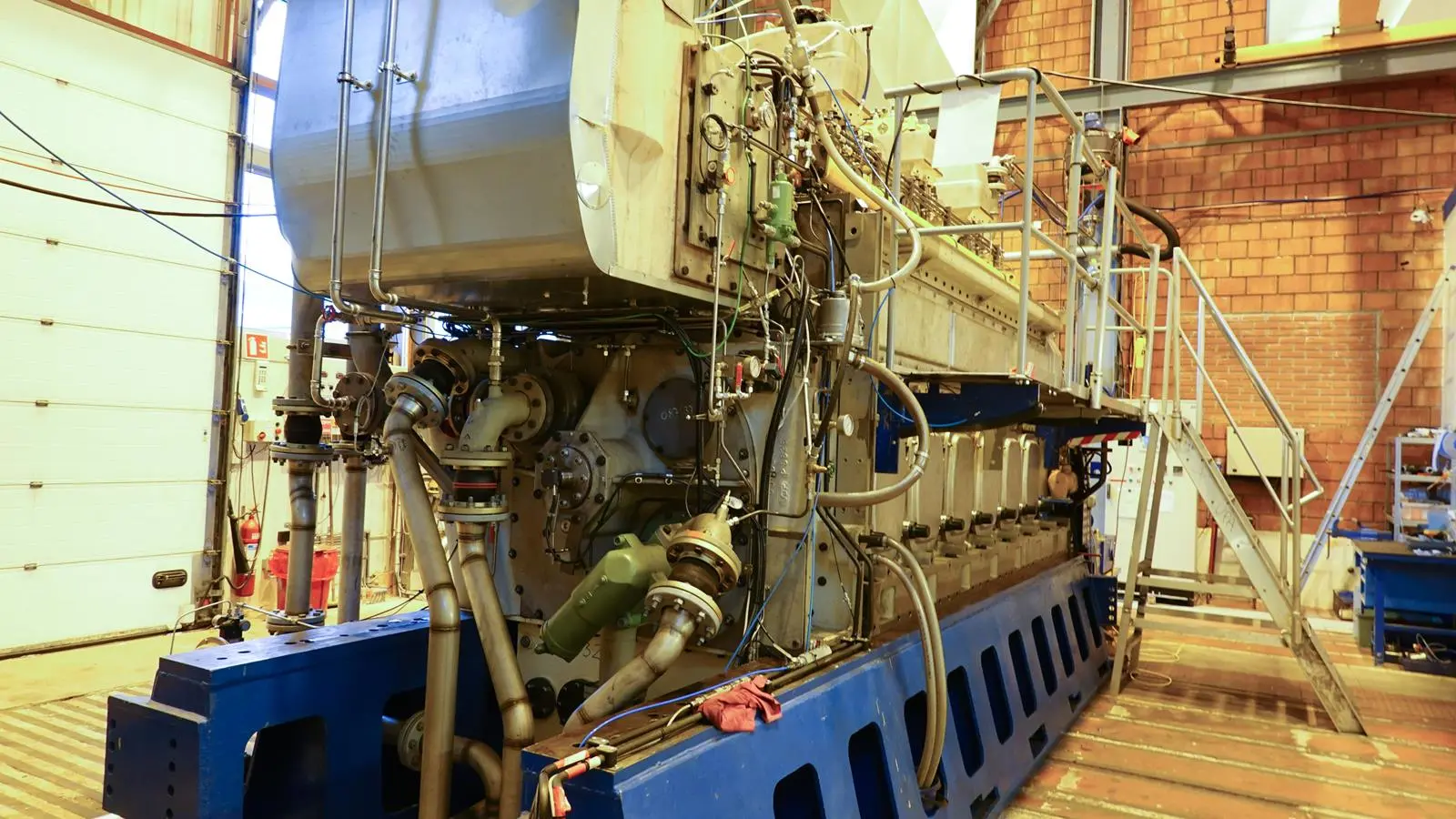
When Bergen Engines set out to test how its B-series gas engine would operate on a blend of natural gas and hydrogen, it already had a three-cylinder version of its B35:40 gas engine installed in its test cell. With only a little modification, the machine was ready to serve as the platform for its studies into its performance with hydrogen.
Hydrogen storage and a mixing unit were installed outside the test cell, with the hydrogen simply being introduced to the fuel supply pipe; the two gasses mix easily, Bergen Engines Senior Principal R&D Engineer, Rune Nordrik, told The Motorship.
For the proportions of hydrogen used in the research so far – up to 40% by volume at full load – no modifications were needed to the gas admission arrangements. The engine is a lean-burn gas engine that operates on the Otto cycle, with a spark plug located in a scavenge pre-chamber; Bergen Engines gas engines do not use any pilot diesel fuel, Dr Nordrik said.
Because of hydrogen’s low density, the volumes required needed to deliver sufficient energy at higher ratios would require modifications to the injection system, he said.
Safety features were also incorporated. The hydrogen supply system has ‘double block and bleed’ valves, which are vented when the test engine is shut down. Both the engine and its fuel supply have been fitted with alarms and safety systems, which include several hydrogen sensors and good ventilation for the hydrogen storage area, which was fitted with explosion relief panels. The engine test cell is also well ventilated to avoid any accumulation of hydrogen from potential leakages.
Double-walled piping is not used in the test engine, since this is not required for land-based installations.
The engine’s exhaust system incorporates explosion relief valves and, in the event of a power outage, the system defaults to a safe position, with all valves closed. That was confirmed when there was a local power cut during one of the tests. The engine was at full power with maximum hydrogen flow at the time, and the emergency shutdown measures worked as intended. “There were no consequences other than that the engine stopped, and then we ran the purging routines”, Dr Nordrik recalled.
Related Articles
 2-STROKE & 4-STROKE
 2-STROKE & 4-STROKE
 2-STROKE & 4-STROKE