



HYDROGEN ELECTROLYSIS AT HEART OF NEW OFFSHORE WIND CONCEPT
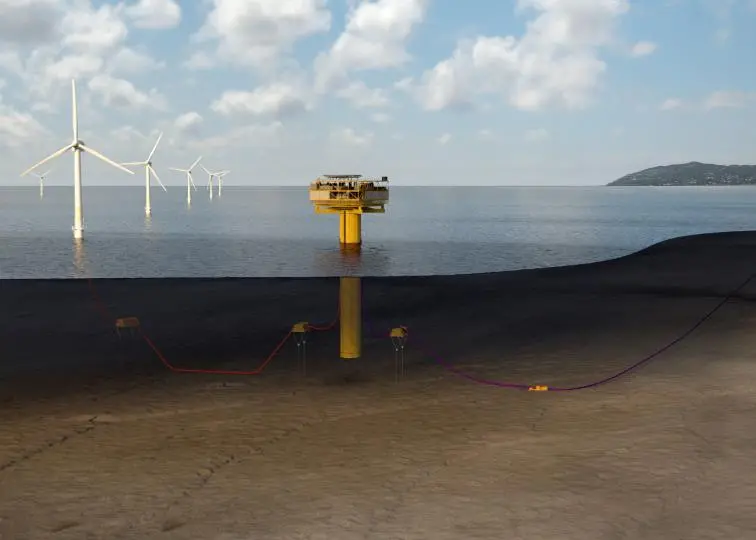
Partners in the BEHYOND project consortium include coordinator EDP, TechnipFMC, the CEiiA Center for Engineering and Development, WavEC Offshore Renewables and the University of South-Eastern Norway. The aim is to develop a conceptual engineering and economic feasibility study for a new offshore system for green hydrogen production from offshore wind power. Underwater pipelines will be used to transport the pure, compressed hydrogen to shore.
EDP brings offshore wind expertise to the project including the implementation of innovative and complex projects such as WindFloat, a pioneer floating offshore windfarm that is supplying the Portuguese electrical grid with the energy generated by from 8.4 MW wind turbines, the world’s largest turbines ever installed on a floating platform.
TechnipFMC brings its history of subsea engineering to the BEHYOND project, including expertise developed on its Deep Purple green hydrogen project that will use offshore wind energy and store the hydrogen produced subsea for later use. This project consortium, including Vattenfall, Repsol, ABB, NEL, DNV, UMOE and Slåttland, will initially design, build and test a land-based pilot at TechnipFMC’s Norwegian headquarters in Kongsberg, Norway.
A Growth Industry
A number of other newly-announced projects are targeting offshore hydrogen production including the Saipem SUISO project launched in July. SUISO will combine various renewable energy sources such as floating wind, floating solar and marine energy in a single system. The aim is to power electrolyses installed on existing offshore platforms for the production of green hydrogen. A first installation is planned off the Adriatic coast near Ravenna, Italy.
In a separate initiative, DNV’s experts will analyse the environmental, safety and operational risks associated with a Lhyfe and Centrale Nantes project that will see an offshore electrolyser installed on GEPS Techno’s floating platform off the coast of Le Croisic, France. It will be connected to various sources of marine renewable energy, including a Floatgen floating wind turbine.
An Offshore Advantage
According to the European Hydrogen Strategy, the need for green hydrogen production in Europe will grow substantially and could account for 24% of energy demand in 2050. The production of offshore hydrogen has aroused interest as a solution able to take advantage of the abundant wind on the high seas while mitigating congestion on the electricity grid on land.
Hydrogen remains one of the potential cornerstones of the energy transition – especially when it can be produced by electrolysis using renewable energy and thus without releasing CO2 into the atmosphere, says Yvonne Ruf, Partner at global consultancy Roland Berger. Green hydrogen and its derivatives can help to decarbonise highly energy-intensive industries like steel and chemicals. It can be easily stored in pipelines, salt caverns and depleted gas fields, to smooth out the intermittent supply of wind and solar energy. At higher volumes, it is even cheaper to transport energy in molecular form through a pipeline than as electrons through a cable.
“If we are to reach the world’s post-2030 decarbonization goals, we need green hydrogen in large volumes. Offshore wind parks can deliver these amounts,” says Ruf. Offshore wind energy is the most suitable renewable energy source in north-western Europe for direct coupling of large-scale electricity generation to industrial-scale hydrogen production. For large volumes, integrating electrolysers and offshore wind turbines is a cheaper, faster and more robust solution compared to onshore hydrogen production. It also offers easy access to storage and has less environmental impact, because, for example, existing infrastructure and pipelines can be used.
The Motorship notes that the use of tankers to transport hydrogen or hydrogen-based e-fuels rather than subsea transport would represent a more economical solution for floating offshore wind installations in deepwater locations.
Related Articles
 ALTERNATIVE FUELS & LUBRICANTS
 ALTERNATIVE FUELS & LUBRICANTS
 ALTERNATIVE FUELS & LUBRICANTS