



HYDROGEN FERRY FITS NORWEGIAN GREEN AGENDA
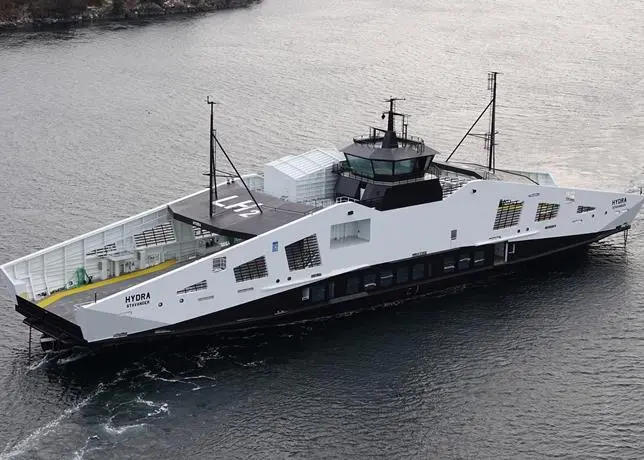
The recent completion of the hybrid hydrogen/battery-electric ferry Hydra exemplifies the sector’s bold thinking and recourse to largely untried technology. The allocation of the 82m passenger/vehicle-carrying ‘double-ender’ to an intensively-utilised, west coast route in Rogaland County implies an expectation of high reliability and availability in conjunction with a near zero emission environmental standard.
Designed by Bergen consultancy LMG Marin and contracted from Westcon Yards by ferry specialist and service concession operator Norled, Hydra can transport 292 passengers and a ro-ro payload of 80 cars, or up to 10 trucks or equivalent mix. She has been engineered for initial operation in battery-electric mode, but with subsequent use of liquefied hydrogen, and has been assigned to the triangular route linking Nesvik and Skipavik with Hjelmeland, north of Stavanger. The Hjelmeland-Nesvik crossing forms a connection on national road 13.
The technical project dates from mid 2017, when Norled began investigating hydrogen fuel cell powering as a pivotal element in a response to a tender called by the Norwegian Public Roads Administration (NPRA) for the service in Rogaland.
Two ships were sought, to replace a pair of diesel-electric ferries, under a 10-year route operating contract expiring in 2031. Norled ultimately won the bid, and awarded two newbuilds of virtually identical main dimensions to Westcon, one incorporating a battery-electric installation, and one specified with the hybrid hydrogen arrangement, in accordance with the stipulated requirements of the NPRA.
Construction of the hulls was placed with Norse Celik in Tuzla, Turkey. After launching, the hulls were towed to Westcon’s premises at Olen for outfitting and completion. First into commission was the battery-powered Nesvik, completed at Olen in April this year, followed during June by the handover of the Hydra in a “hydrogen-ready” state, with the ensuing addition of the hydrogen system. The latter vessel’s entry into the regular sailing schedule is now imminent.
The core elements of the power system in Hydra are two 200kW fuel cells, a 1.36MWh battery plant, plus a pair of 440kW Scania diesel generators as back-up, using biofuel.
The Danish arm of Canada’s Ballard Power Systems was responsible for the development and production of the two 200kW proton exchange membrane (PEM) fuel cell modules. The compact FC-Wave modules are positioned on the ferry’s amidships upper deck, to one side of the offset bridge, along with an 80m3 liquefied hydrogen fuel tank, manufactured by industrial gases company Linde. The LH2 fuel storage and processing equipment thereby occupies an open area, away from the passenger spaces, and a longitudinal blast shield is interposed between the bridge structure and the tank and fuel cells.
Although renewable electricity is more abundant and more competitively priced in Norway than in Germany, the latter’s determined drive into the ‘green’ hydrogen sector and related technology is reflected in the choice of a German group as the provider both of the shipboard storage system and source of the future LH2 bunker fuel.
Hydrogen will be supplied to the Hydra via road tanker loaded at Linde’s new 24MW PEM electrolyser plant at the Leuna Chemical Complex near Leipzig. It is anticipated that hydrogen bunkering will take place every 2 weeks. A mobile (wheeled) LH2 bunker station tower at Hjelmeland will effect transfers from road transport to the ship’s storage tank, by way of vacuum-insulated steel pipes and flexible hose.
The power components, including the fuel cells and Corvus batteries, are controlled through SEAM’s (formerly Westcon Power & Automation) e-SEAMatic Blue system, encompassing and integrating the ship’s ship operating and energy systems. The company has established a battery and hydrogen laboratory, incorporating a fully integrated energy system test bench, including batteries, fuel cells, drives, switchboards and energy management, to evaluate next-generation hydrogen and hybrid marine installations, and to simulate and optimise control strategies for hybrid layouts. This facility played a role in the Hydra project.
Given the particular challenges posed in handling hydrogen liquefied at minus 253degC, and to complement the safety assessments conducted by the class society and the Norwegian Maritime Authority, Norled engaged specialist company Gexcon to carry out safety and risk analyses.
The hull form represents a further refinement on the latest Norwegian fjord ferry designs, characterised by a very low block coefficient and minimised resistance, and was model-tested at the CTO hydrodynamic tank in Gdansk.
Hydra is driven through the water by Schottel azimuthing propulsion units from the Rudder Ecopeller range. The two SRE 340L FP propulsors, one mounted at each end of the hull, are individually rated for a maximum input power of 960kW and incorporate a 2.1m-diameter fixed pitch propeller. Frequency-controlled, permanent magnet-type electric motors are employed.
The SRE model was favoured by Norled because of proven efficiency across the planned operating diagram, not least at very low loads, and due to its suitability to service in exposed coastal conditions. Moreover, and in addition to the precise manoeuvrability achieved with such equipment, the Schottel rudder propeller concept improves directional stability, reducing steering angle corrections.
The electrical propulsion system is based on DC grid technology and includes two fully redundant main switchboards that can draw power from the fuel cells, or the lithium-ion batteries, or the standby diesel gensets. In the case of primary operation on fuel cells, the batteries will also offer a load levelling capability.
The large, unobstructed vehicle deck, making optimum use of vessel length and beam, ensures the rapid handling and swift turnarounds essential to the service.
Norled also foresees longer-term adoption of hydrogen power for one of two smaller (74m) double-enders on order in Turkey, at the Ada Shipyard. To be used from 2022 on the Finnoy route, both are initially designed to run on biodiesel.
PRINCIPAL PARTICULARS
Hydra
|
Length overall |
82.4m |
|
Length bp |
80.2m |
|
Breadth, moulded |
17.0m |
|
Depth |
4.1m |
|
Draught |
2.8m |
|
Gross tonnage |
2,690t |
|
Passengers |
292 |
|
Ro-ro capacity |
80 cars or 10 trucks + 10 cars |
|
Powering system |
Battery/hydrogen-electric |
|
Battery power |
1.36MWh |
|
Main generator engines |
2 x 440kW |
|
Propulsion thrusters |
2 x 960kW |
|
Speed, service |
9kts |
|
Speed, maximum |
12kts |
|
Class |
DNV |
|
Class notations |
+1A1, LC, Ferry(B), Battery(Power),E0, Shore Power, R4(nor) |
|
Flag |
Norway |
Related Articles
 PROPULSION
 GENERAL NEWS
 HYDROGEN