



Hydrogen: no pressure, no chill
Hydrogen has long been billed as the clean, green saviour of our industry: not surprising since it has a gravimetric energy density around three times that of gasoline and – if it’s created from a renewable source – meets the zero-carbon criteria.
But, while it’s a very efficient form of fuel taken by weight, in its natural state it takes up a lot of space: H2 has the lowest specific volumetric density of all the elements. Unfortunately, compression to the standard 300bar still doesn’t make it a realistic alternative to liquid fuels, while freezing it to -253°C consumes a lot of energy and requires cryogenics for transport and storage.
In short, it’s either big and bulky, or expensive and not so easy to handle.
So, what about a form of hydrogen that is liquid at room temperature – one that doesn’t need pressure or cryogenic temperatures?
It’s achieved by binding the hydrogen to a carrier substance, giving rise to the class of Liquid Organic Hydrogen Carriers (LOHCs). Benzene, naphthalene, toluene and their derivatives all fall into the aromatics category which can, with a little help, absorb a number of other molecules into their structure.
While the chemicals differ, the process remains similar: hydrogenate the H2 with the base carrier to bind it and dehydrogenate to release it. It’s a relatively well-established technique, and as such, it’s been drawing some specialised attention since the 1980s, though the abundance of cheap hydrocarbons delayed widespread interest.
Things have changed. Many countries (from Europe to Africa and Asia) are now investigating various ways to harvest clean energy and – importantly – move it from origination to destination.
In Japan, Chiyoda Corporation has chosen to utilise toluene for the process, a fairly cheap and commonly shipped commodity, the resulting methylcyclohexane (MCH) reduces the volume of hydrogen to about 1/500th of its gaseous form. Its attraction is that it’s considered by some to be a useful, economical carrier as it remains in the liquid phase under normal ambient temperature and pressures. Further, although it’s a hydrocarbon, the LOHC can be returned and recycled.
Based on this proprietary carrier chemistry – named ‘Spera’, because it means ‘hope’ – three other companies, Mitsubishi Corporation, NYK line and Mitsui have joined forces with Chiyoda to establish the Advanced Hydrogen Energy Association for technology Development (AHEAD), which is just about to start the world’s first international, H2 supply chain.
First, electricity produced at Brunei’s LNG plant will be fed through a reformer to create hydrogen. Following this, the gas will be hydrogenated to form LOHC which will be trucked to Muara Port around 90km away.
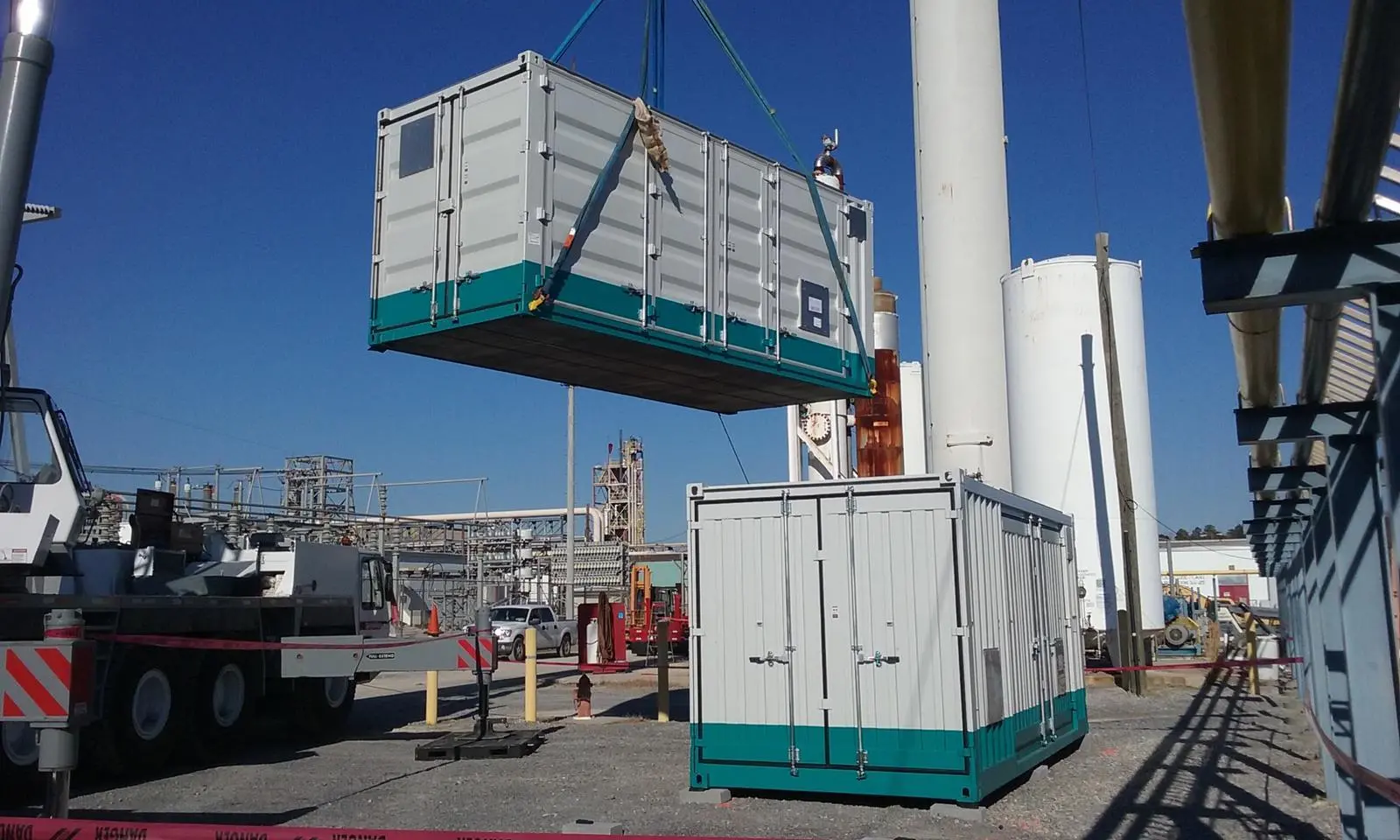
What’s remarkable is that it won’t need any special measures to ship it to Japan: standard ISO chemical tank containers will be loaded for the road leg, and these will take their place alongside other cargo in the container yard, ready for the sea journey on ordinary box ships. Similarly, it requires only regular handling kit when these containers land at Japan’s Kawasaki Port for onward transport to the Toa Oils refinery in Keihin.
Here, Spera is delivered to a dehydrogenation plant where the extracted gas is purified and fed into a solid oxide fuel cell which supplies the city’s electrical grid. Interestingly, excess thermal energy from the fuel cell is being recovered and returned to support the process.
Most importantly the toluene, once released from its burden, can be shipped back to the originating plant … ready to do it all over again.
Even though this early demonstrator project is reasonably substantial and has the aim of supplying Japan’s domestic electricity grid with 200 tonnes of hydrogen p/a as soon as next year, the concept can easily be scaled up. The idea is that the output would be used in a number of ways to support Japan’s nascent hydrogen society, directly feeding its innovative transport sector or even utilised as feedstock for new, synthetic fuels; fuels which may well find their way back into the maritime supply chain.
However, while the first of these plants uses standard LNG, the real aim of the project is to green the entire process by giving hydrogen from renewable sources a foothold. Chiyoda’s president and CEO, Masaji Santo believes “that Spera hydrogen will play a significant role in the transportation storage of energy and the growth of the renewable energy sector”, adding that it “will contribute to realising a zero-emission society”.
Big ideas indeed – but it’s not entirely new; this green-H2 approach is already being tried on a small scale in the UK’s Orkney Islands, where excess energy from wind and tidal producers is now being turned into compressed hydrogen on the spot and shipped out, by ro-ro, for reconversion into electricity on the mainland.
POWERING ON
However, while a new supply chain is always of interest to the shipping community, could it be used to power the ships themselves? The answer is an unequivocal yes from two companies that have entered the field: Hydrogenious and H2-Industries. As Michael Stusch, the latter’s CEO and founder explains, “toluene is very flammable, the flame point is actually -4C, so it can’t be used to power the ship”.
It’s been a consideration for any initiative that wants to provide a practical solution for a large swathe of the supply chain, so while these companies are definitely competitors, not collaborators, both have rejected toluene in favour of a related substance, dibenzyltoluene or DBT.
Firstly, Cornelius von der Heydt of Hydrogenious explains DBT is nowhere near as toxic as its parent, and it’s already in existence as a fully registered, standard product under the Marlotherm brand: “It’s not classified as hazardous by transport regulations, and in fact it’s safer to handle than diesel,” he says.
Secondly, as Stusch explains, it has a relatively high flame point, “around 200C”. He adds: “It’s the only LOHC that’s both stable enough and liquid under ambient conditions.”
Because of these characteristics, von der Heydt underlines that DBT can utilise existing, liquid fuel infrastructure – including assets in urban or densely populated areas. Further, the carrier-loaded hydrogen is very slow to deteriorate, remaining locked in this state – and useable – for years.
While there are fairly high, 30% energy losses associated with the endothermic dehydrogenation process, both companies say the biggest advantage is its ability to sit inside the supply chain and provide a relatively concentrated onboard power source. “With our technology you get 57kg of hydrogen for every cubic metre of LOHC,” says von der Heydt, explaining that this is under one-third of the volume and a fifth of the weight of the compressed alternative.
Moreover, according to Stusch “it costs approximately the same as traditional fuels, compared by nautical miles – although that does depend to an extent on your base electricity price”.
This promises to be music to the ears of ship operators. “We are already seeing a lot of requests for onboard power,” says von der Heydt, adding that discussions have embraced everything from small cargo vessels up to 46MW cruise ships.
Likewise, Stusch explains that “the technology is suitable for everything from 18m boats up to the largest cargo ships”. While H2-Industries is already collaborating with Netherlands-based PortLiner on the first electric inland vessels based on LOHC power storage, Hydrogenious’ maritime focus currently includes the 2MW to 4MW support vessels, “those that see a duty cycle of a few weeks”, explains Von der Heydt.
The idea is that a hydrogenation plant would sit close to the electrical source, creating LOHC fuel ready for transport to the quayside for bunkering. It’s not particularly demanding: Hydrogenious’ technology requires just 25bar pressures and is exothermic at 200 to 250°C and the waste heat from the hydrogen-uptake process can be utilised for boilers or other energy demands.
Scale obviously matters, so what kind of demand means a ship operator could find LOHC hydrogen worthwhile? “It’s a standard process, but the bigger you make it, the more cost-effective it is,” says von der Heydt. “I’d say the lower boundary is where you’d expect to use a few hundred kilos a day.”
Interestingly, Hydrogenious’ has not one, but two approaches to using LOHC onboard. The first sees a dehydrogenation unit set up in the engine room to release the gas from the liquid before it’s pumped to the fuel cell stacks.
Although this end of the process takes place at normal pressures, both Hydrogenious and H2-Industries technologies require a temperature of around 300℃.
While it’s a flexible, scaleable system, the dehydrogenation plant’s footprint is probably the sticking point for more modest craft. Still, von der Heydt explains that as capacity expands exponentially in relation to the diameter it fits snugly inside a standard, 60m support ship layout, potentially replacing one of the engines – a tank can be compartmentalised for collecting the DBT for recycling.
There is an additional point to note: “Any fuel cell system will always be a hybrid, with some kind of battery onboard to cover dynamic loads,” says von der Heydt. This isn’t a bad idea anyway as having batteries onboard gives the vessel more flexibility, but it does mean looking carefully at the operating profile to find out how best to utilise each element. “In the end, for each application, you need to find an optimal setting between all of the energy sources,” he adds.
Given all this, while he admits the technology is “not as space-efficient as an equivalent diesel”, a concept for a Norwegian owner saw the entire system bettering both the compressed or liquefied hydrogen alternatives by almost a third. He explains it’s partly because there’s no need for safety zones around the tanks and also because they don’t need to be cylindrical C-type affairs “of the type that can fit easily into the voids”.
RESHAPING POTENTIAL
While Hydrogenous’ initial LOHC offering is ready to go, the company’s other development will take somewhat longer to see the light of day.
This requires installing a new kind of technology, “a direct LOHC fuel cell” says von der Heydt. Here, not heat but the electrochemical reaction itself releases the hydrogen from the carrier “so there will actually be no molecular hydrogen” he explains. What results is, he says, “hydrogen-free hydrogen mobility”.
While technically challenging, this promises to reshape the vessel’s interior. If these systems can ditch the dehydrogenation plant there’s no need to fight for space in the engine room, allowing the fuel cells to be decentralised, enabling the stacks to be positioned closer to the electrical consumers.
Given all this, LOHC could well be the way forward. It certainly fits Poulsson’s call for deep-sea ready, zero-carbon propulsion.
Related Articles
 ALTERNATIVE FUELS & LUBRICANTS
 ALTERNATIVE FUELS & LUBRICANTS
 ALTERNATIVE FUELS & LUBRICANTS