



Hydrogen-powered tug arrives in Antwerp
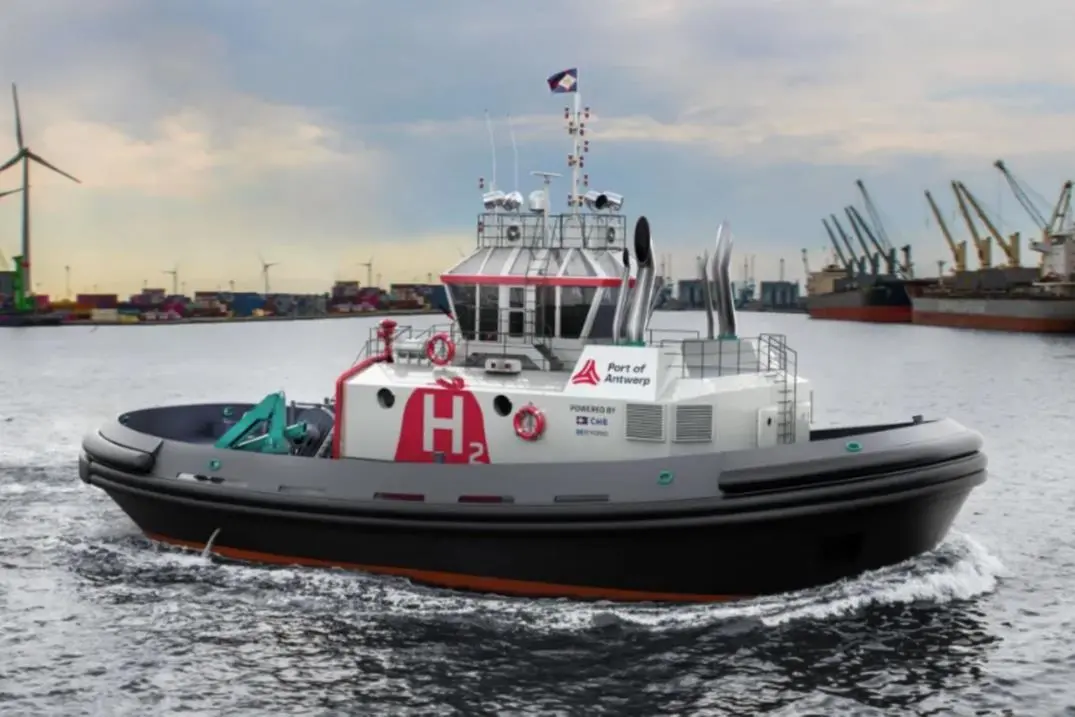
With this world’s first hydrogen fuelled tug, the Port of Antwerp-Bruges strives to integrate the most environmentally-friendly technologies available. Ostend was chosen because the tug can use the hydrogen bunkering facilities set up for CMB.TECH’s Hydrocat 48 there. The Hydrocat 48 is the world’s first hydrogen-powered crew transfer vessel.
The goal is to have Hydrotug 1 fully operational in Antwerp in the first quarter of 2023.
The HYDROTUG 1 features two BeHydro V12 dual fuel medium speed engines that can run on both hydrogen and traditional fuel. The HYDROTUG 1 can store 415kg of compressed hydrogen in 6 stillages installed on deck and eliminates the emission’s equivalent of 350 cars.
BeHydro, a joint venture between CMB.TECH & ABC, has recently developed the engine technology, and Hydrotug 1 is the first vessel to be powered by these dual fuel medium speed engines – each providing 2MW, with the latest EU Stage V emissions after treatment.
The engines deliver 100% clean energy. They emit no CO2, NOx, SOx or soot particles. In addition, they are non-toxic and no use is made of scarce raw materials such as lithium, zinc, cobalt, platinum, rare earths. They therefore avoid environmental damage caused by the extraction of scarce raw materials. The engines do not cause any damage to human health; the by-products are water vapour and air.
They also have a long service life, due to an optimised air/gas mixture that reduces component heat-up. The engines are also extremely versatile, because they have no problem with slight impurities in the hydrogen. For example, they can also be used to recover waste hydrogen instead of flaring it.
The engines are available in 6- and 8-cylinder in-line engines and 12- and 16-cylinder V-engines.
Related Articles
 AMMONIA
 HYDROGEN
 HYDROGEN