



Hydrogen testing on unmodified Wärtsilä 50SG engine confirms performance
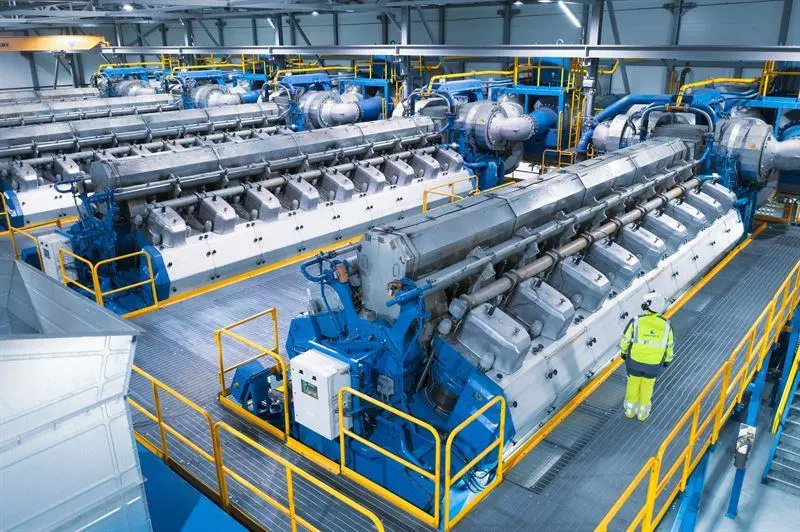
The Electric Power Research Institute (EPRI), WEC Energy Group, and Wärtsilä have successfully demonstrated 25% hydrogen by volume fuel blending in a Wärtsilä natural gas reciprocating internal combustion engine in a power plant in Michigan.
The demonstration project, which also included team members from Blue Engineering, Burns & McDonnell, Certarus, Lectrodryer, and Mostardi Platt, was conducted at WEC Energy Group’s 55 MW A.J. Mihm power plant using an unmodified Wärtsilä 50SG engine.
The project, conducted late last year, was the first hydrogen power test of a utility-scale, grid-connected reciprocating engine generator in the world. Engine manufacturers have conducted hydrogen-natural gas tests previously, but these tests have generally been conducted at small scale or in a test laboratory environment.
During two weeks of testing, hydrogen and natural gas were tested in blends up to 25/75 percent by volume to power one of the three 18.8 MWe Wärtsilä 18V50SG reciprocating internal combustion engines at the plant. Three engine loadings were tested: 50, 75 and 100%.
Engine performance
Throughout the testing period, the Wärtsilä engine continued to supply power to the grid. The capability of the engine to co-fire hydrogen blends was successfully demonstrated, showing clear improvements in engine efficiency. CO2 emissions were reduced by up to 10%, and other engine emissions were kept well below regulatory permit limits.
The research report released by EPRI in March 2023 notes that minimal intervention was needed other than adjusting charge-air pressure and ignition timing manually for changes in fuel composition, and then the automated controls operated effectively under those parameters.
The EPRI report further states that this class of engine can maintain its higher efficiency compared to simple-cycle gas turbines. Because engines in general have higher efficiency, their relative CO2 output compared to turbines will also be lower, as was the case in this study.
“These tests provide clear evidence that Wärtsilä’s engine technology can deliver future-proof power solutions that make a huge contribution towards decarbonised operations. The results of the testing with a hydrogen/natural gas blended fuel mix have been outstanding. We continue developing and futureproofing our engines to run on sustainable fuels and expect to have an engine and power plant concept for operating with pure hydrogen available by 2026,” said Anja Frada, Chief Operating Officer, Wärtsilä Energy.
Emissions
CO2, carbon monoxide (CO), NOx, and total hydrocarbons were measured at both the engine outlet and the outlet of the selective catalytic reduction (SCR) system going to the stack. Measurements taken as the exhaust gas entered the SCR indicate that unburnt hydrocarbons and formaldehyde were generally lower with hydrogen cofiring compared to the 100% natural gas baseline, with the exception of NOx.
At 50% load, NOx increased by 21–74% with higher hydrogen content due to increased cylinder temperatures. The researchers stated that this could have been reduced with further engine tuning, but the SCR system reduced NOx levels to below permit levels without it. With engine tuning, NOx emissions were 58% lower than the baseline at 100% engine load.
Modifications
In the report, Wärtsilä states that the capability of the 18V50SG engine to burn higher ratios of hydrogen can be increased by making modifications to:
• Increase air flow to the cylinders. This would entail rematching the turbocharger or an upgrade to a more efficient turbocharger.
• Lower the compression ratio. Lowering the engine’s compression ratio would create more margin in terms of knocking and cylinder pressures. In most cases, minimal downtime is required to do this.
• Enhance pre-chamber control. An upgrade to electrically controlled pre-chambers would optimise starting reliability, load ramping, and overall operation. For engines with a ready design available, this replacement is a straightforward activity.
• Control heat release. With the latest Wärtsilä engine control system, heat release control comes as a standard feature so the combustion is phased automatically. This maintains the engine performance regardless of what gas composition is fed to the engine.
Future demand
Hydrogen is expected to contribute 20% of the total abatement of CO2 needed in 2050. The International Energy Agency has predicted a sixfold increase in global manufacturing capacity of electrolysers by 2025. This is needed to produce low-emissions hydrogen from renewable electricity.
Significant investment into market-ready engines which can run on sustainable fuels is crucial in supporting the transition to net-zero, says Wärtsilä.
Related Articles
 2-STROKE & 4-STROKE
 2-STROKE & 4-STROKE
 2-STROKE & 4-STROKE