



Hydrogen’s viability as fuel for long haul ferries some years in the future
The world’s first hydrogen powered ferry, Hydra of the Norwegian domestic ferry operator Norled, has been in service for just over a year. Soon after its entry into service, Enova, the Norwegian government owned organisation that contributes to transition to a low emission society, introduced a programme to launch value chains for both hydrogen and ammonia as marine fuels.
Among the recipients of these grants was Samskip Kvitnos, a 2015 built, 120 metre long freight ferry that operates between Rotterdam and the west coast of Norway – a much longer run that that served by the 82 metre long Hydra. The grant covers a pre-project study of the viability to convert the vessel to run on hydrogen fuel and fuel cells in the future.
Many ferry operators face more pressure to go green compared to owners of many other types of ships, as they deal with passengers among their customers, rather than just freight owners that are corporate clients. A vessel that operates on green fuel can have a significant advantage in competition for passengers compared to a conventionally fuelled vessel.
Stena Line, one of the largest ferry companies in the world, had been studying a concept called Stena Elektra that involved a large ropax ferry for its Gothenburg- Fredrikshavn service. However, the company abandoned the battery pack and solar panel power concept in favour of Stena Hydra, a 212 metre long hydrogen fuel cell powered ropax with about 2,500 lame metres of freight capacity. The projected vessel would have two 7.5 MW propulsion motors and with net hydrogen storage of approximately 10 tons, the vessel would have a range of 150 miles and a top speed of 22 knots, the Swedish Environmental Research Institute (SERI) said in a report called “Concept Design and Environmental Report of a Fuel Cell Ropax Vessel.”
Hydrogen fuel cell ropax annual costs 40% higher than traditional vessel
Citing figures for the fuel cell installation is obtained from the fuel cell manufacturer Powercell, the report said fuel cell cost is assumed to be 1,400 EUR/kW, the installation cost is 280 EUR/kW, and the annual maintenance cost, including replacement due to degradation, is assumed to be 0.044 EUR/kWh. The figures are based on a lifetime and depreciation time of 15 years and a discount rate 7.5%. All annual investments costs are calculated based on constant payments over the lifetime. “In addition, costs for electrical engines including maintenance as well as a redundancy/range extending auxiliary diesel engine installation of 10 MW as well as a 2 MWh battery installation is included in the total propulsion system for which capital costs and maintenance costs are added,” the report said.
The report concluded that a hydrogen fuel cell driven ropax ship would be more costly from a total cost of ownership perspective than for example running a conventional ropax ship on MGO or LNG with conventional marine diesel engines. “In total, measured in annual costs, the hydrogen fuel cell fuelled ship is estimated to be 40 per cent more costly, excluding EU ETS costs, respectively 25 per cent more costly with EU ETS costs taken into consideration, using an expected cost for emissions allowances of EUR100 per tonne CO2,” it pointed out.
However, there are several variables that can change over time and which can have a material effect on the calculations, such as the cost of hydrogen, that of fuel cell technology and e.g. emission trading rights in the EU. Potential unexpected costs connected to pilot projects, including technology that is less mature, and less used and widespread could also be substantial and even become a hinder for the development of hydrogen fuel cell powered ships.
“Such potential risks can be everything from delays connected to getting all permits in place, delays related to technology failures, risks for cost increases for the technology, the fuel or additional safety measures that might restrict the operations or any other obstacles that might be difficult to foresee or estimate on forehand,” the report that was published in August 2023 pointed out.
Maria Hellbjörn, communications manager at Stena Line in Gothenburg, told The Motorship that the company does not currently have a timetable to introduce the projected vessel, but that work is ongoing on the development of it.
DFDS, the Copenhagen based ferry major, has also been studying the use of hydrogen as fuel on long haul ferries. In the autumn of 2020, it unveiled a project to introduce hydrogen fuel cell powered ropax vessel on the overnight crossing between the Danish and Norwegian capitals. Using PEM fuel cell technology, the 1,800 passenger and 380 car capacity vessel was intended to have 23 MW engine power and a bunkering interval of 48 hours – the same as the time a round trip would take. It had been due to enter service in 2027.
However, earlier this spring, DFDS sold the route and the two cruise ferries that currently operate on it to Rederi Aktiebolaget Gotland, a Swedish company. Its main business is a service between Visby on the island of Gotland and Nynashamn on the Swedish mainland and the company has a project called Horizon that calls for the introduction of hydrogen powered vessels on that run. The project calls for a ropax vessel capable of 28 knots and with space for 1,900 passengers and 100 lorries with a crossing time of three hours and 15 minutes.
Given that Gotlandsbolaget, as the company is locally known, is interested in developing hydrogen powered ferries for its main service, the question arises whether it would also be interested in promoting the same technology on the newly acquired service between Denmark and Norway. “Our focus right now is to take over (the Denmark- Norway) service. In the long run, we have high ambitions when it comes to the climate and the environment on this service, as we also have with the service to and from Gotland. However, we cannot say more at this time, this will be something we will discuss a bit later in the future,” said Karin Bill, head of communications at Gotlandsbolaget.
Retrofit of large freight ferry to run on hydrogen “technically feasible and commercially viable”
Meanwhile, in December 2023, DFDS published the results of a study regarding the viability of converting Magnolia Seaways, a 199 metre long freight ferry, which operates between Esbjerg and Immingham, to use a hydrogen- electric power plant. Hydrogen would be supplied from a proposed plant near Esbjerg at a pressure of 40 bar, which would be increased to 500 bar by three compressors. A buffer storage facility capable of holding 49 tons of hydrogen would supply 10 tons of the fuel per hour to the ship, while Magnolia Seaways would use 18.8 tonnes of the fuel per round trip on average.
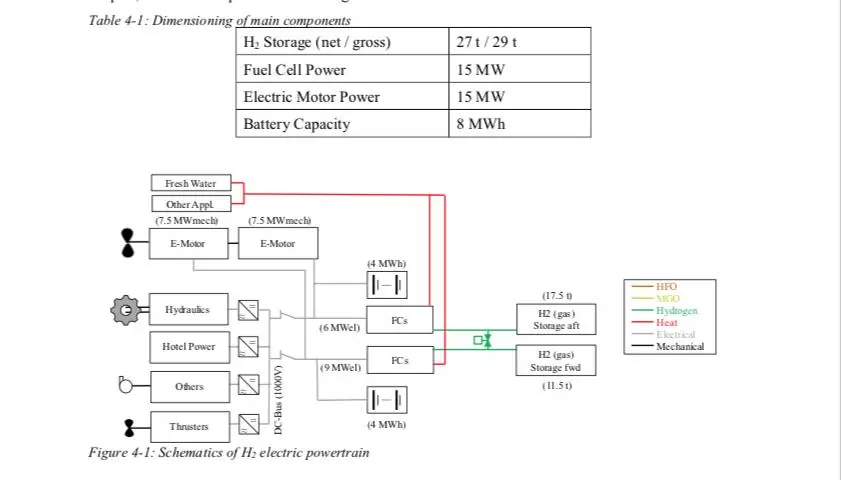
“On-ship safety concept envisages high-pressure installations above deck and low-pressure installations below deck. Approx. 27 t of hydrogen are stored in pressure vessels at 250 bar. This powers a fuel cell system delivering a max. output of 15 MW, which is accompanied by batteries with a gross capacity of 8 MWh. The rated power of the electrical motors is 15 MW,” the report said.
It concluded that the retrofit of Magnolia Seaways with a hydrogen fuelled propulsion system, under a set of basic assumptions, would be technically feasible and commercially viable. “Cost for hydrogen is of most significance for TCO. With H2 prices from production plant at pre- sent level, CO2 abatement cost in the range of 400 – 500 EUR/tCO2 are assumed. It is expected that the costs for H2 will be lower in the future, significantly reducing cost for decarbonisation,” the report summed up.
Dennis Kjærsgaard Sørensen, global head of media relations at DFDS, told The Motorship that the aim of the study had been to analyse the feasibility of retrofitting large ferries with a hydrogen propulsion system. “However, we are not planning to use hydrogen as a fuel in the very near future. The study was a part of our efforts to contribute to the development of knowledge on the use of hydrogen as we analyse possible net-zero scenarios for both vessels and road transport going forward. Our aim and ambition is to introduce six green vessels by 2030 powered by methanol, electricity and ammonia,” he stated.
The views of DFDS align with a report by the Norwegian classification society DNV that was published in May, which forecasts that the uptake of hydrogen as marine fuel would be slow.
“In the maritime subsector, uptake will start in the mid-2020s, but will take ten years to start scaling noticeably. Initially, some smaller vessels will be fuelled by pure hydrogen, but the vast majority of hydrogen use in maritime will be in the form of hydrogen derivatives,” DNV said in the report called energy Transition Outlook – Transport in Transition. Only from the middle of the 2030s could we expect to see hydrogen and other e- fuels to emerge in a significant scale as marine fuels, the report said.
Lack of bunkering infrastructure major obstacle
“According to DNV’s Alternative Fuels Insight… globally there are 10 smaller ships with hydrogen equipment installed, but not used, and another 24 ships on order as of March 2023.There are currently no bunkering facilities for hydrogen available,” the classification society pointed out.
Brian Bender Madsen, head of machinery and systems at Danish naval architect firm Knud E. Hansen also believes that a large scale take up of hydrogen as fuel for large ferries used on long services will take time. “For many years to come, I believe we will only see smaller ships or ships operating on short routes using hydrogen directly from hydrogen storage tanks,” he said, adding that this would be due to storage issues and cost.
Mia Elg, development manager, energy and environmental efficiency at Finnish consultant naval architect firm Deltamarin, is on the same lines: the technology needed to run ferries on hydrogen is largely there, but the infrastructure is not.
“Hydrogen is at its best on services that do not entail very long voyages and where ships use the same ports all the time. This will facilitate the development of bunkering infrastructure –we do not live in hydrogen economy yet,” she told The Motorship.
“I would assume that one will a first always optimize the battery capacity of a vessel and to use shore power for as far as possible. However, longer crossings will require another energy source as well and for this purpose, hydrogen is a potential zero emission fuel,” she continued.
Hydrogen molecules are very small and therefore they can easily escape in the case of a smallest leak, which Elg said is an important factor to bear in mind in particular in the case of high pressure hydrogen storage. Consequently, the hydrogen stores onboard should be kept moderate in size.
Ferries have a moderate hotel load energy consumption and their energy consumption for heating is also moderate, both factors that make hydrogen feasible as energy source. “To sum up, technology we do have, but the question about bunkering infrastructure comes always to mind first. In Norway, MF Hydra receives liquid hydrogen all the way from Germany – perhaps this will not be the final solution (to bunkering the vessel],” Elg concluded.
Related Articles
 AMMONIA
 HYDROGEN
 HYDROGEN