



Improving ship operating efficiency
Ships are designed, built and operated to carry cargo as efficiently as possible. However, the desired level of efficiency is often difficult to achieve during a ship’s operating life. The exact causes of the efficiency losses that occur may be difficult to pinpoint, as there are numerous contributing factors interacting with each other.
MONITORING PERFORMANCE
Traditional methods of monitoring performance largely rely on data entered in the ship’s deck and engine logs by officers on watch. However, these recordings of ship speed, horsepower, propeller rpm, slip and fuel consumption only indicate significant efficiency losses due to hull and propeller fouling when there is a significant increase in propeller slip or daily fuel consumption.
Since vessel resistance from bad weather or deeper draught can also cause increased power and fuel consumption, it can be difficult to isolate the cause of reduced efficiency and to correct it through hull cleaning, propeller polishing or engine tuning.
Today, a performance monitoring system has to identify the degradation in ship efficiency and translate this trend or performance metrics into recommendations for improving overall fuel efficiency.
Efficiency depends on four major factors, i.e., design, deployment, operations and maintenance. A ship is subjected to wind, waves and current while in transit. The engine converts the fuel into propeller torque, which produces thrust to overcome the resistances and maintain desired speed. The resistance can come from the environment as well as rudder movements and hull and propeller fouling. The condition of the engine, hull and propeller can deteriorate over time, thereby requiring increased power to maintain the same speed. All these factors, plus the effects of changing environmental and loading conditions (draft and trim) are interrelated, making it difficult to isolate the causes.
BENCHMARKING EFFICIENCY
Before addressing the question of how to improve ship efficiency, we need to properly define efficiency and establish a reasonable benchmark as the basis for comparison.
Efficiency can be loosely defined as “useful work done per energy unit consumed.” In naval architecture, we have:
Engine Efficiency = Delivered HP / Fuel Consumed
Propeller Efficiency = Thrust HP / Delivered HP
Hull Efficiency = Effective HP / Thrust HP
Propulsive Efficiency = Engine x Propeller x Hull
During the ship design phase, these efficiencies are estimated and optimised for a specific size, service speed and vessel type in order to configure the size and design of both engine and propeller. The performance of the entire ship system is then confirmed during sea trials and accepted by the shipowner.
During actual ship operation and loading, the weather can differ significantly from the calm and controlled conditions of sea trials. However, the specific fuel consumption at various power outputs should not change compared to the test results, unless the engine is out of tune or the quality and calorific value of the fuel are in question. As such, specific fuel consumption is a good metric to use in detecting degradations in engine efficiency.
On the other hand, trying to separate the effects of hull fouling, propeller roughness, wind, waves, and draught/trim on ship performance requires extensive instrumentation. A more cost-effective approach is to take an aggregate measurement and compare it with a series of established benchmarks based on model tests, theoretical calculations or past records taken at the time when the hull was clean. In this case it becomes more interesting to detect the trends over time rather than the quantitative values. We now introduce the following operational efficiency benchmark:
Operational efficiency = Actual Tons per Mile / Baseline Tons per Mile
Operational efficiency is an aggregate measure of ship performance at a certain speed and draft/trim, corrected for wind, waves, and current. Plotting the same metric across the entire speed range and loading conditions over time would show the trend in performance degradation since hull fouling would affect the ship performance under all these conditions.
BENCHMARKING VOYAGE EFFICIENCY
To evaluate the effectiveness of weather routing and speed management in minimising fuel consumption, we introduce the voyage efficiency benchmark:
Voyage efficiency = Actual Consumed / Optimal Consumed for the Same Loading and Schedule
Voyage efficiency is another aggregate measure of ship performance for a particular passage. Since weather, current, ship loading conditions and schedule requirements are different for each passage, it is necessary to normalize the performance to the best scenario one could achieve for the same departure and arrival times, as well as loading and environmental conditions during the same period.
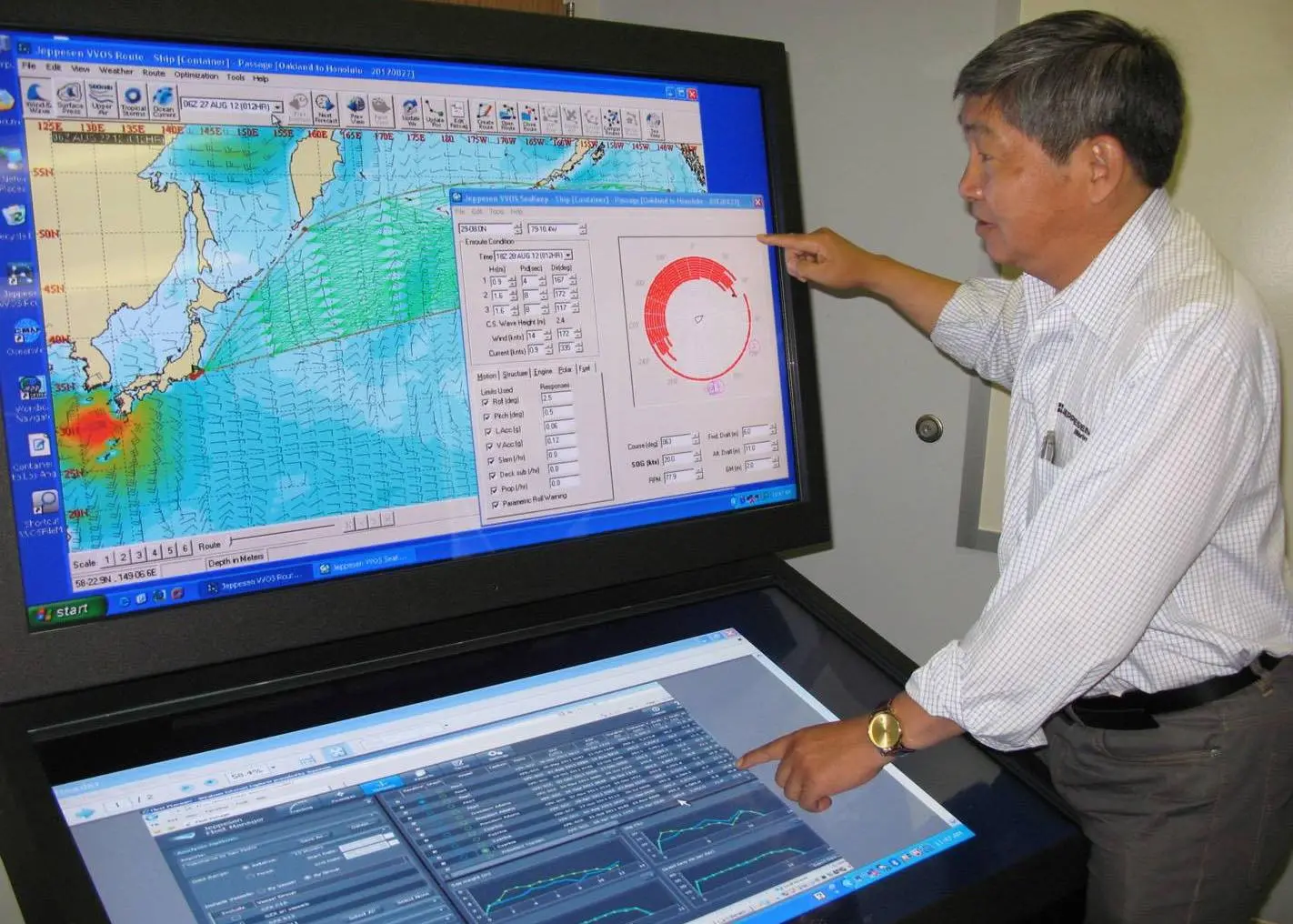
Combining customised ship performance models with optimisation software, such as Jeppesen’s Voyage and Vessel Optimization Solution (VVOS), can help achieve optimised voyage performance.
Related Articles
 ALTERNATIVE FUELS & LUBRICANTS
 FUELS & LUBRICANTS