



Industry exchanges views on the impact of fuels and emissions on life cycle costs
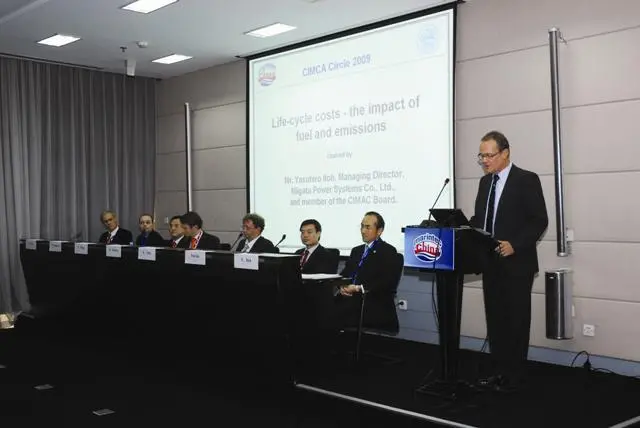
Chaired by CIMAC board member Yasuhiro Itoh, managing director of Niigata Power Systems, the Circle was designed to provide a timely and comprehensive snapshot of present and predicted costs of engine ownership in the light of tightening marine emissions legislation.
The Chairman’s opening speech noted that the Circle, the third such event in China, is an ideal way of interchanging knowledge and experience between the fastest growing ship and engine building nations and the longer established centres of engine technology.
For the engine industry, Kjeld Aabo of MAN Diesel, Denmark and Mikael Troberg, Wärtsilä Industrial Operations, Italy reported on the technologies presently under development which offer the best hopes of meeting and, possibly, undercutting the stringent limitations on NOx prescribed in IMO Tier III for the so-called Emission Control Areas. To attain this 80% reduction vis-à-vis IMO Tier I, the consensus is that combinations of technologies would be needed, including EGR, the Miller cycle in combination with high pressure turbocharging, air and fuel conditioning (fuel water emulsion, direct water injection, charge air humidification) and aftertreatment (SCR, SOx scrubbing). Low emissions hybrid propulsion systems are also feasible for some applications.
On behalf of the oil and gas industries, Jerry Hammett, of Shell Global Solutions in Germany emphasised ways and means of eliminating SOx emissions, in particular the question of low sulphur heavy fuels versus distillates and refining versus scrubbing as methods of SOx abatement. Importantly, he put the whole emissions subject into its global fuel supply and demand context, which will be dominated by increasing demand for finite resources.
Allan Wang, ABB Jiangjin Turbo Systems in China, reported on encouraging recent findings regarding single and two-stage high pressure turbocharging as an enabling technology of the strong Miller cycles which could go a long way to meeting IMO Tier III limits for NOx using only primary measures. Significantly, these technology packages can control NOx without fuel consumption penalties or be used to reduce fuel consumption, as well as leading to a very useful increase in engine power density.
Speaking for engine research establishments in the fastest growing market for engines, Prof Donghan Jin, of the Shanghai Marine Diesel Engine Research Institute, described the impact of new emissions regulations on related industries in China. He outlined the challenges facing China as its economy continues to grow at a rapid pace, and proposed countermeasures needed in the ship and engine building sectors.
For marine end users Oyvind Toft, BW Fleet Management AS, Norway stressed the overwhelming importance of fuel costs to the shipping industry and the need for emissions reduction methods to be economically viable, practical and easy to understand. Ideally, he said, equipment should be robust and easy to use while emissions compliance requirements should be simple and avoid bureaucracy.
A lively panel discussion followed. Questioners were predominantly from China, which CIMAC says reflects its global nature and the Chairman’s stated aspiration that the value of the CIMAC Circle is the interchange of views and information on a regional as well as a stakeholder basis.
Introducing CIMAC to new Circle attendees, CIMAC board member and Vice President Communications, Hanspeter Zingg of ABB Turbo Systems, Switzerland, reported the launch of a new CIMAC programme known as CIMAC Cascades, standing for CAse Studies in Combustion engine Applications and Design ExperienceS. The programme aims to encourage younger engineers by creating a discussion forum where they can meet leading industry experts. The first one had taken place in Hamburg, Germany, in November 2009.
Related Articles
 ALTERNATIVE FUELS & LUBRICANTS
 FUELS & LUBRICANTS