



Innovative Nor Lines duo to raise the bar in shortsea trade
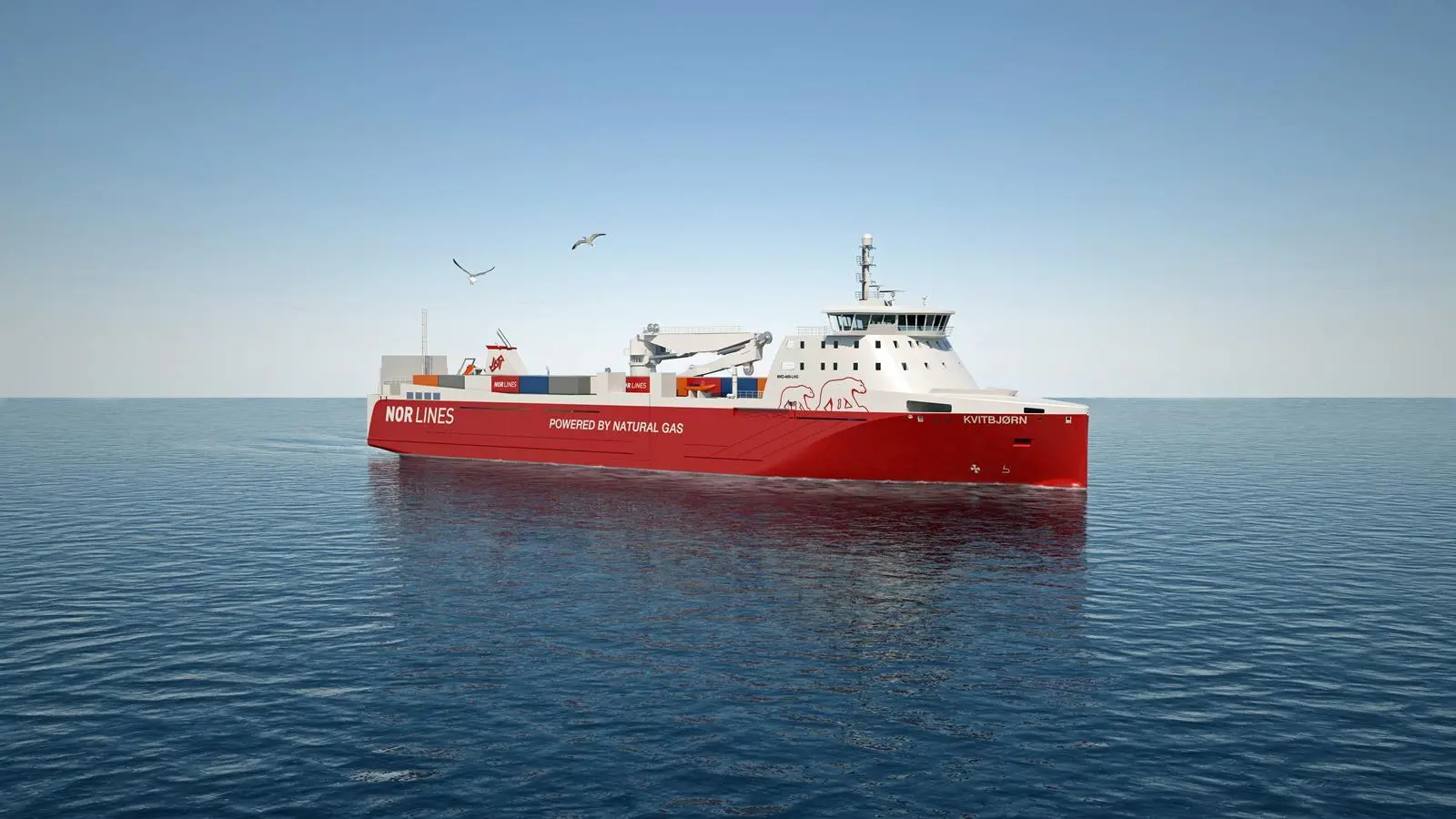
Standards of operational flexibility, service dependability and environmental compatibility demanded of participants in the Norwegian coastal and shortsea trades set the bar high in terms of design performance and newbuild investment. Integrated transport company Nor Lines, which maintains a liner-type cargo network with ships currently up to about 4,000dwt, is providing a beacon for the industry with a new generation of larger, extremely versatile vessels powered by purely gas-burning main machinery.
As the first of two 5,000dwt newbuilds from Tsuji Heavy Industries (Jiangsu) in China, the Kvitbjorn is expected to be phased into her allotted, regular sailing schedule, linking Norwegian ports with the northwest Continent, towards the end of 2014. Intended deployment within IMO-designated emission control area (ECA) waters, in conjunction with considerations of long-term operating economics, has determined the engineering solution adopted.
Developed by Nor Lines in collaboration with Rolls-Royce Marine, Kvitbjørn and sister newbuild Kvitnos embody the Environship design concept. The Environship model has attracted prestigious Norwegian and international awards in recognition of its innovative blend of technologies resulting in superior environmental and operational qualities.
For the Nor Lines project, the specific design is the type NVC 405 LNG, wherein Environship principles have been combined with the multi-modal cargo working arrangements emblematic of Norwegian coastal service providers. The forthcoming entrants to the Nor Lines fleet will each have the capability to handle cargo by ro-ro, sto-ro, side-load and lo-lo means.
Running on natural gas, bunkered as LNG, the single Bergen B35:40 lean-burn gas engine will virtually eliminate sulphur oxides (SOx) emissions and curb nitrogen oxide (NOx) emissions by about 90%, thereby ensuring compliance with both next year’s 0.1% sulphur cap and the 2016 IMO Tier III NOx limit. Moreover, the heightened thermal efficiency (TE) relative to a typical, medium-speed diesel propulsion engine will also offer economic benefits contributing to the vessel’s long-term operating competitiveness and associated, lessened ‘greenhouse gas’ impact.
In fact, key design and engineering features encapsulated by the Kvitbjørn together promise a reduction of up to 40% in carbon dioxide (CO2) emissions compared to a conventional vessel.
Unlike other propulsion solutions using LNG fuel, the 3,940kW Bergen engine has spark ignition and operates solely on gas, without any requirement for pilot injection of liquid diesel fuel.
With a claimed TE of some 48-49%, the Bergen B-series prime mover offers a more effective energy conversion factor and corresponding diminution of around 17% in CO2 per unit of power than a diesel engine. As utilised in the Nor Lines newbuild application, one of the advantages inherent to the Bergen gas engine series is that the power unit can drive the controllable pitch propeller mechanically. The engine can operate at variable load and speed, maintaining a high TE down to low loads. Both the engine and the propeller can thereby be run at their optimal design points for maximum efficiency.
The integrated Promas rudder and propeller system offers a claimed efficiency enhancement in the range of 5% to 8%. Special attention to the foreship form, whereby a vertical stem, a straighter bow shape and extended waterline has conferred ‘wave-piercing’ properties, reducing resistance by up to 8%. Particularly important in rough seas, this allows the ship to cut through rather than ride over the waves, enabling speed to be maintained and obviating the need for additional fuel to be burned to make up lost time.
Although the vessel will be equipped with two auxiliary diesel engines, usage will be minimised due to the installation of a further Rolls-Rolls energy-saving technology in the shape of the hybrid shaft generator (HSG) system.
HSG delivers a fixed frequency and constant voltage to the ship’s electrical system independent of engine speed, even at very low revolutions. Electrical power production can accordingly be ensured when engine speed is reduced, without having to bring an auxiliary genset on line. The HSG system thereby allows engine speed and propeller pitch to be optimised to prevailing operating conditions, cutting fuel consumption and exhaust emissions. The power take-in (PTI) arrangement incorporated by the HSG provides redundancy for the propulsion drive.
The engine’s flat consumption curve down to 20% load in combination with the shaft generator’s facility for deployment in PTI mode also offers an LNG-fuelled electrical power solution when in harbour.
The single LNG fuel tank is located underdeck, in a separate compartment immediately abaft the engine room. The cylindrical tank has a 400m³ capacity, offering a range of about 3,400 nautical miles, said to equate to ensuring 10 days’ operation at full load service speed.
Nor Lines’ business spans a great variety of freight, and its pivotal sea transport operations entail regular services between Norwegian ports, the Baltic and near-Continent, and the Norwegian Coast Express (Hurtigruten) operation connecting multiple ports between Bergen and Kirkenes.
The Kvitbjørn type has accordingly been developed to maximise efficiency in handling mixed cargoes utilising ro-ro, sideport, sto-ro and lo-lo methods. Manifests will typically include general cargo, breakbulk industrial products, machinery and construction equipment, containers, swap bodies, trailers, vehicles and frozen fish.
TTS designed and delivered the comprehensive shipset of cargo access and handling equipment, including a side-loading system, stern ramp, trailer elevator, external and internal doors and knuckle boom deck crane. Nor Lines is a longstanding practitioner of the side-loading concept, which has proven its worth in the demanding task of transporting unitised cargo in small consignments on services entailing multiple and frequent port calls.
Below the main deck, the lower cargo hold encompasses a tweendeck as well as the tanktop and is compartmentalised into five individually insulated cargo spaces. These can either be cooled for palletised frozen or chilled cargo, or used at ambient temperature for palletised and packaged freight such as groceries, consumer products, industrial goods and building materials.
Up to five forklift trucks (FLTs), handling a maximum four pallets on each cycle, will work freight in the lower hold spaces, with loading and discharge effected via pallet elevators and the 7.35m door opening in the starboard side. The sideport door ramp is sized for up to three FLTs simultaneously operating from the quay. The total revenue-earning area offered by the tanktop and tweendeck is about 1,700m², with a minimum free height of 2.5m.
The double pallet lift and side door system also serves the main deck. The two pallet elevators are each dimensioned for handling four Europallets, and afford a lifting capacity of 10 tonnes individually and up to 20 tonnes in tandem operation.
A full width stern ramp/door provides access to the main deck for ro-ro freight and also for sto-ro cargo brought aboard by heavy-duty FLT. The ramp has been designed to take an all-up safe working load (SWL) of 100 tonnes in the case of rolltrailers, and for maximum axle loads of 36 tonnes (FLTs) and 34 tonnes (rolltrailers). Transfers of road trailers, rolltrailers and wheelborne equipment and machinery from the main deck to the weather deck will be accomplished by means of a 60-tonne capacity truck elevator.
The main deck provides an overall cargo area of about 1,640m² or 510 lane-metres for up to 35 road trailers of 13.6m, with 25 sockets available for reefer trailers. Headroom is 4.55m, although there is a short section right aft offering a clearance of 5.4m. The ro-ro capability is complemented by FLT-effected transfers through the sideport system, for palletised freight and building materials.
Containers will be carried on the weather deck, together with other items of freight such as offshore construction equipment. Trailers can also be accommodated at this level, brought up from the main deck on the truck elevator and afforded sheltered stowage in the ‘garage’ under the forward superstructure.
The design confers considerable scope as to the composition of weather deck stows, in that these can include 20ft, 40ft, and 45ft containers, slightly-wider ‘pallet-wide’ containers plus special 2.6m-wide boxes, and swap bodies up to 7.82m in length and 2.6m width. Maximum stack loads are 68 tonnes for 40/45ft containers. Two tiers of loaded containers will give an intake capacity of about 170teu on deck and in the garage area in optimal configuration, although a larger number of boxes in higher stacks will be possible with lighter cargo.
Total weather deck cargo area is approximately 1,560m², and 275m² of this is accounted for by the forward garage. The ro-ro freight equivalent at this level is 480 lane-metres, corresponding to 31 road trailers of maximum 13.6m length. Constructed and equipped also for consignments of plant, machinery, boats, tanks and other equipment, there is a uniform deck load capability for 2.5 tonne/m² and defined strongpoints.
Located halfway along the open deck on the vessel’s port side , an 80 tonne lift-capacity TTS knuckle boom type crane will accomplish most lo-lo operations. Lifting devices will be carried for 20ft and 40ft/45ft containers and 25ft swap bodies with top corner castings. The crane’s specification includes a separate 12.5-tonne hook for handling other and lighter items of freight.
At the time of writing, Stavanger-based Nor Lines deployed nine general cargo vessels in scheduled Norwegian international and North European services plus 11 Coastal Express (Hurtigruten) ships. For its newbuild project in China, the company has retained Schlüter Marine Solutions of Flensburg, Germany, to provide on-site supervision. First-of-class Kvitbjørn was launched in March 2014 using the yard’s transfer system.
Tsuji’s Chinese shipyard was established in 2003 alongside the Yangtze River in Zhangjiagang city, Jiangsu province, about 120km north of Shanghai. It became a part of the Fengli Group in 2010. Tsuji attracted the Norwegian order in the face of competition from more than 20 yards worldwide, including contenders in Germany, South Korea and Turkey. It is reckoned that at least half the contract value is accounted for by the supply of products and technologies from Norway.
PRINCIPAL PARTICULARS—KVITBJØRN and KVITNOS
Length oa: 112.0m
Breadth, moulded: 20.8m
Service draught: 5.5m
Corresp. cargo deadweight: c3,600 dwt
Scantling draught: 6.0m
Corresp. cargo deadweight: c4,700 dwt
Total maximum deadweight: c5,500 dwt
Main engine (gas): Bergen B35:40
Main engine power: 3,940kW
Service speed: 14.3 knots
Class: DNV GL
Related Articles
 PROPULSION
 GENERAL NEWS
 HYDROGEN