



INNOVATIVE PROPELLER TECHNOLOGY TO REDUCE URN
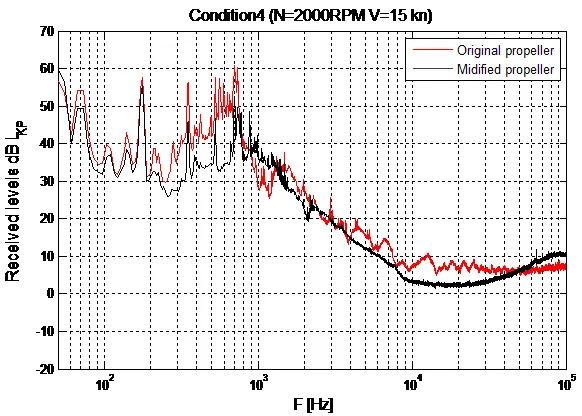
The patented Oscar PressurePores system reduces propeller tip vortex cavitation by applying a small number of strategically bored holes in the propeller blades. The addition of these pressure-relieving holes now allows ships to operate with a more silent propeller with a minimum of compromise on its efficiency or having to slow steam.
Computational fluid dynamics (CFD) modelling and cavitation tunnel tests performed at Strathclyde demonstrated the PressurePores system can reduce cavitation volume by almost 14% and underwater radiated noise (URN) by up to 21dB. The results were corroborated by separate model tests on the sub-cavitating propellers used by the Princess Royal, a 19m research catamaran operated by Newcastle University, comparing the original propeller with two propellers of the same design, one with 33 strategically-introduced holes in each blade, another with 17 holes.
The outcome showed that PressurePores technology substantially reduced tip vortex cavitation and URN. “Remarkably, it was found that the optimum number of holes could be as few as 17 per blade tip so long as they were placed in the most effective positions,” said David Taylor, CEO, Oscar Propulsion.
“It’s not a case of simply drilling holes into the blades, as this will affect the propeller’s thrust capability. CFD modelling at Strathclyde allows us to know exactly where to place the holes for maximum efficiency and optimum noise reduction.” Taylor added.
David Taylor, added: “Underwater radiated noise is one of the most adverse environmental by-products from commercial shipping, yet unlike other forms of marine pollution, there is no legislation yet in place to prevent this type of environmental damage. We now have a cost-effective, easy-to-apply solution to prevent this from happening. Introducing holes in propeller blades to reduce root cavitation, for example, is not in itself new, but achieving high levels of noise reduction by strategically placing relatively few holes, while maintaining efficiency, is new.”
David Taylor furthered: “PressurePores has a major mitigating effect on propeller cavitation and URN and can be incorporated into new propellers or can be retrofitted to existing propellers either in drydock or possibly in-water. While PressurePores are suitable for all types of vessel, they are particularly suitable for naval vessels, fishing fleets, offshore vessels and cruise ships operating in sensitive environments. The technology can be applied to all types of propellers, including pods and thrusters.”
Related Articles
 LNG
LNG
 LNG
LNG
 SHAFTS AND PROPELLERS