



Is it a ship? Is it a thruster? Is it a mooring? No, it’s Remora…
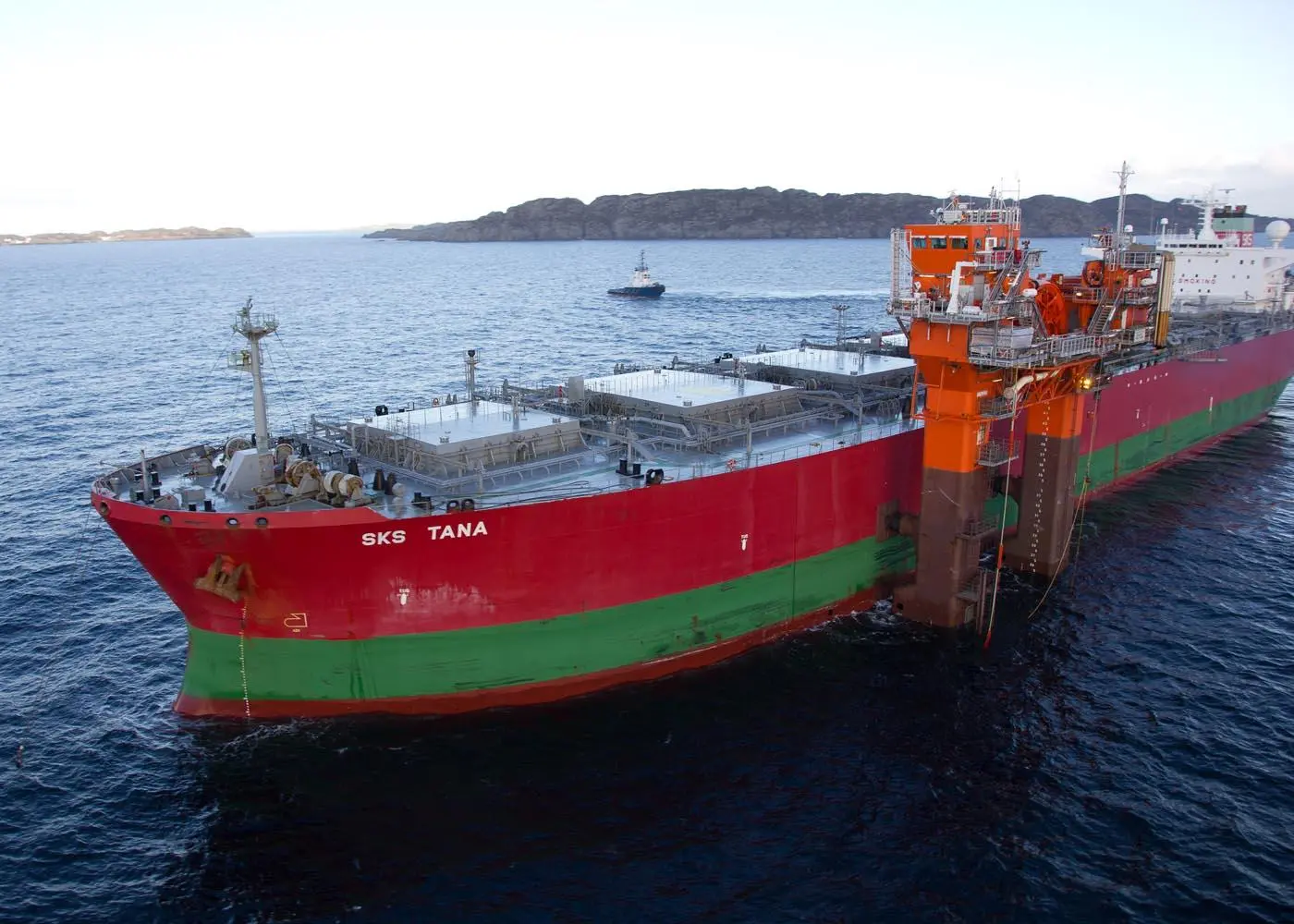
The HiLoad DP structure is designed to obviate the need for specilaised, expensive-to-charter, DP-equipped shuttle tankers, by giving almost any tanker vessel, up to VLCC size, a full dynamic positioning capability. Thus DP-equipped, the tanker can load or unload from a floating storage unit via its own manifold and the cargo hose carried by the HiLoad DP, so there will be no need for the normal shuttle tanker bow loading system. A further cost-saving benefit is that fewer tugs need to be used – one being sufficient rather than the normal three which are employed in shuttle tanker-FPSO operation.
Remora’s HiLoad – which is classed by DNV as a ship, albeit in a newly-established special class – is self-propelled, via its three Wärtsilä diesel-powered thrusters. This allows it to move up to the tanker, and attach itself to the sides and bottom with its suction fenders (the Remora name comes from a species of sucker fish). HiLoad’s DP capability allows it to precisely manoeuvre and position the tanker for loading or unloading.
The vessel is basically an ‘L’ shape, with the upright part projecting above the waterline and the base below – the HiLoad partially submerges to allow the base to pass under the bottom of the tanker, with the side of the tanker adjacent to the side of the ‘L’ upright. The unit’s powerful de-ballasting pumps allow the connection to the tanker hull to be completed within about seven minutes, and the trials proved that this can be achieved in 43 knot wind speeds. The HiLoad is then raised so that its suckers can attach to the bottom of the tanker. HiLoad’s suction technology is the key to the operation; the patented system attaches firmly enough to the bottom and side of the ship to allow it to steer the ship, even in heavy seas. Thus HiLoad performs the function of an offshore oil terminal.
The grip from the suckers is said to be in the order of 5,000 tonnes, but the effect on the tanker structure is said to be negligible, as this is virtually identical to the water pressure the ship would experience in normal operation. The three thrusters provide force equivalent to a bollard pull of 120 tonnes.
It may sound a relatively simple idea, but it has taken nearly 10 years of design and development, and an investment of over1billion NOK to reach the stage where a working ship is undergoing sea trials. About 80% of the investment was poured into building, commissioning and testing the first HiLoad. This ship was built in Haugesund, Norway by the Aibels yard, and as with any new concept there were problems – reportedly with the control cabling and the centre thruster. Fortunately the problems were eventually resolved satisfactorily and Remora CEO Peder Farmen is confident that the next vessels can be built much more quickly, and at a unit cost of around $100 million – almost half of the expenditure on the prototype. “Obviously it has taken a lot longer to complete the project than we expected when we started, but now we have it proven in front of industry and the next one can be built much faster,” he said.
Following intensive sea trials over a 20-day period earlier in 2011, the prototype HiLoad DP1 was demonstrated over a period of a week, with 120 international oil company people, including some from North and South America, witnessing the final, very successful, day of demonstrations. Farmen says that around 20 oil companies, and several tanker operators and suppliers, participated in the trials.
The HiLoad, which stands some 58m tall and has a displacement of 5,600 tonnes at normal operating draught, has been designed to handle ships up to VLCC size. The sea trials were carried out in Noregian waters, in the fjord near Stord, using the Aframax- tanker SKS Tana. Operations included hooking up to the tanker, manoeuvring it, rotating it, and disconnecting.
Once final certification was achieved, in December 2009, with DNV, working in conjunction with Noble Denton, Remora began looking for working contracts for the ship. Agreement has been reached with an unnamed customer for actual operational trials on n offshore field, and Farmen reports considerable firm commercial interest. Following these trials, Remora is hopeful that HiLoad DP1 will be further tested by Total, a long-term supporter, with a view towards possible operation in Angola.
Farmen is hopeful that once the first ship gains a commercial contract then his company can start to build more ships – one day owning a fleet of HiLoads. Already Remora is looking at variations to the basic design, though still centred around the core suction technology. Remora has been cooperating with Stena on the MVD version – a disconnectable bottom turret mooring system for use with Stena’s drillship Drillmax Ice when in shallow water. The suction technology is further being considered for the proposed Bienville LNG import and regasification terminal in the Gulf of Mexico, which is being promoted by Torp, another project supporter.
Related Articles
 PROPULSION
 GENERAL NEWS
 HYDROGEN