



Japan Opts For UK Hovercraft
Construction of the first of three 24m amphibious ferries ordered from Griffon Hoverwork by the Oita Prefecture authorities has been implemented at the contractor’s Woolston yard in Southampton. The £25m (US$34m) newbuild project will restore the 10 nautical mile coastal link between Oita Airport, at Kunisaki, and Oita City. The final craft in the series is due to be delivered by January 2024.
In the wake of the global financial crisis and rising fuel costs, the route had been closed in 2009 after several decades of operations using two Mitsui-built, 105-passenger hovercraft, leaving airport/city transfers by public transport to bus and taxi.
Rising passenger numbers through the airport over the past several years and the wish for a faster connection led to a plan to reinstate the hovercraft option. Following market investigations, the significantly improved efficiency levels and performance offered by Griffon Hoverwork’s new-generation 12000TD design, proven in service on southern England’s Solent tidal strait, has brought the production deal to the UK.
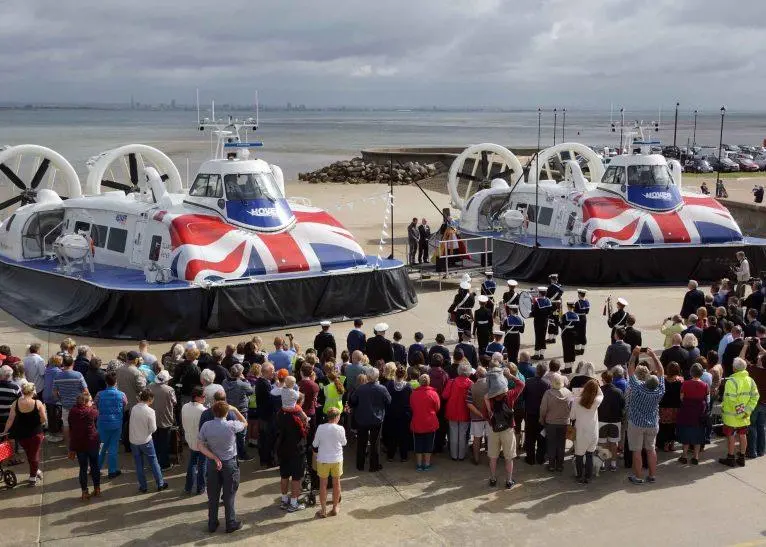
The Oita craft will be customised versions of the 12000TD-class. The previous examples are the Solent Flyer and Island Flyer, introduced in 2016 to Hovertravel’s route between Southsea (Portsmouth) and Ryde, on the Isle of Wight.
On main dimensions of 23.7m x 12.8m, and manned by a complement of three, the newbuilds for Japan will carry approximately 80 passengers and a payload of 12t. A top speed of 45 knots-plus will be ensured by an MAN diesel installation providing power for both lift and horizontal acceleration. The Oita schedule calls for airport-to-city transit times of about 25 minutes.
The hull of the craft is equipped with a skirt made of special, durable composite. An air cushion is generated by fans under the hull, making the vessel hover or ‘fly’ 1.5m above the water, or over ground. The ‘amphibian’ is moved forward by means of two air propellers mounted aft.
Installed as low as possible so as to achieve the requisite centre of gravity, two high-speed engines will power the propellers and centrifugal lift fans, forming an integrated lift and thrust system. Replicating the plant in the Hovertravel duo, each of the Japanese craft has been specified with two 12-cylinder MAN diesels of the D2862 LE 124 type, turning out 793kW apiece at 1,800rpm.
The innovative drive system adopted in Griffon Hoverwork’s 12000TD design has meant that two engines suffice to meet all operational requirements, rather than the four-engine arrangement (two for lift and two for thrust) used on earlier hovercraft. Substantial fuel savings consequently accrue from having just two power units.
Improvements introduced by the 12000TD, including larger propellers, have realised a significant reduction in noise levels compared to earlier craft of similar size. Cabin noise in the Oita newbuilds should be less than 75dB. The fact that a hovercraft, riding on a cushion of air, produces virtually no wash or wake at high speed chimes well with local administrations and port communities. The nature of the craft renders operations independent of tides and also versatile as to locations served due to the capability to travel up the shoreline.
Related Articles
 PROPULSION
 GENERAL NEWS
 HYDROGEN