



Japan takes the lead in shipbuilding
But first, the July issue contained the first half of the then-customary survey of ships on order, both diesel and steam powered. August contained the other entries. Britain was about to surrender its leading position in the shipbuilding world, though listings of ships in build in UK yards still occupied nearly four pages. The vast majority of these were motor ships, with steam surviving for tanker propulsion, nearly all of the steam tankers on order being for BP Shipping. The might of Germany challenged Britain’s position, but as West and East Germany were separate nations this could give a false impression. Japan had taken the lead, particularly when deadweight tonnage was counted rather than just numbers of ships, though there was no reference to Korea or China (unless you count two ships being built in Formosa, as Taiwan was then known).
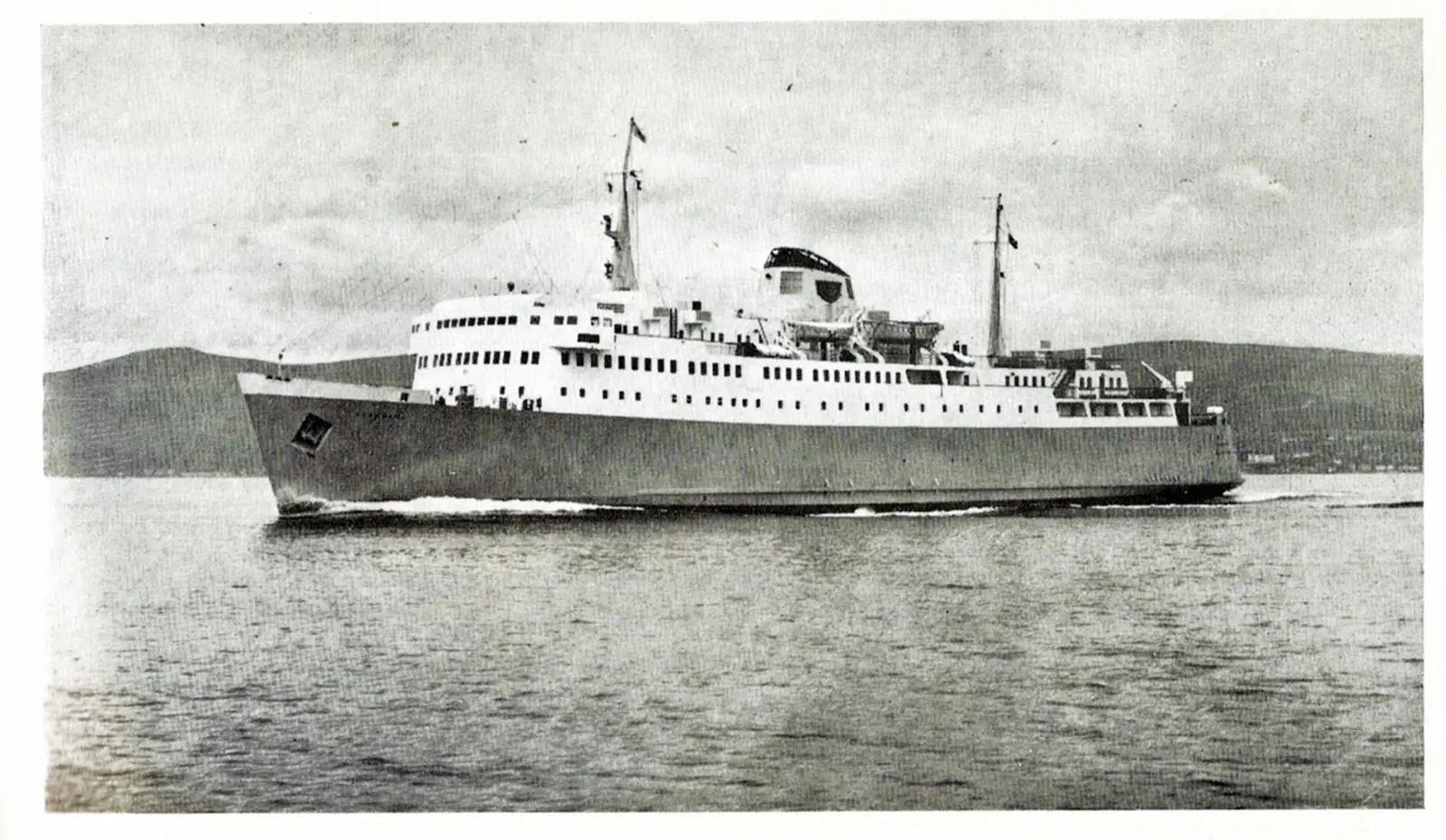
A New Zealand rail ferry, built in Scotland, featured diesel electric propulsion, which at 9,000hp was the most powerful such plant ordered in the UK. The machinery – six main gensets of V8 configuration, 1,756bhp at 750rpm, plus three auxiliary gensets, and four 2,250hp propulsion motors – was all supplied by English Electric. In normal operation, four gensets could provide sufficient power for a 17 knot speed. The considerable weight of the railway rolling stock on the main vehicle deck necessitated a sophisticated ballast and heeling tank arrangement, with 22 quick-opening valves.
Another new ferry reviewed in July was the Koningin Fabiola, operated by the Belgian State Railways on the Dover-Ostend route, and built by the Belgian Boel yard. With capacity for 800 passengers and 150 cars, and a maximum turn-round time of 1.5 hours imposed by Dover Port, loading arrangements were of prime importance. Even so, only a stern door was fitted, and hoistable ramps gave access to the upper of the two vehicle decks. Propulsion was by two Sulzer 12MD51 two-stroke engines, each developing 4,800bhp at 325rpm, running on light diesel fuel. Denny-Brown stabilisers were fitted, the writer of the report commenting on their effectiveness in heavy seas, while Belgian-made hydraulically-operated bow and stern rudders provided high manoeuvrability. The size of this class of ferry can be gauged by another vessel mentioned in the same issue; a Danish-built 438-passenger ship for the Harwich-Elsinore service, with capacity for a “large number” of cars – in this case 75-85.
The passenger ship complement was rounded off with a German, Blohm & Voss-built, ship designed to carry up to 1,700 passengers in German coastal waters, though far fewer on longer cruises. Despite the 21-knot service speed, chosen to allow passengers the maximum time in Heligoland before returning to Hamburg, a low wake was required for operation on the Elbe. Two 16-cylinder non-reversible Pielstick engines of 4,480bhp each drove KaMeWa three-bladed CP propellers.
The August issue started in the way it was to continue, with a warning scarily reminiscent of the present. The adoption of ‘boiler fuel’ (i.e. HFO) meant that owners had to rethink their engine lubrication strategies, just as the move to low-sulphur fuel today means different grades of oil.
Another article was entitled ‘towards maximum economy’ and outlined the fuel-saving measures designed into a new French-built bulk carrier. These included a shaft generator, and a waste heat recovery system startlingly similar in principle to today’s exhaust-driven turbo-alternators.
Another parallel with today’s news was an account of financial difficulties facing a Hamburg shipyard, in 1962 the stricken yard being Willy H Schlieker.
A reversal of today’s trend was noted in an account of an 1,800bhp coaster running on ‘intergrade’ fuel, taking advantage of a blend of distillate and residual fuel in order to cut operating costs. The ship’s 1,800bhp Deutz four-stroke engine was said to have suffered no ill effects.
One innovation that, maybe thankfully, didn’t catch on was a two-stroke diesel engine design from Mitsubishi that featured 24 cylinders in ‘W’ format. The 150mm bore lightweight engine, with three banks of cylinders, feaured constant-pressure Turbocharging from four exhaust blowers, two at each end. Possible applications of the engine weren’t mentioned, but its complexity must have ruled it out for normal ship propulsion. It may have been designed with warships in mind, though it bore a greater resemblance to an aircraft engine, particularly in the materials employed
Related Articles
 50 YEARS AGO
 50 YEARS AGO
 50 YEARS AGO