



Japanese Consortium Targets 2026 For First NH3-Fuelled Gas Carrier
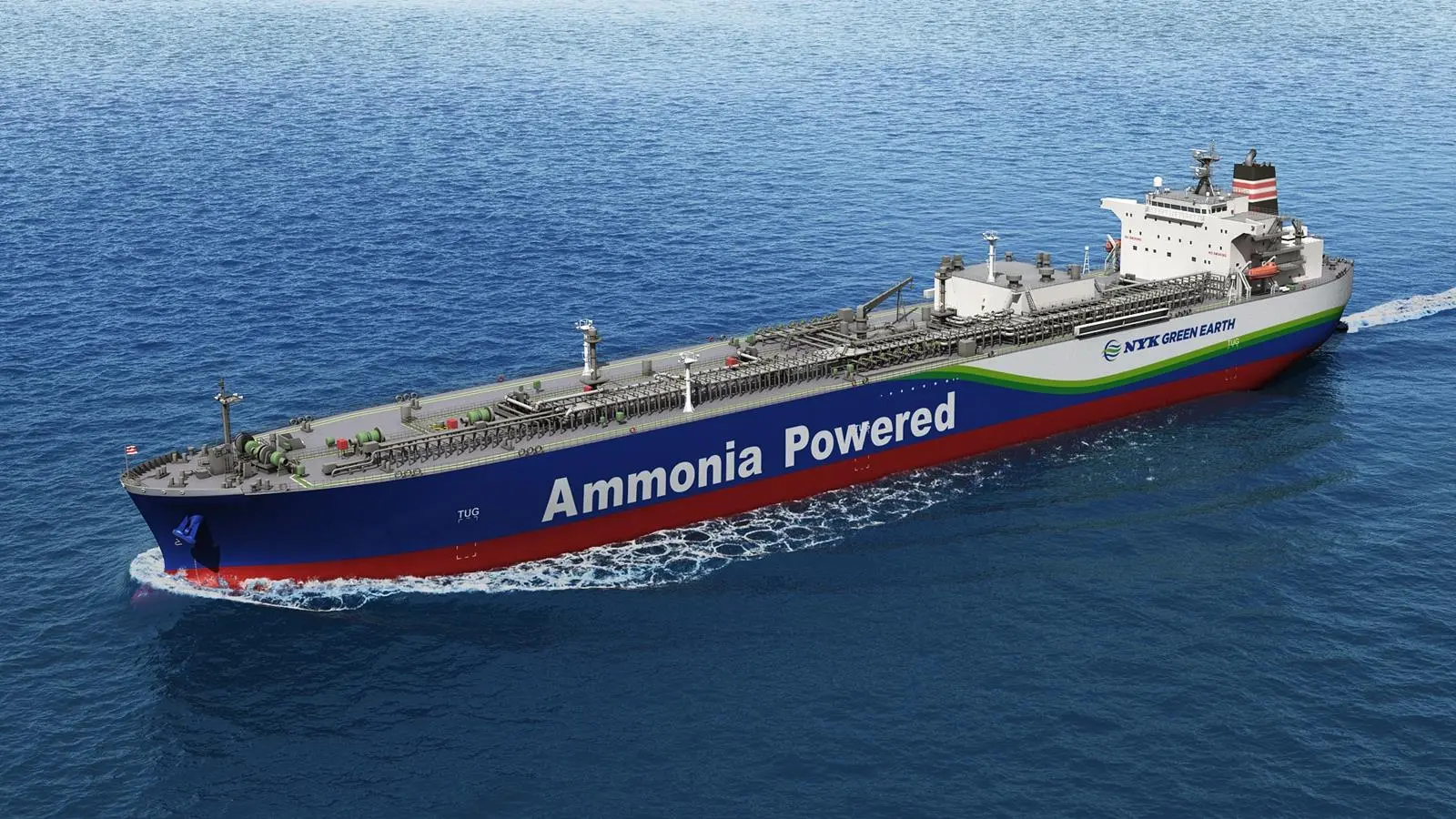
The vessel will also feature four-stroke gensets supplied by IHI Power Systems Co. The dual-fuel gensets will also be capable of operating on ammonia as a fuel. The completion of the vessel, which will be operated as a demonstration project, will mark a significant advance in the J-ENG and IHI Power Systems’ ammonia-fuelled combustion portfolios. The vessel, which will be completed by November 2026, is expected to be the first ammonia-fuelled medium sized ammonia carrier to be delivered.
History of project
As previously reported by The Motorship, the four companies began working on “a demonstration project for the commercialization of vessels equipped with a domestically produced ammonia-fueled engine” (the “Project”) in October 2021, along with classification society ClassNK. The project was identified as a Green Innovation Fund Project, receiving funding from Japan’s New Energy and Industrial Technology Development Organization (NEDO).
The four companies designed a prototype vessel which obtained an Approval in Principle (AiP) in September 2022 after a safety verification process that included confirmation of the safety concept and risk assessment by ClassNK. The acquisition of AiP is in anticipation of the approval of an alternative design. After further research and development, the consortium determined that the prototype ship had reached a level sufficient for social implementation, particularly in safety and environmental friendliness, and decided to build the ship.
Technical challenges
| Challenge | Issues In Designing and Developing Ammonia-Fuelled Vessels |
|---|---|
|
Flame retardancy of ammonia |
Because ammonia is a flame retardant, developing advanced technologies for stable combustion in engines is necessary. |
|
Treatment of nitrous oxide (N2O), a greenhouse gas |
Nitrous oxide (N2O), which has a greenhouse effect of approximately 265 times that of CO2, may be generated during ammonia combustion. Technology is needed to reduce and treat nitrous oxide emissions. |
|
Ammonia toxicity |
Because ammonia is toxic, the vessel must be designed to prevent leakage from the piping and tanks. Even in the event of leakage, measures must be taken to protect the safety of the ship’s crew. |
Test engine results
The decision to proceed with the project follows a number of engine development milestones. In May 2023, IHI Power Systems achieved the world’s first stable combustion of fuel ammonia at an 80% co-firing rate with fuel oil in a 4-stroke engine that is planned to be used as an auxiliary engine for the dual-fuel NH3 carrier.
This experiment confirmed that emissions of nitrous oxide (N2O) and unburned ammonia from the engine were virtually zero and that there was no ammonia leakage during operation and after shutdown.
In May 2023, Japan Engine Corporation also began mixed firing operations on a large, low-speed, two-stroke engine to optimise engine performance and verify safety. Based on the data obtained from these demonstrations, the consortium has determined that it is generally on track to achieve sufficient environmental performance by the engines. The consortium will continue further research and development with the ultimate target of achieving 80% or more GHG reductions for the entire fleet.
Related Articles
 2-STROKE & 4-STROKE
 2-STROKE & 4-STROKE
 2-STROKE & 4-STROKE