



Japanese Yard Endorses LPG As Main Fuel
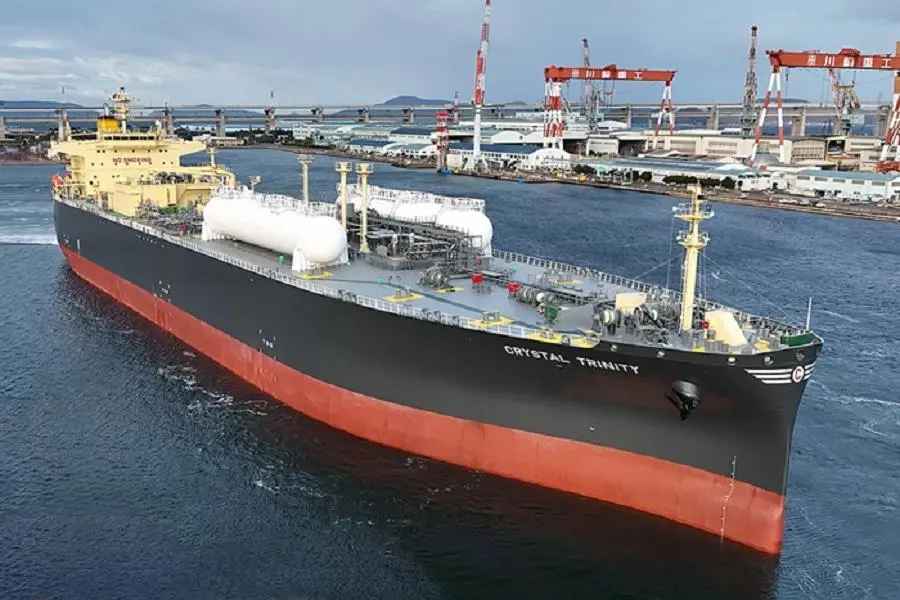
The Crystal Trinity denotes a further stage in the renewal and expansion programme implemented by Kumiai Senpaku through its Singapore affiliate Kumiai Navigation. Offering a cargo capacity of 84,222m3 , the vessel reinforces the Japanese shipping group’s standing in the very large gas carrier (VLGC) category.
Crystal Trinity underscores Kawasaki Heavy Industries’ leading position in the gas tanker domain, as the 65th LPG carrier to have been built by the company, although only the second to incorporate LPG-capable propulsion machinery. Uptake of the Japanese builder’s offering has accelerated, to the extent that LPG dual-fuel installations have been specified in 11 VLGCs subsequently ordered for various owners.
By burning LPG in the gas-injected, dual-fuel MAN two-stroke main engine, SOx emissions are slashed by more than 90% compared with operation on heavy fuel oil, and greenhouse gas emissions are reduced substantially. As well as conforming with criteria in sulphur Emission Control Areas (SECAs), the ship thereby complies with EEDI Phase 3 regulations governing CO2,as applicable to certain vessel types such as gas carriers built from 2022 onwards.
The IMO Tier III NOx standard is ensured in Kumiai’s latest ship by using exhaust gas recirculation (EGR) in the main engine and selective catalytic reduction (SCR) technology in three auxiliaries.
Delivered from the Sakaide yard on Shikoku, Crystal Trinity is powered by a seven-cylinder model of the S60ME-C10.5-LGIP engine developed by MAN Energy Solutions and manufactured under licence by Kawasaki at its Kobe complex. The power output of 12,850kW at a crankshaft speed of 84rpm enables the vessel to make 17 knots.
A pair of dedicated LPG fuel tanks arranged midships on the upper deck provides for the loading and storage of fuel-use LPG independent of the cargo. Moreover, pipe runs allow extra LPG to be transferred from the cargo tanks to the deck fuel containment if necessary. The ship’s electrical load is covered by four generators, with a total effect of 4,830kVA.
Hydrodynamic efficiency is enhanced by aft-end devices known as the Kawasaki rudder bulb system with fins (RBS-F) and the semi-duct system with contra fins (SDS-F).
Crystal Trinity was preceded from Sakaide into the Kumiai Navigation fleet by the 84,229m3 Crystal Asteria, which made her debut with LPG importer Astomos last September as Japan’s first LPG-powered LPG carrier, incorporating the same type of main engine as the latest ship. When Kumiai initially opted for an LPG-fuelled design three years ago, it was indicated that the price was around 8-10% more than that for a ‘conventional’ VLGC. The company has a third newbuild of the same type, as the fourth of the design series, under construction at the yard and expected to be handed over in June this year
In the meantime, the third vessel in the production run, the Calluna Gas, was completed during March to the account of Iino Kaiun Kaisha. She is the first LPG dual-fuel VLGC commissioned by the Tokyo firm, and has been taken on charter by Norwegian energy company Equinor.
Kawasaki’s forward workload at Sakaide has been augmented in the space of the past seven months by one 86,700m3 LPG/ammonia carrier for Japan’s ENEOS Ocean Corporation and three further newbuilds of the design to the account of NYK Line, occupying delivery slots into 2024. NYK’s third LPG/NH3 tanker will be the 13th LPG-fuelled VLGC from the yard.
MAIN PARTICULARS – Crystal Trinity
|
Length overall |
229.9m |
|
Breadth, moulded |
37.2m |
|
Depth, moulded |
21.9m |
|
Draught |
11.6m |
|
Gross tonnage |
49,943t |
|
Deadweight |
55,068t |
|
Cargo capacity |
84,222m3 |
|
Main engine power |
12,850kW |
|
Speed |
17kts |
|
Class |
ClassNK |
|
Registry |
Singapore |
Related Articles
 ALTERNATIVE FUELS & LUBRICANTS
 ALTERNATIVE FUELS & LUBRICANTS
 ALTERNATIVE FUELS & LUBRICANTS