



Japanese yards seek competitive adaptions
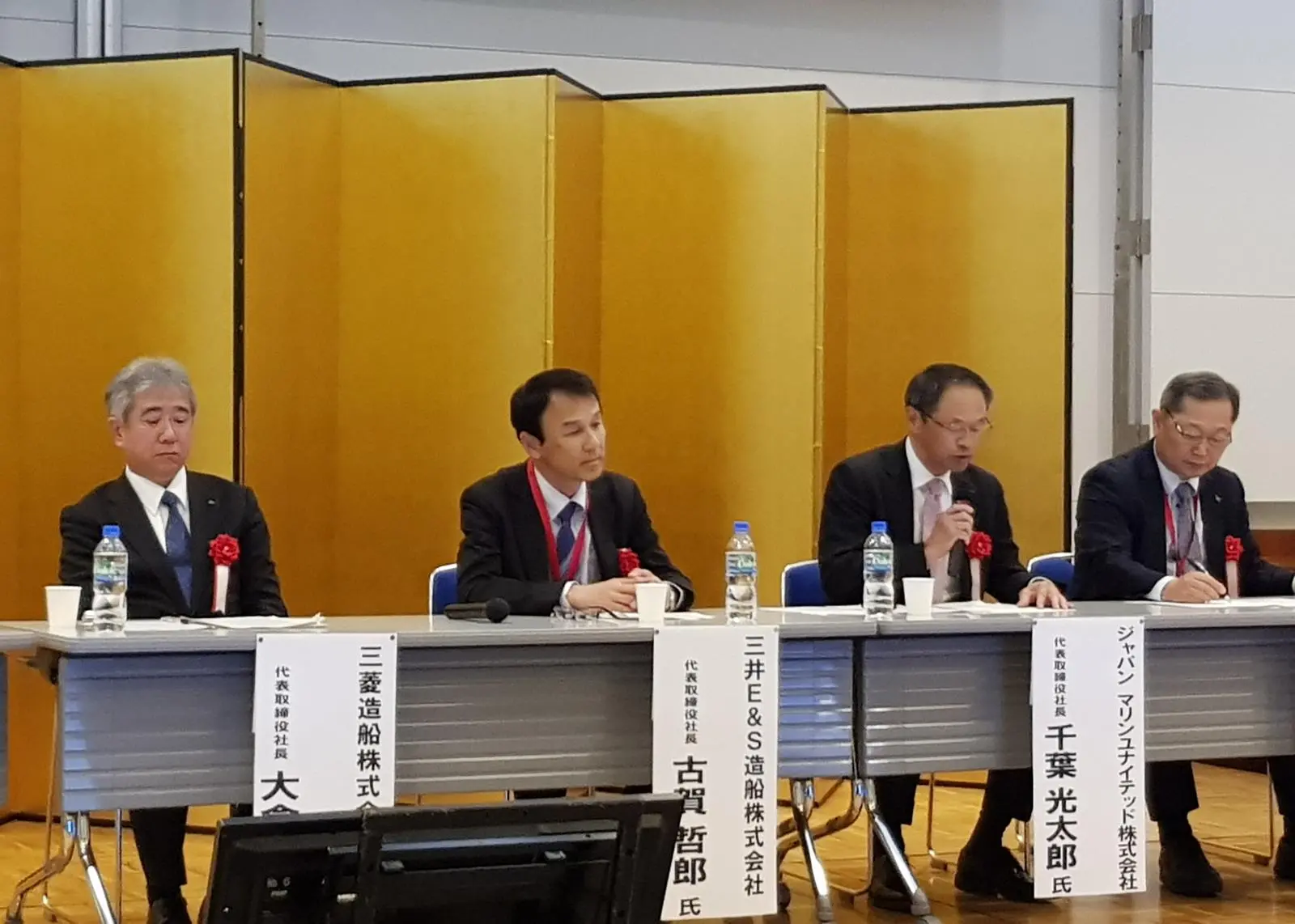
Cooperation, innovation and agility. Some of the leading shipbuilders in Japan – Mitsubishi Shipbuilding, Mitsui Engineering & Shipbuilding, Japan Marine United and Kawasaki Heavy Industries – believe that those three factors will be crucial if they are to take advantage of an emerging recovery in shipbuilding.
Orders at Japanese yards last year were up by 150% compared to a disastrous 2016, according to figures from the Japan Ship Exporters’ Association, with 195 vessels totalling 9.45 million gross tonnes – compared to a historic low of 3.71 million gross tonnes the previous year.
While focusing on those positives, however, the yard groups clearly see competition from both China and South Korea as a concern. Koji Okura, president, Mitsubishi Shipbuilding, explains: “China is using European partners to drive tonnage and raise quality, so has no reluctance in making aggressive investments. The quality of ships built continues to rise, and the industry is supported by national policy. The country’s shipbuilders are seeing as rapidly increasing number of orders and are getting through the backlog, at pretty low prices.
“Meanwhile Korea’s shipbuilders are also supported by public policy. They have taken money from the government and are being aggressive in order to repay the investment. Within World Trade Organization rules are these subsidies from governments accepted? We have some concerns.”
According to Kotaro Chiba, president, Japan Marine United, the Japanese industry needs to be active in countering these distortions. “Japan should be demanding that the government of Korea correct these practices. Fair competition under equal terms will be important in the long term.”
COMPETITIVE MARKETS
But China and South Korea are not the only areas of competition. When it comes to highly specialised ships – particularly cruise vessels – Europe has clear dominance, noted Mitsubishi’s Okura. “Europe has a JPY8 trillion industry in shipbuilding and machinery,” he noted. EU companies have strengths in specialist areas. It is the largest market and also exerts leadership in technology.”
Overcapacity in the shipping market has not helped yards to attract orders, although there are signs that capacity trends are moving in the right direction. Hiroaki Sakashita, an advisor to Japanese ship equipment certification body Nippon Hakuyohin Kentei Kyokia, cited figures from Clarksons that indicate that additions to the global fleet in 2017 was lower than that required to replace decommissioned ships and account for annual trade growth.
Yoshinori Mochida, president of Kawasaki’s Ship & Offshore Structure company, agreed with that sentiment. “Supply and demand is better and now we are going to see good times, but some are still dumping products at low prices. This could cause excess in the market. All stakeholders need to think together, otherwise we will repeat the same negative cycle all over again.”
Responding to these challenges will require fresh thinking from all parties. As reported previously, Mitsubishi’s new organisation puts a focus on building high-value ships. Among them are LNG and LPG fuelled vessels and gas carriers. According to Okura, China and South Korea will be important factors here too. Both are showing an increasing demand for LNG and LPG, and transport infrastructure needs to be put in place. For Mitsubishi, with a strong background in gas carriers, that spells opportunity – unless China begins building those ships itself.
Meanwhile Mitsubishi Shipbuilding is gearing itself up to produce passenger vessels and other ‘densely outfitted’ ships. To accommodate that it will need to focus on its integration capability, a strong supply chain and good partnerships with specialist companies, says Okura. The company is also banking on its ability to build ship machinery and environmental technology.
NEW AVENUES
“Working with partners will be essential,” Okura notes. “We have a strong maritime cluster in Japan and we need to harness it.
For Tetsuro Koga, president, Mitsui Engineering & Shipbuilding, improving technical capability is a must. This includes the digitalisation of design and manufacturing processes. In part, notes Koga, that focus is in response to declining skill levels among shipyard workers. But it is also a question of responsiveness.
“Speed is everything,” says Koga. “Collaboration can help. Where we have strong relationships, we want to develop them in future. For example, we should not be particular about building the entire ship by ourselves. We have five repair yards in Japan and that kind of lifecycle service is somewhere we plan to inject efforts. We don’t necessarily have to build everything ourselves.”
Japan Marine United is in the process of consolidating central functions including design, procurement and marketing functions – last month it gathered diverse design offices into a 200-strong headquarters. The company believes these moves will strengthen both its expertise and its bargaining power, enabling it to improve competitiveness.
Finding new sectors will also be crucial, argues JMU’s Chiba. “Orders for public ships and container ships are declining and we cannot expect growth in the future. We believe there is high potential in new areas such as building LNG fuel tanks and wind farm installations. We will be injecting much investment into offshore engineering.”
At Kawasaki, several measures are being undertaken to drive competitiveness. The company, which also has two shipbuilding yards in China, will aim to leverage that advantage further by manufacturing more blocks overseas. To that extent it is building a second dock in Dalian, going against the grain of Chinese yard closures.
The company is also investing in new vessel designs, notes Mochida. In the long term, that includes a hydrogen carrier, of which a demonstrator will be ready by 2020. Meanwhile the company is developing new concepts for LPG carriers, gas bunker vessels and even autonomous underwater vehicles.
One thing on which the companies agree is that cooperation will be key if Japan is to achieve its stated goal of securing a 30% share in the global shipbuilding market. The last word on the subject comes from Mitsui’s Koga: “There is a history in Japan shipbuilding of working with the maritime cluster to overcome difficulties. We have done it several times. Now we more closely to make this one of the most appealing and attractive shipbuilding markets in the world.”
MOL’s macro perspective
Junichiro Ikeda, president of Mitsui OSK Lines (MOL), gave Sea Japan delegates a perspective of macro trends shaping the industry, contrasting the protectionism and division that is causing concerns today with the global connections that the maritime industry creates. Emphasising the company’s abilities to enter new markets and deploy new technologies in the search for growth, Ikeda cited MOL’s recent entry into the windfarm installation and FSRU sectors – becoming the first Asian liner in the latter market via the MOL Challenger, delivered in September last year.
Concerning new technologies, Ikeda showed how MOL had curbed carbon emissions on some of its latest vessels, including a 50% reduction in CO2 on a 20,000teu container ship thanks to innovative propulsion and energy saving propeller, as well as a 13.5% cut compared to previous designs thanks to a pure car truck carrier vessel that minimises wind resistance.
Renewable energy was a focus. The company is harnessing wind power in the UT Wind Challenger, a wind-assisted bulk carrier that Ikeda said would be launched soon after several years in the design and verifications stage. The vessel will feature intelligent routing that allows it to sail where the strongest winds are to be found. MOL has also signed an agreement with Total to operate and LNG bunker vessel – to be used to refuel CMA CGM’s gas-fuelled container ships – and will start an LNG-powered tugboat operation in Osaka Bay from April next year.
Ikeda also explained that MOL is exploring how to change its working style for its employees. He noted that Japan’s traditionally long working hours mean the country has to contend with a low per-hour productivity and argued that the challenges of the future will require time for employees to think creatively and to collaborate outside traditional departments. In a sign of the importance MOL is attaching to this reform, Ikeda himself is chairing the company’s committee for working reform.
The ‘maximum’ size of vessels has been continuously stretched thanks to the ingenuity of engineers, Ikeda said, and an innovative approach would continue to deliver new business models and open new markets in the future. Ikeda whimsically suggested that the future for container ship operations might involve drones used both to load cargo onto ships – thus cutting loading times at ports – and to deliver cargo to end consumers themselves or local distributions centres.
Related Articles
 PROPULSION
 GENERAL NEWS
 HYDROGEN