



Landmark deal for Co2 carrier
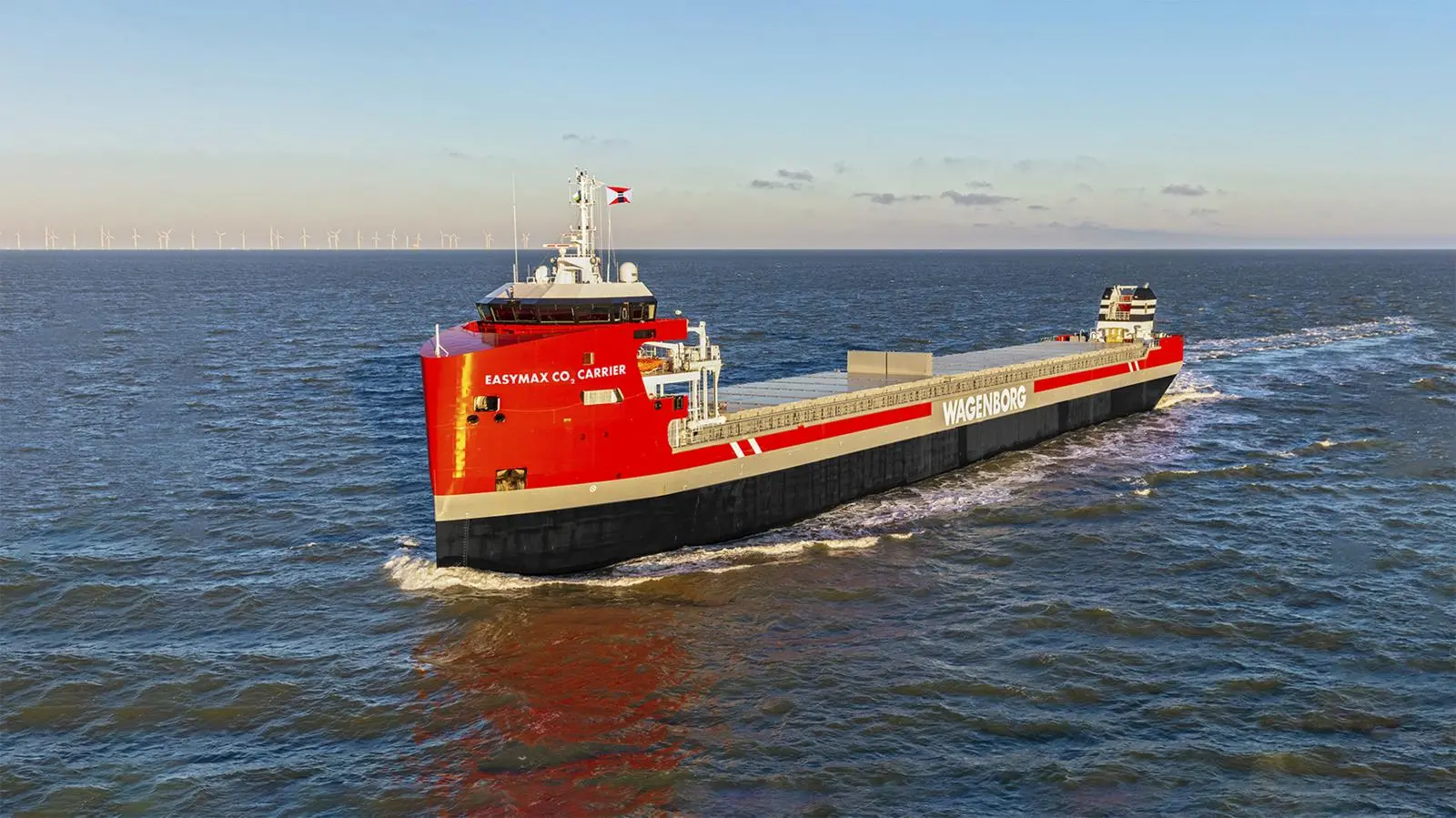
True to the tenets of the concept—‘Easy to build, easy to operate, easy to load’–the 14,200dwt, 150-metre EasyMax type set a new standard in efficiency and capital cost competiveness on its appearance in the European industrial traffic during 2017.
Production of the series continues to be the province of Royal Niestern Sander, which formulated the design in conjunction with Conoship International and Royal Wagenborg. The latest addition to the workload takes the Groningen shipbuilder’s workload through 2026.
The investment is underpinned by a long-term agreement with the UK international chemicals and energy group INEOS. The vessel will be deployed in the shipment of CO2 to the Greensand storage site in the Danish sector of the North Sea, led by INEOS Energy with Danish licence partners Harbour Energy and Nordsoefonden. The pioneering carbon capture and storage(CCS) initiative constitutes the country’s first large-scale CO2 storage facility.
CCS aims at reducing greenhouse gas(GHG) emissions by capturing CO2 and providing secure storage in depleted oil and gas fields.
Offloading of CO2 to Greensand will be achieved through the hub port of Hirtshals, and also Esbjerg. Drawing on learnings from the 2023 pilot phase, the aim is to begin CO2 storage in the North Sea by the beginning of 2026, the initial objective being to bring in up to 400,000t per annum, potentially rising to as much as 8mt annually from 2030 onwards.
Experience from Greensand will also benefit studies into the feasibility of storing CO2 underground ashore in Denmark, at Gassum, which would provide further scope for seaborne deliveries.
INEOS Energy CEO David Bucknall said “The lack of dedicated CO2 carriers has been a bottleneck for advanced CCS projects within Europe. The collaboration between INEOS and Royal Wagenborg serves as a breakthrough moment for the EU’s climate goals, offering a viable solution for large-scale CO2 transport. The agreement highlights the commitment of INEOS, Royal Wagenborg and the governments of the Netherlands and Denmark to achieve a sustainable and low-carbon future.”
The EasyMax generation is striking in form and configuration by way of an exceptionally high length-to-breadth ratio, with a castle-like forward bridge and accommodation structure and completely straight bow and absence of flair.
Up to the contract for the CO2 carrier, Royal Wagenborg had ordered a total of six EasyMax vessels. Besides 2017-delivered lead ship Egbert Wagenborg, the company’s EasyMax flotilla now comprises the Maxima(completed in 2021), Amalia(January 2024), and the newly-commissioned Alexia(November 2024). For handover in 2025, a fifth sister is under construction at Royal Niestern Sander’s Groningen premises, from whom the sixth vessel was booked in October this year, with stipulated delivery in the summer of 2026.
The EasyMax class leads the EEDI league table in its segment, imposing the lowest CO2 footprint per tonne of cargo carried. A low EEDI rating was attained from the outset through a combination of measures, notably including a substantially smaller engine output than a ship of 14,000dwt would normally require, and by hull shape optimisation for several draughts.
Notwithstanding the design’s limited hold outfitting, whereby exclusion of elements such as tweendeck panels, container fittings, lashing pots and beams has helped to limit build costs, the trading versatility of the two-hold EasyMax has been assured through suitability for both high intakes of heavy and light cargoes, forestry products, and project shipments. Underdeck freight capacity amounts to some 625,000-628,000ft3. The relative simplicity and volume of the underdeck spaces has proved conducive to the development of a liquefied CO2 carrier variant.
The vessel which heralded the EasyMax marque, the Egbert Wagenborg, had been specified with a six-cylinder MaK M32C diesel, yielding a maximum 2,999kW at 600rpm, geared down to turn the nozzled, controllable pitch propeller at 111rpm. Sailing in favourable sea and wind conditions at 11 knots on a draught of 8.3m, and with the 1,005kVA shaft generator connected, MGO fuel oil consumption is approximately 9t per day. Consumption in port is of the order of 1t of MGO per 24 hours.
With the Caterpillar Group’s exit from MaK production, the nominated main engine for the EasyMax became the Wartsila W32 series medium-speed diesel in six-cylinder format, meeting the requisite 2,999kW power ‘paragraph’ at 750rpm crankshaft speed.
The design is at the top end of the scale in terms of ship construction within the limits set for the industry located on the northern Netherlands’ inland waterway network. At 15.9m, the beam is the maximum for access into the Ems estuary through the sea lock in Delfzijl’s outer harbour.
The process of scaling up global CCS capacity will require substantial investments in specialised tank-fitted vessels, which must incorporate pressurised systems for containment of cargo in a liquefied state. One of the projects now coming into play involves a series of 7,500m3-capacity LCO2 carriers contracted from Dalian Shipbuilding Industry Co(DSIC) by the Northern Lights joint venture in Norway.
The fact that few orders for such tonnage have as yet transpired gives added significance to Royal Wagenborg’s entry into the sector. The EasyMax series epitomises Dutch flair in the smaller trading vessel category, as regards design, construction and operational efficacy
Related Articles
 PROPULSION
 GENERAL NEWS
 HYDROGEN