



Large NH3-fuelled boxship design overcomes new-fuel challenges
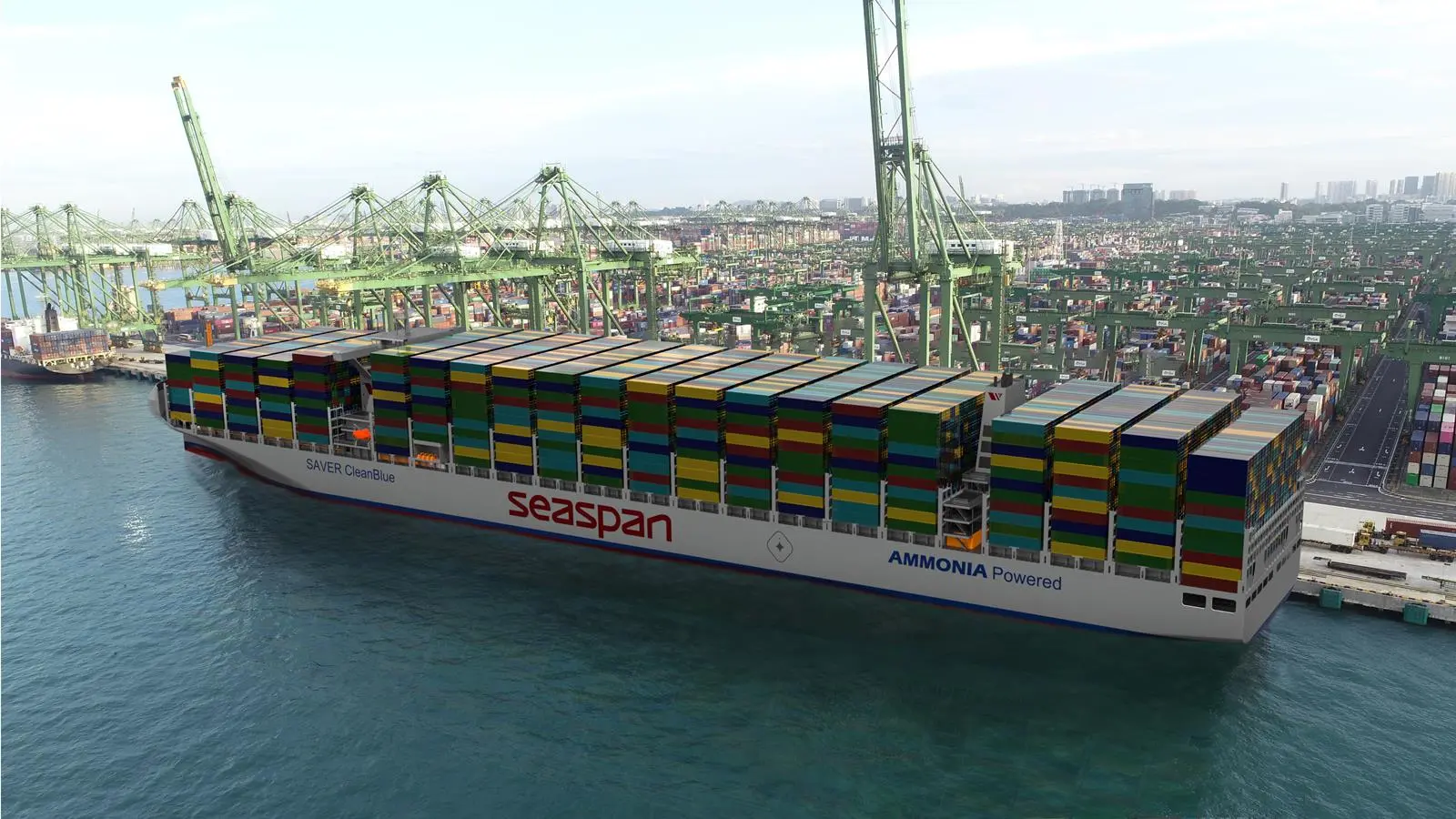
Seaspan Corporation, the Maersk Mc-Kinney Moller Center for Zero Carbon Shipping and Foreship have jointly developed a concept design for a 15,000 TEU ammonia-powered container vessel which has been granted an Approval in Principle by ABS earlier this year. Now the companies have released their detailed analysis to The Motorship.
The project is connected to the Singapore Ammonia Bunkering Feasibility Study (SABRE) consortium, focusing on developing and demonstrating an ammonia supply chain in Singapore. Phase 1 of SABRE performed an end-to-end technical and commercial feasibility study of ammonia bunkering in Singapore along with a preliminary ammonia bunkering vessel design. Phase 2 is investigating how to mature the commercial feasibility so that contractual terms across the supply chain are prepared and can be executed to establish an ammonia bunkering operation in Singapore.
The 15,000 TEU vessel was designed as a potential receiver of ammonia fuel in Singapore from bunker vessels currently under design and development. Based on input from the SABRE consortium focused on trade in and out of Singapore, two specific routes were selected to optimise the vessel design:
o Asia to Northern Europe + Middle East
o Transpacific (west coast of North America or west coast of South America).
The desired range, design and operating speed of the container vessel has a significant impact on the ammonia-fuelled design. These factors determine the basic requirements for the fuel storage tank size, which in turn impacts the tank location.
Based on the two trading routes, a one-way target endurance of 12,000nm was selected using ammonia and an additional endurance of 12,000nm using LSFO. The one-way ammonia endurance was selected to minimise the impact on cargo while maintaining sufficient low-emission operation.
Ammonia as a ship fuel requires a larger tank volume than fuel oil for the same range (typically more than three times, net volume). This combined with the different storage requirements compared to traditional or other alternative fuels presents challenges that had to be considered and overcome during the concept design study. Considerations included optimising the location of ammonia storage tanks to minimise container slot loss.
Propulsive power
The vessel’s power and propulsion system includes an ammonia-capable dual-fuel two-stroke main engine – based on the MAN 7G90ME-C10.5 or WinGD 8X92DF-2.0 engines – with a mechanically-driven shaft and propeller.
Four ammonia dual-fuel auxiliary gensets manage the electrical load onboard: specifically, two 4.1MW gensets and two 2.7MW gensets. The auxiliary engines considered were based on the HiMSEN H35DF engine. The concept design also has an ammonia-fuelled auxiliary boiler for onboard heat demand.
The energy content of the pilot fuel, assumed to be LSFO for the analysis, relative to the ammonia energy content used for this analysis, was 8% for the main engine and 20% for the auxiliary gensets.
To minimize fuel consumption and emissions while at sea, a 3MW shaft generator was studied. Based on a 16-knot speed, the installation of a shaft generator would improve the total efficiency of the vessel and reduce ammonia consumption by around two tonnes/day. However, the associated additional Capex would need to be factored in.
It was assumed that existing selective catalytic reduction (SCR) technology can reduce NOx emissions to compliant levels and that ongoing engine and treatment technology development will find solutions to manage N2O emissions. Any ammonia slip from the engine was also expected to be utilised within the SCR as a NOx reducing agent.
Regulatory compliance
The IGF Code does not currently provide prescriptive requirements to cover the use of ammonia as a marine fuel, but it does provide for alternative design arrangements for the use of low flash point fuels. Recognising the obvious regulatory gap, the ship design project team adopted compliance in general with industry leading ammonia guidelines, rules, and industry reports during the execution of the concept design. These included:
o ABS Requirements for Ammonia Fuels Vessels (September 2021)
o ABS Rules for Building and Classing Marine Vessels (Marine Vessel Rules) – Part 5C
o LR Rule proposal No. 2022/CLS005 Specific Requirements for Ships Using Ammonia as Fuel
o IMO International Code of Safety for Ships Using Gases or Other Low Flashpoint Fuels (IGF Code).
Risk Assessment
The concept design was developed based on partner collaboration and a qualitative HAZID risk assessment workshop. The aim of the workshop was to improve the concept design of the vessel by identifying potential major safety threats and hazards. This review is an important step in ensuring that the safety concept is acceptable with sufficient time remaining in the design process to incorporate needed design changes.
The critical nodes, or systems, related to the ammonia-fuelled aspects of the vessel design were selected for the HAZID assessment.
Based on a review of these findings and recommendations, suitable design improvements were either incorporated into the final concept design or added to a list to be considered in the next design stage.
Storage considerations
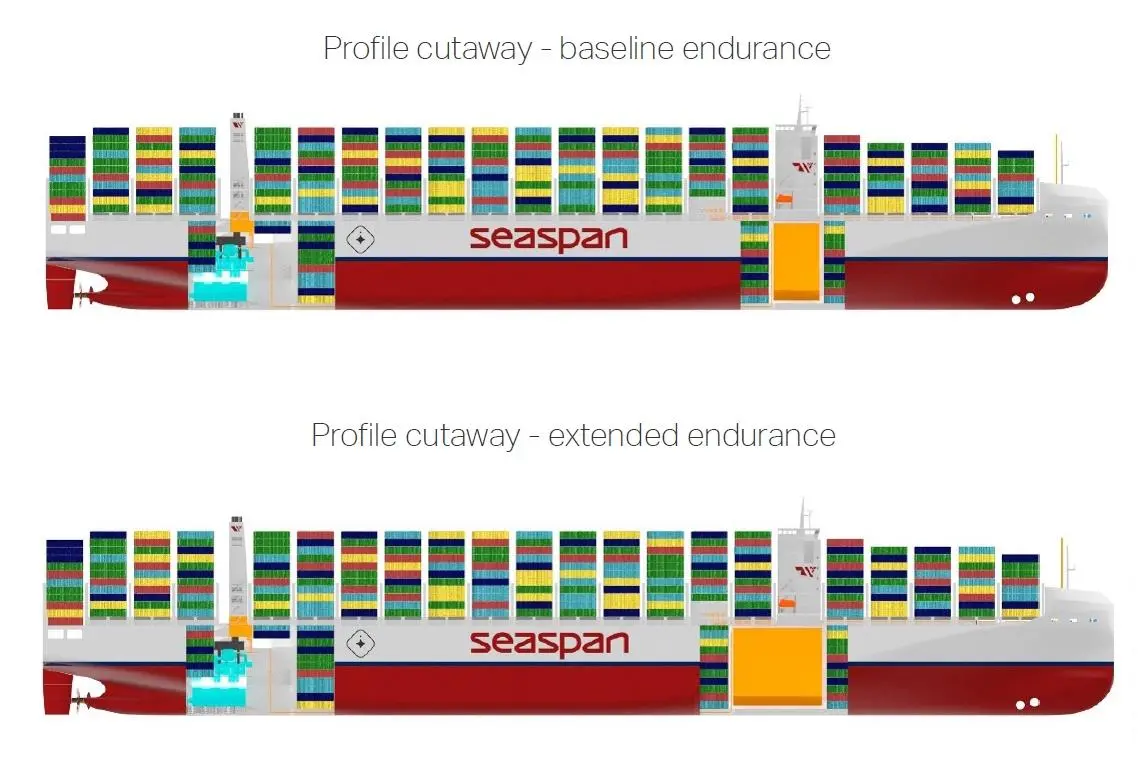
The ammonia storage tank solution selected was an insulated IMO Type B tank. An ammonia storage tank size of 11,500m3 is required to meet the 12,000NM endurance requirement including un-pumpables, fill-limits and a safety margin.
Design of a newbuild vessel with ammonia storage tanks will have an impact on the stability and longitudinal strength of the vessel compared to conventional reference designs. An initial stability calculation was undertaken for the concept design. The analysis concluded that the concept design complies with relevant intact and damage stability criteria up to the maximum draught.
Container slot cost (propulsion power per TEU (kW/TEU)) due to fuel storage requirements was used as the main metric for evaluating the suitability of the design arrangement. As part of the assessment, different locations were considered for the forward accommodation area to determine the optimal accommodation-storage tank combination. Moving the accommodation forward meant fewer container slots were lost, while also ensuring that the lifeboats could be safely raised and lowered and that the bunker station provided sufficient parallel body line for the bunker vessel. The accommodation length was adjusted to ensure sufficient volume was available for the tank.
Fuel supply
The fuel supply system (FSS) includes a recirculation system, a fuel valve train system, a nitrogen system, a ventilation system, and an ammonia catch system (knock out drum) to prevent release of ammonia to the environment. Ammonia water catchers/chemical absorbers can treat ammonia emissions from fuel systems.
The vent mast would be located at the front of the vessel and arranged at least 25 meters from the nearest air intake, outlet, or opening to accommodation spaces. All accommodation windows facing the vent mast location will be non-opening. Additionally, two independent vent lines are provided in the design, one port and one starboard, under the hatch cover to the vent riser location at the front of the vessel. The vent mast included a fixed ammonia gas detection system.
The vessel arrangement mitigates the consequences of pipe rupture of the fuel line from the tank connection space (TCS) to the fuel preparation room (FPR), storage tank penetration due to collision penetrating the storage tank, and damage of ammonia fuel line due to grounding.
BOG management
Given the low maturity of many technical solutions for ammonia boil off gas (BOG) management, the design project included a qualitative assessment of a reliquefaction plant, gas combustion unit and a dual-fuel auxiliary boiler.
The solutions were scored based on Capex, Opex, environmental impact, and level of future-proofing. This resulted in the choice of having a reliquefaction plant and a connection to the auxiliary boiler. The proposed reliquefaction system adopts the vapor compression cycle with the ammonia refrigerant.
GHG performance
There is currently no explicit provision for the direct use of an ammonia emissions factor in the IMO’s EEDI and CII calculations. However, the preliminary EEDI rating for the ammonia dual-fuel vessel was estimated to be 4.68, which is about 44% lower than the required Phase 3 level that is currently in force for container ships. This result indicates that if the current EEDI calculation formula is maintained, allowing for the primary fuel to be used to impact the attained rating, ammonia dual-fuel vessels will likely comply with EEDI requirements for future phases as well.
The EEDI rating for the vessel when using only LSFO would be around 7.2, which is also below the Phase 3 level, indicating an efficient baseline ship design.
The 2023 CII rating for all operating scenarios and ship speeds was estimated to be A, the highest possible rating.
The concept design increases confidence in the maturation of the ammonia fuel pathway to unlock ammonia as a viable fuel that can contribute to maritime decarbonisation.
Related Articles
 AMMONIA
 AMMONIA
 AMMONIA