



Largest, most efficient yet for Royal Caribbean
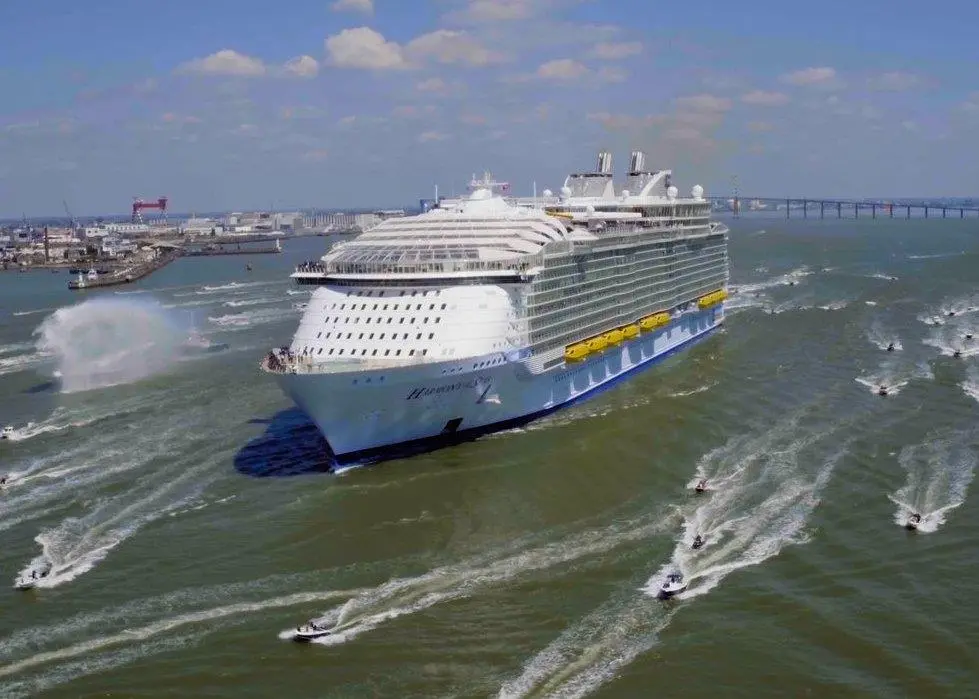
Attaining the title as owner of the world’s largest passenger ship was not a goal in itself in constructing the Harmony of the Seas, but rather the consequence of Royal Caribbean’s bid to push the bounds even further with regard to scope, extent and quality of cruise facilities in addition to vessel capacity and productivity.
From an economic perspective, the most impressive aspect of the project has been the creation of a ship which affords extra revenue-earning potential per voyage while achieving a remarkable 20% gain in fuel efficiency relative to the marginally smaller Oasis of the Seas, commissioned just seven years ago.
As well as building on the technical design of the Oasis generation, the US$1bn-plus Harmony of the Seas also incorporates upgraded features from the smaller, state-of-the-art Quantum class brought into service in the interim. One example of this transfer, and which has an important influence on the latest vessel’s progression in energy efficiency, is the adoption of the under-hull Air Lubrication System (ALS) used in the 2014-completed Quantum of the Seas. At 226,963gt and 362m in length overall, Harmony of the Seas surpasses the Oasis of the Seas by some 2,000gt and about 2m in length.
Whereas Oasis of the Seas and Allure of the Seas emanated from Finland’s showcase Turku yard, Harmony of the Seas denotes a new milestone for French shipbuilding’s major player, STX France, the former Chantiers de l’Atlantique. The St Nazaire yard’s position as a bastion of European high-added value ship production has been bolstered this year by further contractual successes in the cruise vessel market.
Construction is underway on a fourth Oasis-class vessel for Royal Caribbean, with stipulated delivery in 2018, and the French bulder’s 2016-landed tranche of orders from the US group includes a deal for a fifth such ship, due in 2021.
On the basis of double-occupancy of the staterooms, the latest vessel has capacity for 5,494 passengers, although the flexible nature of the accommodation arrangements allows for up to 6,780. With a crew complement of around 2,100, the total size of the onboard community gives added dimension to the modern concept of a floating, self-contained resort.
Efficiency and scale
The increase in scale is accompanied by an efficiency increase of around 20% compared with the two preceding Oasis-class ships, largely attributable to hydrodynamic improvements, refinements in engine and propulsor design, the use of a steam turbine that generates electricity from recovered waste heat, and operating system enhancements.
“We build ships with the planet in mind, utilising the latest designs and technology to optimise performance and minimise our carbon footprint,” Royal Caribbean Cruises’ project director Petteri Keso told class society DNV GL’s publication Maritime Impact. “This makes good environmental sense and –if you consider the increasing awareness of our customers with regard to green issues—excellent business sense as well.”
“We are constantly upgrading the hull designs of our ships to help them perform more efficiently, and Harmony of the Seas takes that evolution a further step. This hull, optimised for real-life operating and speed profiles, particularly at the bow, reduces drag and enhances efficiency,” counselled Keso.
The ship affords a prestigious new reference for the diesel-electric mode, employing a triple Azipod propulsor installation and a considerable diesel generator plant based on six Wärtsilä medium-speed and two MTU high-speed engines. The Wärtsilä 46F-series diesels alone provide a power concentration of 92,400kW, with up to 61,500kW for main propulsion, ensuring transits at up to 23 knots. In addition, four bow thrusters confer a potent, maximum manoeuvring force of 22,500kW.
The Wärtsilä prime movers are based on the 46F design in vee-form configurations, and comprise four 12-cylinder models developing 13,860kW apiece and two 16-cylinder engines of 18,480kW. The entire outfit of alternators was supplied by Emerson Industrial, as owner of the Leroy-Somer brand. The two largest Wärtsilä-driven gensets employ LA62 B145 alternators, while the four aggregates based on smaller models of the Wärtsilä V46F engine have LA62 B105 alternators, and all are rated for 11kV.
The ship’s auxiliary/emergency power system uses Leroy-Somer LSA51.2 VL90 alternators with the two MTU 16V4000 engines, delivering 450V current from each 2,250kVA genset.
The triple Azipod installation, comprising AO-series azimuthing electric podded propulsors individually rated at 20.5MW, combine potency with enhanced hydrodynamics and easier access for maintenance than earlier models.
High manoeuvrability
Hull rotational capability at the bow is no less impressive, by virtue of an array of four tunnel thrusters of the Wärtsilä CT3500 design. Standards of manoeuvrability are critically important to large, windage-prone cruise ships, often working to restricted berths, anchorages and in narrow channels, and the operational and safety implications of a suitable equipment specification are complemented by the economic benefits of dispensing with or minimising tug assistance in all but the most adverse conditions.
The extensive package of Wärtsilä technology includes the Nacos Platinum dynamic positioning system (DPS) for vessel control, manoeuvring and station-keeping. Harmony of the Seas provides the first commercial shipping application for a new wave monitoring system. Now fully integrated into the range of Nacos Platinum software, the system employs detectors on the bow and on each side of the vessel to monitor actual wave heights and to calculate the path and progress of the ship.
The under-hull Air Lubrication System (ALS) employed by Harmony of the Seas, and first introduced with the Quantum of the Seas, was designed by the Finnish naval architectural and engineering consultancy Foreship and developed in conjunction with Royal Caribbean. By creating an air layer between the hull and the water, resistance is reduced, resulting in the need for less propulsion power and cutting fuel consumption.
The optimisation of the hull form is wholly pragmatic in its approach, since close reference has been made to the vessel’s operational and speed profiles, so as to reduce drag and improve efficiency in all conditions, rather than tune the design to still-water conditions.
Harmony of the Seas is fitted with two Wärtsilä hybrid scrubber systems, said by the supplier to represent the largest exhaust treatment plant of its kind at sea today, and ensuring compliance with sulphur emission controls worldwide. The hybrid solution confers the flexibility to operate in both open-loop and closed-loop mode using seawater to remove SOx from the engine exhaust.
The plant thereby ensures the requisite environmental performance in low alkaline waters as well as in the open ocean.
Sulphur solution
At sea, in the open-loop state, and using only seawater, the sulphur oxides in the exhaust stream react with the water to form sulphuric acid. Chemicals are not required, since the natural alkalinity of the seawater neutralises the acid. When switching to closed-loop operation, on entering a port in a low-alkilinity area for instance, the natural alkalinity of the seawater is boosted by an alkali which uses caustic soda (NaOH) as a buffer.
As with the Oasis of the Seas, the latest vessel embodies the ‘neighbourhood’ concept, whereby the public spaces contain seven, main themed areas that provide guests with choice in seeking out activities, experiences and entertainment to suit personal preferences, styles and moods. The ‘neighbourhoods’ include the Royal Promenade mall on deck 5, the Boardwalk on deck 6, the tree-lined Central Park on deck 8, and the Pool and Sports Zone on the upper deck.
The numerous possibilities and facilities for passengers reflect the sector’s continual drive for innovation and competitive differentiation. For instance, the feature known as the Ultimate Abyss, reckoned to be the tallest slide at sea, towers more than 16 decks above sea level, overlooking the AquaTheater at the stern of the ship. The side-by-side slides take guests through a serpentine-like descent from the Pool and Sports Zone to the Boardwalk 10 decks below.
The multifarious entertainment options testify to the industry’s strategy of building what are effectively floating, comprehensive holiday resorts, extending the cruise operators’ market reach and creating new competition for, and alternatives to, shoreside resorts and vacation destinations.
LED (light-emitting diode) and fluorescent lighting throughout the ship reduce power consumption and heat radiation, minimising the strain on the air conditioning system. Wärtsilä Funa has provided light dimming systems for all public venues and suites, and a low-resolution LED (light-emitting diode) wall for the theatre.
Advances in passenger-handling systems bearing on overall cruise vacation quality and first introduced on the Quantum-class have also made their mark in Harmony of the Seas. With next-generation embarkation technology, passengers can check-in at the cruise terminal while dropping-off luggage and be onboard just 15 minutes later. Guests have the option of using radio-frequency identification (RFID)-enabled, bracelet-like Royal WOWBands, which serve as a cabin key and enable purchases to be made at points of sale.
Water safety
Harmony of the Seas gives a platform for a new disinfection control strategy claimed to be revolutionary in its application to the cruiseship industry. Originally developed for customers in the naval sector, the technology from Howell Laboratories of the USA generates a mixed oxidant solution onboard that replaces bottled chlorine and other disinfection chemicals. It is used on the new cruise vessel to treat drinking water and swimming pool water.
The system is based on a mixed oxidant chlorine generation system patented by MIOX Corporation, in conjunction with Howell’s expertise in integrating shipboard technologies.
Salt is converted into chlorine on-demand in accordance with actual requirements, obviating the need to purchase and store bottled disinfectants. By generating chlorine on-site, it is claimed that the product is purer, allowing the swimming pool filter to work more effectively. It is also said to virtually eliminate the taste of chlorine in potable water and the odour and eye irritation associated with chlorine in pools.
Harmony of the Seas sailed from Southampton on May 22 on an inaugural north European cruise prior to starting a summer cruising schedule in the western Mediterranean, operating out of Barcelona and Civitavecchia. From November onwards, the ship will maintain a Caribbean cruise programme, from Port Everglades in Florida.
PRINCIPAL PARTICULARS—Harmony of the Seas
|
Length overall |
362.12m |
|
Length b.p. |
330.70m |
|
Breadth, waterline |
47.40m |
|
Depth, to main deck |
12.65m |
|
Draught |
9.32m |
|
Gross tonnage |
226,963t |
|
Deadweight |
20,236t |
|
Passenger cabins (Staterooms) |
2,747 |
|
Passengers, double occupancy |
5,494 |
|
Passengers, maximum |
6,780 |
|
Passenger decks |
16 |
|
Crew |
2,100 |
|
Power & propulsion system |
Diesel-electric |
|
Main diesel generators |
2 x 18,480kW; 4 x 13,860kW |
|
Emergency diesel generators |
2 x 2,250kVA |
|
Electric propulsion thrusters (Azipods) |
3 x 20,500kW |
|
Bow thrusters |
4 x 5,500kW |
|
Speed |
23 knots |
|
Class |
DNV GL |
|
Class notations |
1A1 Passenger Ship, BIS, Clean, COMF (V-1), ECO F (M), Fuel (380cSt, 991kg/m3,0degC), LCS (DC) |
|
Flag |
Bahamas |
Related Articles
 PROPULSION
 GENERAL NEWS
 HYDROGEN