



LATEST CRUISE VESSEL SETS STANDARD FROM ITALY
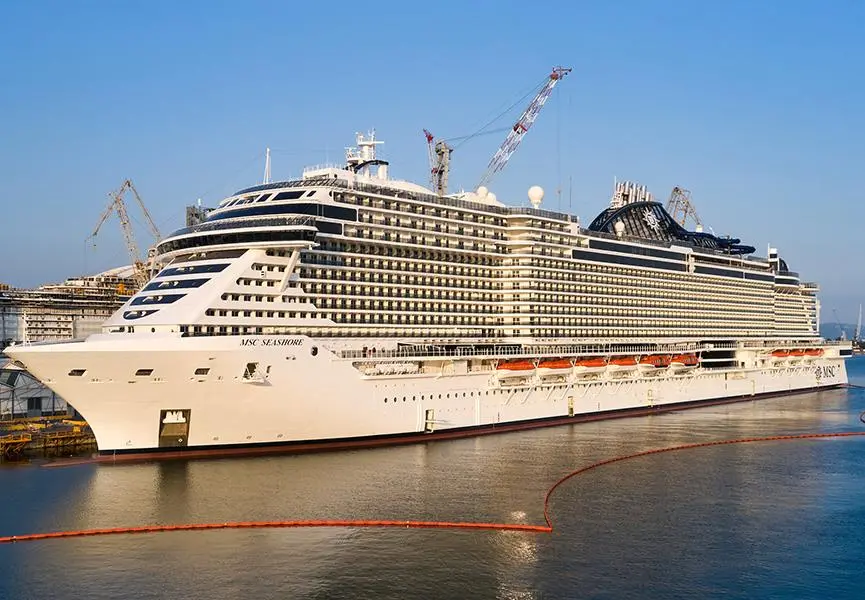
The diesel-electric MSC Seashore is the first of two Seaside EVO-class newbuilds contracted by Geneva-based MSC Cruises in November 2017 from Fincantieri at a combined price of EUR 1.8 billion (US$ 2.13bn), for construction at the Monfalcone yard near Trieste.
As an evolution of the design employed in the 153,500gt sisters MSC Seaside and MSC Seaview, completed at Monfalcone in 2017 and 2018, respectively, the newly-commissioned MSC Seashore has a longer and higher hull, yielding a greater passenger capacity and deck area, with a more potent power and propulsion installation.
Besides the array of features addressing energy efficiency and environmental stewardship, the latest fleet addition is the first cruise vessel to employ the Fincantieri-developed air sanitation system known as Safe Air, which uses UV-C lamp technology to combat viruses and bacteria.
MSC Seashore has received two additional class notations from Registro Italiano Navale (RINA) in recognition of the extent of environmental protection measures adopted. The Sustainable Ship description reflects investments in pollutant air emission reduction, advanced wastewater treatment and energy saving, in line with the UN’s strategic sustainability goals, while the Biosafe Ship notation endorses steps taken to mitigate infection risk among passengers and crew.
Also achieved by the company’s 2019-built MSC Grandiosa, Biosafe Ship is a goal-based and voluntary accreditation certifying that a vessel incorporates systems, components, layout and operational procedures to reduce the risk of infection.
Compared to MSC Seaside, the EVO generation as embodied in MSC Seashore is 16m longer at 339m overall, higher at 76m, some 17,000gt larger in internal volume with an extra deck and 200 more cabins, and offers an increase of some 700 in maximum passenger intake (in the case of short international voyages) to 5,877.
Whereas the power station-type plant in MSC Seaside comprises two 16,800kW 14-cylinder Wartsila 46F diesels plus two 14,400kW 12-cylinder models for an overall power concentration of 62,400kW, MSC Seashore has 14V46F engines throughout, yielding an aggregate maximum output of 67,200kW.
While a total 40MW can be directed to main propulsion in the preceding ships, whereby 20MW GE Marine electric motors act on each of the two shaftlines, the machines for the EVO-class newbuilds were specified at 21MW for a 42MW propulsive effect. The system provides for transits at 21.3 knots, with a maximum speed of 22.4 knots, slightly faster than the Seaside-type.
Hybrid (open/closed loop) scrubbers provide the means to meet sulphur controls while continuing to burn fuel oil, and selective catalytic reduction (SCR) technology minimises NOx release.
The new addition, which takes MSC fleet strength to 19, will be deployed in the western Mediterranean before moving to homeport in Miami for the winter season. Seven-night cruises will then be maintained to Puerto Rico, St Thomas (US Virgin Islands), the Dominican Republic, and Ocean Cay MSC Marine Reserve, the company’s private island in the Bahamas. MSC Seascape, currently taking form at Monfalcone, is due to be phased into service during the northern winter of 2022.
TECHNICAL PARTICULARS – MSC Seashore
|
Length overall |
339.0m |
|
Breadth, moulded |
41.0m |
|
Draught, design |
8.6m |
|
Gross tonnage |
170,412t |
|
Decks |
19 |
|
Passenger capacity, maximum |
5,877 |
|
Passenger cabins |
2,270 |
|
Crew, maximum |
1,648 |
|
Propulsion system |
Diesel-electric |
|
Main genset engines |
4 x 16,800kW |
|
Propulsion motors |
2 x 21,000kW |
|
Speed, maximum |
22.4kts |
|
Speed, service |
21.1kts |
|
Class |
RINA |
Related Articles
 PROPULSION
 GENERAL NEWS
 HYDROGEN