



LEADING PLAYERS TREAD NEW BUSINESS PATHS
Perhaps generally understated as to its scale and potential long-term implications for customers, consolidation among the major players in the Orient is changing the face of worldwide shipbuilding.
As in other sectors of what economists and mass media glibly refer to as ‘traditional heavy industry’, the creation of larger groupings through mergers and takeovers holds the promise of a stronger business platform through the combination of production, research and technological resources and synergistic effects.
The process has been going on for many decades in shipbuilding. It reflects the ever-intensifying competitive and legislative pressures on a relatively fragmented industry that must countenance high fixed costs, long-cycle project and contract timelines, and ensure production continuity in the face of constantly fluctuating shipping markets and associated demand. Now the shift towards larger and fewer organisations has accelerated due to a clutch of recent, far-reaching initiatives taken within the shipbuilding powerhouses of China, South Korea and Japan.
Not only has the pace of structural change quickened, but it is occurring against the backcloth of the economic and social havoc wrought by the global pandemic, and at a time when a fundamental energy transition is under way, affecting every aspect of the design, engineering and construction of vessels. The skills required to realise a newbuild project through its multifarious stages from concept to trading vessel are considerable, and a workforce age profile reflecting many years of declining recruitment give added import to the availability, quality and use of high-technology tools and plant.
The light on the horizon for a slimmer but possibly more resilient industry is the rising demand for environmentally compliant and more energy efficient tonnage. The drive towards shipping reducing its carbon footprint, fostered not only by legislation but by the corporate agendas of a rising number of shippers, charterers and shipowners, is rendering more of the existing fleet uncompetitive and outmoded technologically. How the rationalisation of shipbuilding into fewer contractors wielding greater influence will impact on newbuild prices, and on the requisite flexibility and elasticity in capacity to withstand the market’s highs and lows, remains to be seen.
Furthermore, prices and the financial conditions offered to buyers will continue to be affected by the interplay between the shipbuilding powers as regards the hand of government, whether open or covert. Direct and indirect support remains a contentious issue, as much within the eastern Asian region as between Europe and the Far East.
A Chinese behemoth has come into being through the re-merger after 20 years of the two government-owned groups, China State Shipbuilding Corporation (CSSC) and China Shipbuilding Industry Co (CSIC), together controlling over half the nation’s shipbuilding industry and some 10% of the global orderbook. The combined asset value of CSSC and CSIC amounts to approximately US$115 billion, making the merged entity the largest shipbuilding undertaking in the world. The new enterprise, which continues under the banner of CSSC, also oversees the network of R&D institutes formerly in the lap of separate organisations.
The move was in part spurred by the prospect of South Korea’s pending link-up between the world’s single largest newbuild producer, Hyundai Heavy Industries (HHI), and Daewoo Shipbuilding & Marine Engineering (DSME). But it also encapsulates China’s characteristically long-term thinking, as a measure to lay a more solid platform for realising the national shipbuilding strategy of securing greater business value and international standing through increased emphasis on higher-technology, high quality vessels. The industry’s achievements and progress over the past 30 years are wholly indicative of its future possibilities.
The CSSC combine’s leadership has already given pointers as to an enhanced commitment to research at all levels to foster innovation in targeted sectors and cutting-edge and disruptive technologies.
While Japanese concentration on continuous design refinement and shipyard productivity gains has maintained the industry’s prominence in certain sectors of the deep-sea merchant shipbuilding market, financial results generally have suffered the onslaught of aggressive competition from its Asian counterparts, whom the Japanese contend enjoy greater direct or indirect support driven by national economic and strategic goals.
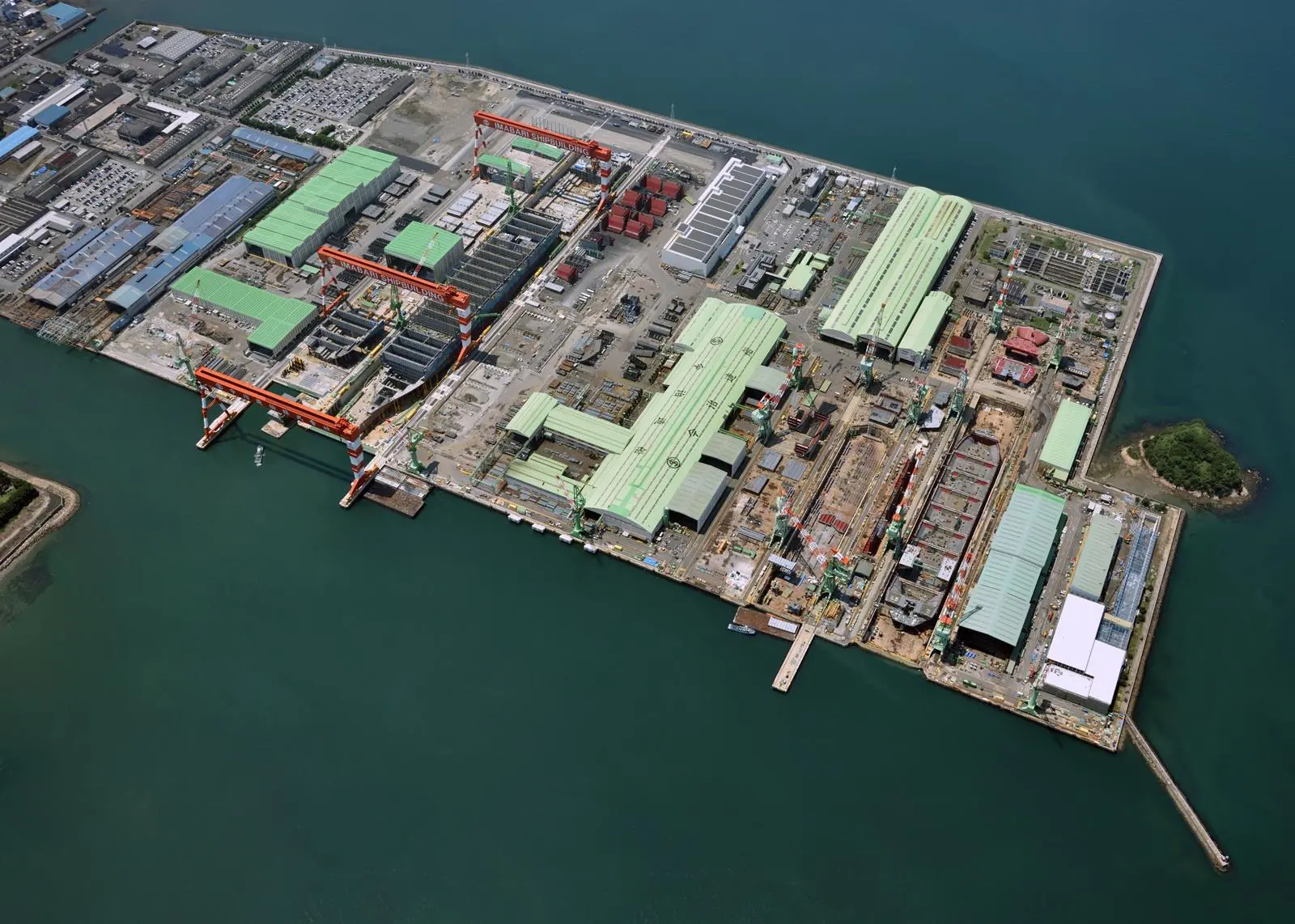
Although a recurring theme, consolidation in Japan assumed new dimension on January 1 this year through the formation of a capital and business alliance between Imabari Shipbuilding and Japan Marine United (JMU) Corporation, with respective 51%/49% holdings in the joint venture company Nihon Shipyard. The new entity’s remit is the marketing, sale, product development and planning of all types of merchant ships bar LNG carriers, whereby subsequent production design, procurement and construction is fulfilled by either Imabari or JMU.
Imabari is already the country’s largest and most prolific builder, controlling 10 shipyards, while JMU has seven domestic yards plus two technical research centres. According to the founding partners, Nihon Shipyard will leverage respective strengths to “create a system that enables them to offer proposals that will exceed traditional frameworks with a greater sense of speed, aiming to survive in the international market”. While outside the new venture’s province, the LNG tanker sector is embraced by Imabari through an earlier agreement with Mitsubishi Heavy Industries.
The high-profile merger on the cards in South Korea remains subject to dilatory review by foreign bodies, most significantly the EU’s anti-trust agency. Two years ago, Hyundai Heavy Industries (HHI) and Korea Development Bank (KDB) signed a definitive agreement on the acquisition of Daewoo Shipbuilding & Marine Engineering (DSME) under which Korea Shipbuilding and Offshore Engineering (KSOE) would be established as an HHI subsidiary holding company.
Of the six overseas jurisdictions which have to approve the planned merger of DSME into HHI, only two have so far sanctioned the move. The European Commission has repeatedly postponed its decision, citing problems over data collection due to the pandemic. EU go-ahead would likely see other jurisdictions follow suit. Korean sources have indicated that KSOE and KDB have now pushed back the completion of the HHI-DSME merger until the end of June this year.
In preparation, the HHI conglomerate has restructured HHI into two entities, comprising KSOE and a reorganised HHI. KSOE, as the sub-holding company of the Group, controls the latter’s three shipyards, namely the HHI complex at Ulsan, Hyundai Samho Heavy Industries (HSHI) and Hyundai Mipo Dockyard (HMD). KDB is to transfer all shares in DSME in return for an equity stake in KSOE, which will then be expanded by the assimilation of the DSME yard at Okpo.
Having shifted into a new holding structure with KSOE at the centre, HHI’s shipbuilding sector has embarked on a business development strategy in which greater-than-ever emphasis is placed on technological intensity and engineering capabilities, underpinned by high-level R&D resourcing.
Notwithstanding the extra challenges posed in 2020 by markets suffering the effects of the Covid-19 pandemic, KSOE re-asserted the HHI group’s prowess in key areas of newbuild construction by landing orders for 12 LNG carriers and 27 VLCCs over the course of the year. The latter stages of December yielded contracts covering four of the gas tankers plus two of the crude carriers. Three of the quartet of 174,000m3 LNGCs, all booked on the strength of long-term charters to Shell, have been assigned to HHI’s Ulsan complex, with the fourth sister plus the pair of scrubber-fitted, 318,000dwt VLCCs allotted to Hyundai Samho Heavy Industries.
HHI has this year augmented its longstanding working relationship with energy group Saudi Aramco by entering into a new fuel supply agreement and by partnering on a related scheme for a combined LPG/liquefied CO2 carrier.
HHI refining subsidiary Hyundai Oilbank, in which Aramco gained a shareholding two years ago, will import LPG from Saudi Arabia to be used in the production of ‘blue’ hydrogen, signifying hydrogen derived from fossil fuel resources such as natural gas. CO2 captured and stored during the production process will be shipped back to Aramco, using a new class of tanker suited both to CO2 transport as well as Korean imports of LPG. Hyundai Oilbank envisages 300 hydrogen charging stations across South Korea by 2040.
The Korean company has also signed a deal to buy ‘blue’ ammonia from Aramco. HMD is pressing ahead with plans to commercialise ammonia-fuelled ships by 2025, drawing on expertise of MAN Energy Solutions and Lloyd’s Register. A concept design of 50,000dwt medium-range tanker powered by ammonia-capable two-stroke propulsion machinery has been prepared.
Unerring technological progression in the group’s offering is exemplified by plans to build a liquefied hydrogen carrier. The domestic project advanced by logistics specialist Hyundai Glovis in cooperation with HHI and HMD foresees a significantly larger vessel than the pioneering hydrogen tanker recently built by Kawasaki Heavy Industries in Japan.
In the meantime, both South Korea and China are looking to provisional agreements with Qatar covering a potentially considerable volume of LNG carrier tonnage being converted into firm orders. Last year, the Gulf state reserved delivery slots among Korea’s ‘Big Three’ and at CSSC’s Hudong-Zhonghua Shipbuilding for approximately 120 vessels in total. Qatar’s recent, final investment decision relating to the North East Field Project, which will raise the country’s LNG production capacity from 77 million tons per annum to 110m tpa, brings the prospect of the major new round of fleet development closer.
Related Articles
 PROPULSION
 GENERAL NEWS
 HYDROGEN