



LNG-fuelled car carrier quartet for German auto mover
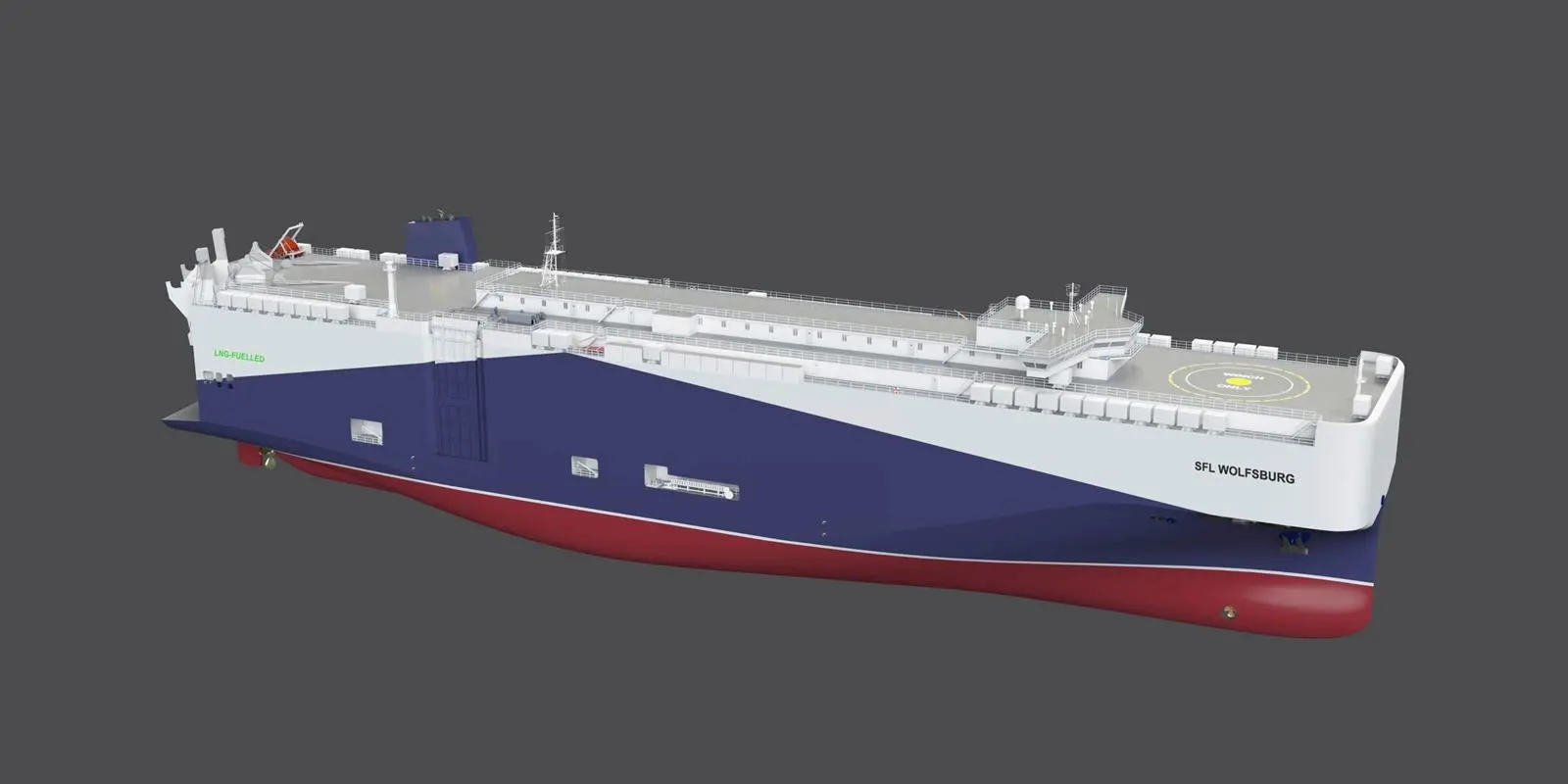
Volkswagen put two LNG carriers into service out of Emden last year and said the latest ships – from unspecified yards in China – would mean that six of the group’s nine carriers on the North Atlantic route will be operating with DF LNG engines by the end of 2023.
The Wolfsburg-based concern said long-term and exclusive usage contracts for the four newbuilds had been concluded with Wallenius Marine and SFL Corporation.
The ships, which it described as “ultra-modern”, would each have a capacity of 7,000 CEU (Car Equivalent Units), which corresponds to around 4,400 to 4,700 vehicles in the VW Group model mix. They will be driven by 13,300kW DF marine engines from MAN Energy Solutions which, in eco-speed mode, will provide 15-16 knots, it said.
Volkswagen also noted that the newbuilds will be “particularly climate-friendly” because the high-pressure technology of the 2-stroke engine from MAN Energy Solutions minimises the potential for fugitive methane emissions (methane slip)”.
The high pressure low speed engines specified for the four vessels have been operated in two earlier LNG-fuelled ships, which have been in service since 2020. The methane emissions potential of the engines was “a key decision criterion when choosing the ships”, VW said.
The Chinese-built 200m x 38m Siem Confucius and sister Siem Aristotle also appear to offer similar capacity and capability to the four newbuildings. Carrying about 4,700 vehicles on 13 decks they were powered on entering service by MAN B&W S60ME-gas injection, dual-fuel, two-stroke main engines delivering 12,600 kW and 16.5 knots in eco mode. Two tanks on each ship held 1,800 m3 of LNG apiece and the ships also operated on biogas.
The new carriers will also be suitable, without modification, for use with alternative, non-fossil fuels such as biogas, so-called e-gas from renewable sources or biodiesel, Volkswagen said. Two of the ships will also be capable of battery cell installation later if required, so reducing fuel consumption even further. And all four LNG ships, Volkswagen noted, will have shore power plug-in capability.
Simon Motter, Head of Volkswagen Group Logistics said by using LNG, Volkswagen was reducing ship CO2 emissions by up to 25 percent (measured on a tank-to-wake basis). “After the group’s commitment to e-mobility and climate-neutral production, the LNG fleet is making a further important contribution to making Volkswagen a CO2-neutral group by 2050”, he declared. Motter also noted that being able to operate with non-fossil fuels in future would reduce CO2 emissions even further.
The German group has already converted all its Deutsche Bahn transport to green electricity and says it is expanding this across Europe. In coastal shipping, it already operates two car freighters with bio-fuel for a CO2 reduction of 85%.
Volkswagen Group Logistics organises around 7,700 ship departures worldwide and ships some 2.8 million new vehicles every year.
Related Articles
 PROPULSION
 GENERAL NEWS
 HYDROGEN