



Low-Speed Four-Stroke Family Embraces Methanol
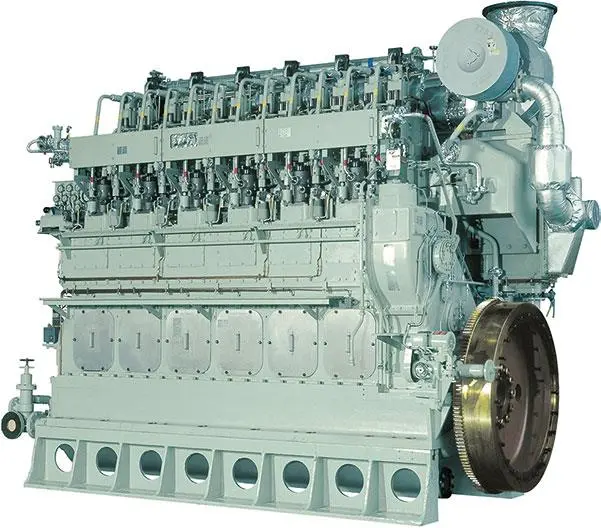
The addition of the LA28M model to the line-up of trunk piston machinery produced by Hanshin Diesel is the culmination of many years’ development work and test campaigns involving methanol combustion.
The new design is based on the LA28 diesel, and expresses the company’s view that methanol offers a raft of environmental, practical and logistic benefits at a lower capital cost than that entailed with other alternative fuels such as hydrogen or ammonia.
An early reference for the six-cylinder, LA28M will be as the propulsion engine in the methanol-fuelled coastal tanker newbuild project announced earlier this year by the Mitsui OSK Lines (MOL) Group. The 65.5m vessel ordered from Murakami Hide Shipbuilding for delivery in December 2024 will be jointly owned by MOL Coastal Shipping, Tabuchi Kaiun and Niihama Kaiun.
Employing the same 280mm bore and 590mm stroke of the LA28, the methanol-capable Hanshin engine has a slightly lower nominal power of 1,103kW, compared to the diesel’s 1,323kW, at the 330rpm crankshaft speed.
Compared to conventional use of heavy fuel oil (HFO), operation on methanol brings a considerable reduction(80%) in NOx, virtual elimination of SOx (99%) and particulates (95%), with the further advantage of a 15% abatement in CO2. As an energy transition pathway, machinery designed to ingest methanol as the primary fuel paves the way to use of synthetic methanol produced by hydrogenated CO2. Although easier to handle and store than LNG or hydrogen, and widely available using existing infrastructure, methanol’s calorific value is about half that of marine distillates.
With the new addition to the Hanshin portfolio, marine diesel oil (MDO) or marine gas oil (MGO) will be used for starting, and for operation through the low-load range until the engine speed increases to the higher-load point whereupon methanol will be injected as main fuel, supplemented by MGO or MDO to ensure stable combustion.
In the event of a failure of the methanol fuel supply or its double-wall piping, back-up operation can be secured on MGO or MDO. Provision is made for the methanol piping to be purged with nitrogen gas before maintenance disassembly.
Favoured over the medium-speed four-stroke, and low-speed two-stroke options, the low-speed, four-stroke engine concept retains a strong following among Japanese and east Asian operators engaged in coastwise and short-sea trade. The moderate crankshaft speed enables direct drive to the propeller, dispensing with the need for a gearbox.
Hanshin and other manufacturers involved in the sector continue to attach particular importance to design simplicity, high reliability and cost affordability, given the financial capacity and competitive considerations of companies within the target market sectors, and these principles have endured in the developmental path that has led to the LA28M. Six-cylinder formats predominate in the low-speed, four-stroke stakes, and such is the methanol engine’s configuration.
The intake and exhaust valves use a hydraulic system, reducing noise around the cylinder cover, preventing sprinkling of lube oil, and obviating the requirement for tappet clearance adjustments. Camshaft drive is retained for methanol fuel and pilot fuel injection and valves, with the cam profile tailored to methanol usage. The crankcase is integrated with the cylinder frame, cam case, and cooling water main inlet pipe, thereby enhancing engine rigidity, reducing the component count and simplifying the overall structure.
The LA28M follows last year’s release by Hanshin of a gas monofuel engine, the 300mm-bore G30, using diesel architecture and the low-speed, four-stroke cycle formula.
MAIN PARTICULARS – Hanshin LA28M engine
| Cylinder bore | 280mm |
|---|---|
|
Piston stroke |
590mm |
|
Cylinder configuration |
6 in-line |
|
Main fuel |
methanol |
|
Pilot and back-up fuel |
MGO/MDO |
|
Power, maximum |
1,103kW |
|
Speed |
330rpm |
|
Brake mean effective pressure |
18.4bar |
Related Articles
 2-STROKE & 4-STROKE
 2-STROKE & 4-STROKE
 2-STROKE & 4-STROKE