



LPG-Fuelled Gas Tankers For Croatia
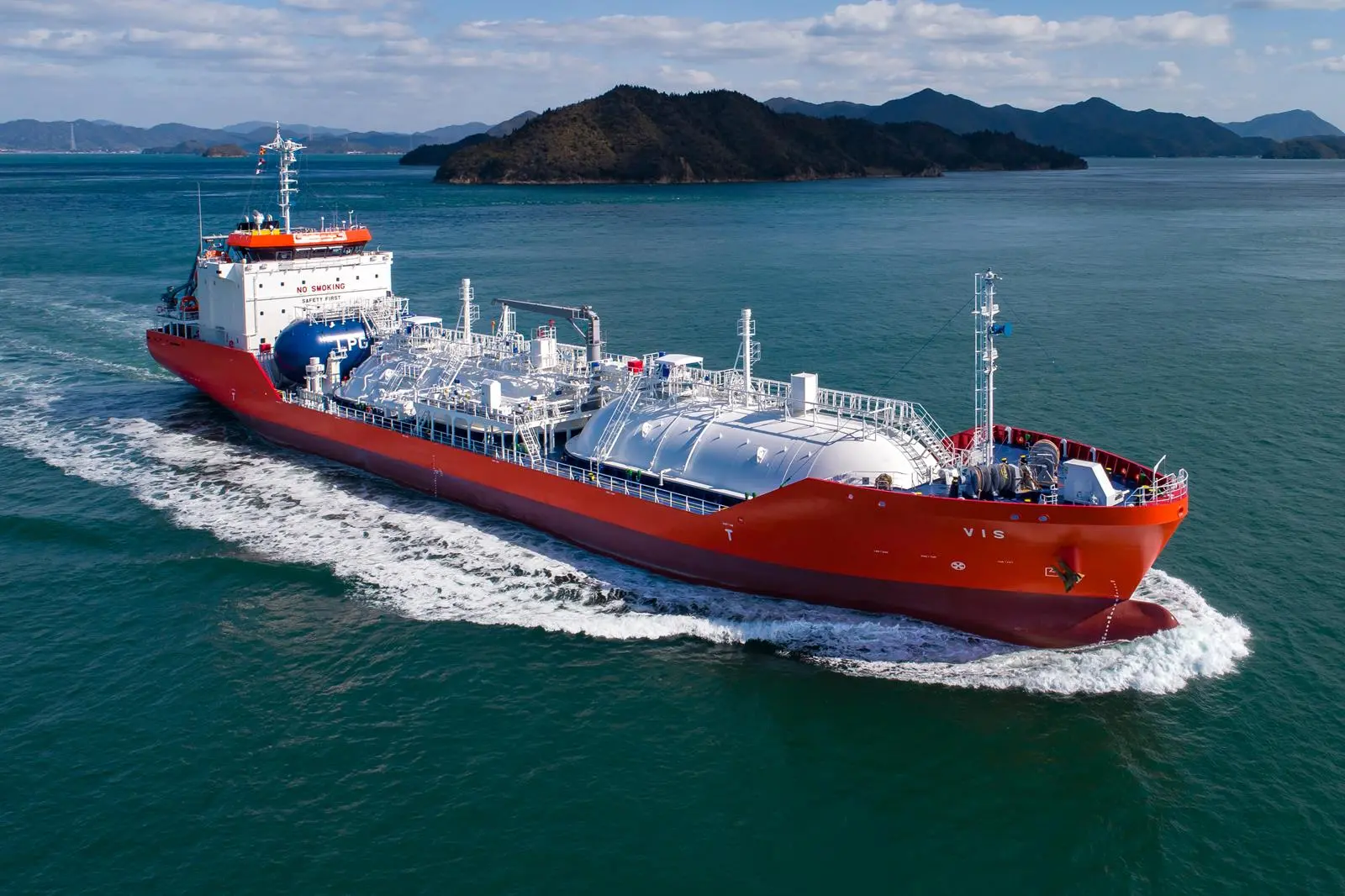
Originally contracted by Irus Holding of Nyon, lead vessel Marko Marulic was bought by Split-based Jadroplov prior to delivery last autumn by the Japanese yard, while the February 2023-completed second-of-class Vis has been acquired from another Swiss firm, Global One Energy (GLOEN). The combined investment is reportedly just under $50m.
The 117m Marko Marulic has the distinction of being the first gas tanker of its size and type under the Croatian flag, and also ranks as the first Japanese-built, small LPG carrier to adopt an LPG-capable dual-fuel propulsion plant.
In the case of both vessels, the two-stroke propulsion unit is a five-cylinder example of the S35ME-C9.7 engine in its LPG liquid gas injection (LGIP) version, designed by MAN Energy Solutions and manufactured under licence by Hitachi at its Innoshima works. The specified maximum continuous output of 3,000kW is achieved at 143rpm and enables the vessel to make 13 knots.
In gas mode, fuel is drawn from a 450m3 storage tank positioned at the aft end of the main deck. Sasaki-patented stern fins promote water flow into the propeller, enhancing propulsive performance and saving fuel. Such has been the technical oversight that the gas carriers conform with the EEDI (Energy Efficiency Design Index) Phase 3 requirements effective from 2025 onwards, and also meet Bureau Veritas’ Clean Ship criteria.
Cargo containment is in two equal-sized, cylindrical Type C tanks rated for a design pressure of 17.65 bar, and affording an overall, practical shipment volume of some 7,350m3 at 98% capacity. The whole is served by two multi-stage, vertical centrifugal cargo pumps, each of maximum 450m3 per hour throughput.
Managed by Thome Croatia, the ships have been approved for Inventory of Hazardous Materials (IHM) certification under the EU’s Ship Recycling Regulation.
Aside from the added design complexity associated with a dual-fuel installation, construction of gas carriers of this type poses particular challenges due to the amount and sophistication of the equipment and systems involved relative to the limited machinery room space available within a compact hull envelope.
Located in the Toyota district of Hiroshima Prefecture, Sasaki has experience in this domain, borne out by references for LPG carriers in the 6,000-11,000m3 range, and by new design proposals including methanol dual-fuel chemical tankers of 7,000-13,000dwt and a hydrogen dual-fuel LPG carrier of 5,000m3.
Related Articles
 AMMONIA
 AMMONIA
 OTHER ALTERNATIVE FUELS