



Lubricant Formulations Face Real-World, Multi-Fuel Challenges
Lubricants are part of engine design
WinGD X-DF engines have the flexibility to operate in both the Otto and Diesel combustion cycles, either solely or in combination during fuel-sharing mode. Combustion of LNG occurs during the lean-burn Otto-cycle, while combustion during the Diesel cycle uses distillate and residual fuels, or their renewable substitutes such as bioLNG/synthetic LNG and biodiesel. During the design of the Otto cycle LNG combustion engine, proven running components were adopted from the Diesel engine, and piston, piston rings and cylinder lubrication system are all but identical.
Due to the successful uptake in the market of WinGD X-DF engines using LNG as fuel, and the growing trend towards operating these engines in this gas mode for as much running time as possible, WinGD continues to work with oil companies to conceive, develop and validate lubricants suited primarily for use during LNG operation; all the while maintaining oil performance for times when the engine is operated in Diesel or fuel sharing mode.
Legacy cylinder lubricating oil recommendations were designed to fit the oil with fuel-sulphur content: matching low BN products with gas and distillate operation, and high BN products with fuels with high sulphur contents. The issues surrounding acid corrosion are fairly well understood and while important, the focus has waned. More recently, and very importantly, all cylinder oils are individually evaluated by WinGD on their additional ability to keep the piston running components clean and free from deposits. This overall individual oil performance is reflected in the oil specific usage guidelines in the WinGD list of validated oils.
The pre-mixed charge of the Otto cycle combustion process has resulted in increased thermal stress on the lubricant. “This can lead to increased lubricant degradation and resultant deposit formation,” says Dr Bartosz Rozmysłowicz, Expert Fuels & Lubricants at WinGD. “Therefore, higher cylinder oil oxidation stability is required in order for it to perform its regular functions such as physical lubrication and keeping piston running components clean. Accordingly, WinGD introduced a new class of lubricants. Cylinder oils that show good performance during DF engine validation trials using LNG are awarded an additional ‘DF Validated’ status which is reflected in official lists.”
Investigations into the potential impact of alternative future fuels on lubrication performance is also being considered within WinGD internal research programs. Having successfully integrated both the Otto- and the Diesel-cycle combustion principles into a single engine, WinGD is able to apply the best combustion strategy to each fuel candidate alone or in combination, but this of course requires suitable lubrication. “We treat the lubricant as a part of the engine design,” says Rozmysłowicz. “Therefore, we are in close contact and cooperation with lubricants and additives suppliers to fulfil the needs of the future engines.
“Although currently available lubricants should be capable to handle lubrication of future engines, new fuels might pose novel challenges for lubricant performance,” he says. “Change in the combustion conditions might lead to higher thermal stresses for the lubricant, similar to the situation observed in the past for LNG engines. Additionally, changes in the chemical nature of the new fuels together with different combustion by-products might lead to the need for slight adjustment of the current lubricant additive formulations for future engines. WinGD continues with research into low ash cylinder lubricants and low BN cylinder lubricants with high detergency.”
More formulation changes to come
With the introduction of IMO 2020 low sulphur fuels some operators experienced issues with deposits, and this required the use of cylinder oils with rebalanced additive packages, adjustment of the oil consumption to increase detergency and close monitoring of engines. But, says Ioannis Chatzakis, Global Aviation & Marine Field Engineering Manager at ExxonMobil, it is important to remember that deposit formation was not a new problem. ExxonMobil’s Mobilgard™ 540 X, released to the market last year for use with 0.10%, 0.50% sulphur fuels as well as LNG, was specifically formulated to guard against this.

Mobilgard 540 X was the first oil with dual fuel validated approval from WinGD. “This gave us the opportunity to accumulate engine running hours for quite some time,” says Chatzakis. “In addition, much more data have been accumulated in various other engine designs and operating conditions with very promising results.”
The level of formulation change, post-2020, is likely to be more pronounced though, says Chatzakis. “It is doubtful that a single oil formulation will work for all alternative fuel choices. Characteristics such as base number, viscosity and detergency will continue to need to match the conditions found inside an engine, which is partly down to engine design but will predominantly be the result of fuel chemistry.”
LNG is now a mature fuel
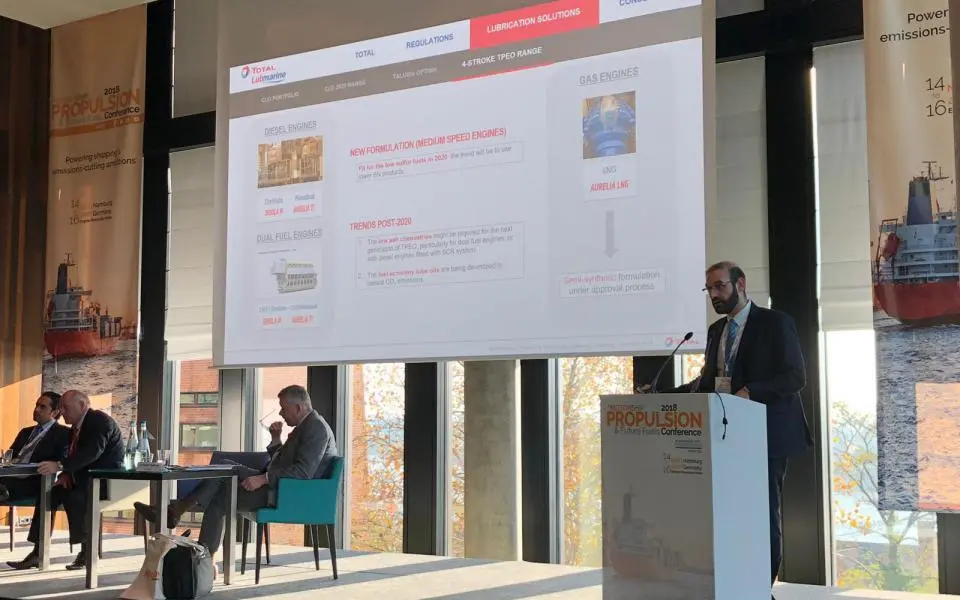
Today, the amount of research into LNG as a bunker fuel is diminishing as the order book grows, says Nikolaos Kotakis, Technical Director, Lubmarine at TotalEnergies. It is now considered a mature technology along with the liquid fossil fuels. Yet, these fuels still figure in lubricant development, as he believes they will still continue to have a place in new ship designs as a backup in case of problems with the availability or operation of new fuels. He notes TotalEnergies’ involvement upstream, downstream and as a bunker fuel consumer and says the adoption of new fuels by the shipping industry is more likely to be driven by familiarity and how closely they resemble current operations rather than technical maturity. Part of that familiarity will be driven by the logistics of making new fuels available at ports around the world, so he sees ammonia as an important transition step in the progression towards the less familiar fuel hydrogen.
For lubricant development the on-going use of multiple fuels means a cylinder oil formulation that is suitable both old and new fuels will be required. Lubmarine, already seeing success with its Talusia Universal 2-stroke engine product range, will expand that platform beyond its current compatibility and proven performance for IMO 2020 compliant fuels, including LNG. The product has been validated across a range of dual-fuel engines including WinGD and MAN ES engines.
With new fuels, engine design is being pushed to the limit, says Kotakis, as parameters such as compression and combustion pressures in both Diesel and Otto cycle engines are optimised for new fuels. Lubricant formulation will adapt accordingly, but post combustion treatment also needs to be considered. “We have to make sure that the part of the lubricant which will be burned and emitted will not pollute the selective catalytic reduction (SCR) system. In the case of an exhaust gas recirculation (EGR) system where part of the exhaust emission is re-entering the engine, we additionally have to make sure that there is nothing in the lubricant formulation that could create abrasive wear.”
Lubmarine is currently developing a common lubricant platform for 4-stroke engine lubricants, although Kotakis noted that the development of 4-stroke medium-speed engines able to burn efficiently all these new fuels may be more challenging given the fuels’ different flame propagation and calorific value characteristics, compared to the long, slow cylinder stroke of a 2-stroke engines; an element that facilitates the combustion process.
A first generation of the common platform is expected to be released by Summer 2022 and a second generation covering new fuels such as ammonia is expected later. To date, the first generation has gained approvals from MAN Energy Solutions, testing with MaK-Caterpillar is underway and Wärtsilä engines will be next. Once these approvals are gained, the platform will cover over 50% of the market, and Kotakis says Lubmarine will then move forward with other engine manufacturers.
For four strokes, the most challenging aspect of the lubrication development is resilience, he says. “A one-off product would be too costly, so we must continue to have something which circulates from the sump tank for some time. This means that over a period of say 5-10,000 running hours, the lubricant could have experienced multiple different fuels. “This will be a very wise lubricant, because it will have seen many things in its life, and this is where the idea of creating a common platform comes in.” The concept is important from an operator and crew perspective, he says. “We want to give extra flexibility without the need of having to think about the lubricant every time.”
Of key importance in working with new low-carbon and low-sulphur fuels will be keeping the ash content low. It will be important for the lubricant to not generate deposits in new cylinder space designs. “We need a particular detergency, a particular additive profile, but we have to make sure that the lubricant is matching the needs of the engine and the fuel in a way that is not overly aggressive but not under-performing either. So ash content is a key parameter that has changed, and we have a better mix of surfactants.”
Varied requirements
Pat McCloud, GM Europe & Global Marine Lubricants at Chevron, says a key focus of the company’s 2-stroke lubricant development program is the ash content (for exhaust after treatment compatibility), engine cleanliness (especially piston deposit control) and helping optimise feed rate to reduce oil consumption and overall OPEX. “Controlling and helping minimize wear and corrosion of course remain the cornerstones of good lubrication, but these other factors are of equal importance.”


He says: “A one-size-fits-all approach to cylinder lubrication is not sufficient to meet future emission legislations, the complexity and range of alternative fuels, efficiency improvements and exhaust after-treatment systems. All these varying requirements will require an extensive range of tailored products supported by technical specialists.”
Lawrie Peck, OEM Technical Manager – Marine Engine Oils, Lubrizol, says that new challenges are already emerging from laboratory and in-service experience with new fuels. For example, when combusted, the flame from gas fuels can burn down the sides of the piston crown, and methanol can emulsify system oil.
Ammonia also comes with many specific challenges, he says, as it does not burn well and requires a pilot fuel to ignite. “Incomplete combustion can also be a problem when using ammonia, allowing unburnt ammonia to collect in crevices within the combustion chamber. When in a liquid form, ammonia vaporises when injected into the engine, reducing the temperature of the combustion chamber. Together with its high evaporation rate and lower cetane value, when compared to traditional hydrocarbon fuels, it is likely that ammonia-fuelled engines will require higher fuelling rates to maintain similar power outputs.”
Ammonia also provides challenges for the lubricant. It can cause corrosion, present issues with seal compatibility and have an impact on the system oil. “These factors mean that formulators will not only have to consider providing the cleanliness of a classical 100 base number cylinder lubricant but also other lubricant performance requirements such as acid neutralisation, wear protection, after treatment compatibility, water handling, nitration impact, thermal and oxidative stability.
“There are also likely to be challenges when it comes to laboratory experimentation, developing test methods and conducting initial engine testing with ammonia. It is going to take time to understand the interactions between the lubricant and the fuel and how existing bench tests correlate to real world conditions. Developing products for new fuel types takes an enormous investment not only of time spent on in-service testing, but also in ensuring that laboratory tests are measuring the right characteristics.
“We have been using our early access to engine testing with ammonia fuel to give us an insight into factors such as deposit formation, oxidation and wear as well using this data to help correlate our current bench testing methods. When a bench test result does not correlate with what we have seen in the field, we are working to adapt these tests. We are also looking into designing new bench tests to strengthen the correlation between these and real word application. This will give us a better indication of performance.” Peck says collaborative partnerships are going to play an essential part in this process. Shipowners, engine designers, fuel suppliers and lubricant companies all need to work together to understand engine performance, condition and the implications of new fuels.
He believes the increasingly varied demands placed on the lubricant by the different fuel options mean more advanced lubricant solutions will be required and the number of lubricant solutions in the market is therefore likely to increase. This means that complexity is likely to remain in the marine cylinder lubricant market.
Related Articles
 ALTERNATIVE FUELS & LUBRICANTS
 ALTERNATIVE FUELS & LUBRICANTS
 ALTERNATIVE FUELS & LUBRICANTS