



MAN ES’ ammonia-powered two-stroke engine
With approximately 80-90% of global freight transported by sea, decarbonising the shipping industry is essential for meeting global climate goals. MAN ES has identified ammonia as a leading alternative fuel, predicting it will play a dominant role in marine energy by 2050. Both blue and green ammonia offer viable pathways for reducing greenhouse gas emissions, with e-ammonia (produced from green hydrogen and atmospheric nitrogen) emerging as a cost-effective and scalable solution.
Ammonia engine: A timeline
MAN Energy Solutions has made remarkable progress in developing ammonia-powered engines since initiating research in 2019. Key milestones in the development include:
- Conducting combustibility investigations and engine concept simulations.
- Installing and testing auxiliary systems for ammonia supply.
- Successfully achieving 100% engine load on ammonia.
- Launching the first commercial ME-LGIA engines on testbeds.
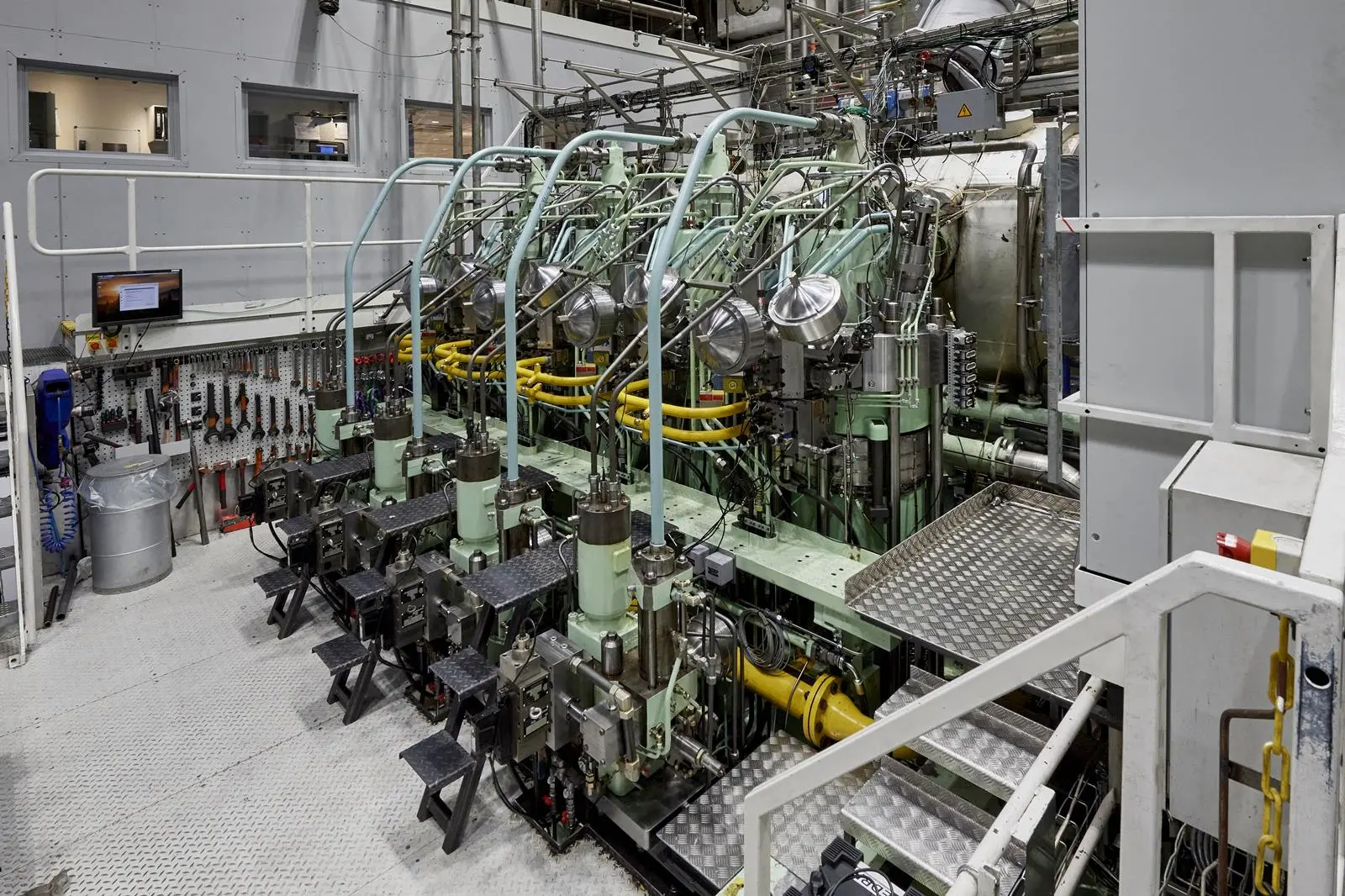
The company’s flagship ammonia engine, the 7S60ME-C10.5-LGIA, is undergoing rigorous testing at Mitsui E&S and the Research & Development Centre (RCC) in Copenhagen, where full-scale operational trials are taking place.
Challenges and breakthroughs
Ammonia presents unique combustion characteristics compared to traditional marine fuels. Computational Fluid Dynamics (CFD) simulations reveal that ammonia has a six-times lower flame speed and a significantly higher autoignition temperature than methanol. However, MAN Energy Solutions’ two-stroke slow-speed engine technology has effectively managed these challenges.
Key advancements include:
- A dual-mode operation that allows switching between ammonia and conventional fuel.
- Achieving a 5% Specific Pilot Oil Consumption (SPOC) at 100% load.
- Reduction of NOx emissions by approximately 40% compared to conventional fuel oils.
- Advanced tuning mechanisms that virtually eliminate nitrous oxide (N₂O) emissions, a potent greenhouse gas.
- A newly developed Fuel Booster Injection Valve (FBIV-A), which ensures high-pressure ammonia injection for stable combustion.
Safety in ammonia engine operations
Given ammonia’s toxicity, MAN Energy Solutions has implemented stringent safety measures. Risk assessments such as Failure Modes and Effects Analysis (FMEA) and Hazard and Operability (HAZOP) studies have been conducted to mitigate potential hazards.
Additional safety features include:
- Double-walled piping for ammonia transport.
- Ammonia catch systems designed to prevent leaks and ensure safe disposal.
- Ventilation and absorber systems to maintain controlled environments.
- Automated purging to handle emergency situations without human exposure to ammonia vapors.
Testing the market
Unlike traditional fuel engines, the ammonia-powered two-stroke engines require real-world testing before full-scale commercial deployment. MAN ES aims to secure positive seagoing experience before listing ammonia engines in its full sales catalogue. To achieve this, the company is engaging in multiple pilot projects across Korea, Japan, and China.
The first ammonia-powered vessels, including two 93,000 CBM Very Large Ammonia Carriers (VLACs) for Eastern Pacific Shipping, are expected to receive their engines by Q1 2026. Based on performance data from these trials, full-scale sales of ammonia engines such as the G50, S60, G60, G70, and G80 ME-LGIA models are tentatively expected by end of 2026.
The future of ammonia shipping
In addition to newbuilds, MAN ES is also working on retrofit solutions to convert existing ME-C engines to ammonia fuel. This approach aligns with the broader industry trend of designing ammonia-ready vessels, ensuring a seamless transition when ammonia infrastructure becomes widespread.
With over 37 patents filed in ammonia engine technology, MAN Energy Solutions is leading the charge toward a sustainable and efficient maritime industry. The company’s innovations not only pave the way for ammonia as a mainstream fuel but also set new standards for safety, efficiency, and environmental responsibility.
As the industry moves toward a carbon-neutral future, MAN ES’ ammonia-powered two-stroke engines represent a monumental shift in how the world’s shipping fleet is fuelled, marking the dawn of a new era in maritime sustainability.
Related Articles
 AMMONIA
 AMMONIA
 AMMONIA