



MAN ES completes methanol retrofit for Maersk Halifax
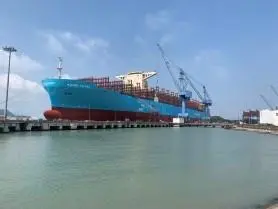
The work was carried out by MAN PrimeServ, the company’s after-sales division, and marks the first such project globally involving a Very Large Container Vessel (VLCV).
The 15,000 teu Maersk Halifax entered service in 2017, originally powered by an MAN B&W 8G95ME-C9.5 engine. The retrofit involved upgrading this to an 8G95ME-LGIM Mk10.5 unit, enabling the vessel to operate on green methanol and potentially reducing CO2 emissions by 90% compared to conventional operation.
Alongside the engine conversion, the ship’s engine-control system was updated to MAN Energy Solutions’ latest Triton system. Following successful sea trials, the vessel has resumed service on Maersk’s Trans-Pacific trade route.
Leonardo Sonzio, head of fleet management and technology at Maersk, emphasised the strategic importance of retrofits in meeting the company’s climate ambitions. “Since we set the ambitious climate goal of reaching net zero emissions by 2040, we have explored the potential in retrofitting existing vessels with dual-fuel engines. In the coming year, we will take learnings from this first conversion of a large vessel. Retrofits of existing vessels can be an important alternative to newbuilds in our transition from fossil fuels to low-emission fuels,” he said.
The Halifax retrofit is expected to serve as a model for future conversions. Maersk has already pre-ordered additional retrofits for 10 vessels from its fleet to enable operation on methanol.
Michael Petersen, senior vice president and head of PrimeServ Denmark, highlighted the importance of the project for MAN Energy Solutions’ broader decarbonisation strategy. “Retrofits are one of the five growth areas identified in MAN Energy Solutions’ ‘Moving Big Things To Zero’ strategy, enabling shipowners to drastically reduce CO2 emissions without having to commission newbuilds. Retrofitted engines can switch between fuels with minimal disruption, flexibility that is crucial for maintaining operational efficiency and reliability. At PrimeServ, we estimate that more than 4,000 existing marine engines have the potential to be converted to operation on green fuels like e-methanol and e-methane.”
Sarath Prasannan, senior vice president and Head of Region Asia Pacific, also underscored the significance of the project during a recent event at Asia Pacific Dockyard in Zhoushan to commemorate its completion. “This groundbreaking project marks a pivotal moment in the shipping industry’s journey towards decarbonisation. We hope that China’s policies and infrastructure will continue to foster an environment where shipyards can carry forward this commendable work,” he stated.
Related Articles
 ALTERNATIVE FUELS & LUBRICANTS
 ALTERNATIVE FUELS & LUBRICANTS
 ALTERNATIVE FUELS & LUBRICANTS