



MAN ES discusses the future of fuels during an update on its new methanol engine
MAN ES’s head of sales and promotion Thomas Hansen led the talk dubbed “Set your course to net zero”, starting with a recap of his company’s role in decarbonising the sector including the fact it has sold 200 2-stroke methanol engines during the last three years. These have been used on all ship types including bulkers, container vessels, PCTCs and tankers.
However, similar to other players in the market, Hansen seems fuel agnostic stating: “Whatever the market demand in the future, we will make that engine, of course.”
The reason for this flexibility over fuel choice is one of the standout points from the discussion with Hansen stating that while his company has secured orders for the company’s methanol fuelled engines up to now, he believes ammonia may have a bigger role to play going forward.
“Ammonia has the potential of being the defining fuel, setting the market price of fuel in the future and the other fuels will have to adapt to that, but I think they will do because it’s a free market, and the different fuel makers will compete with each other,” said Hansen, adding that shipowners have been somewhat cautious with ammonia, presumably due to the potential toxicity of the fuel.
Depending on how methanol is produced, the results range from a grey to green end product which has risen to the fore with regulators adopting a well to wake approach for emissions ratings. Hansen referred to a chart that incorporated regulatory stipulations with the current trajectory of fuel choices. He noted that for shipowners using bio-methanol, they won’t be able to reduce their carbon footprint to zero by 2050 as required by the Paris Accord and similar environmental policies although with e-methanol this target is achievable.
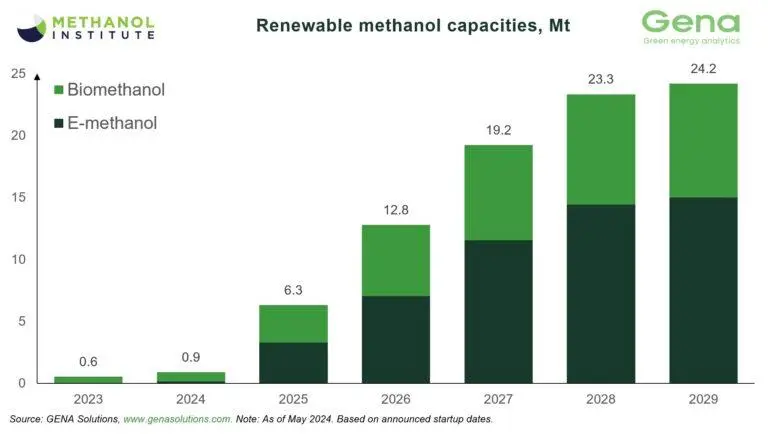
The availability of fuel types will obviously have a big part to play in what fuel mix will be available in years to come. Using data from the Methanol institute and Finland’s GENA Solutions (see graph), he showed that by 2027 there will be a total of 19.2 tonnes of methanol available for all sectors. If ships are using the fuel in a duel-engine configuration, Hansen said that most won’t run 100% on methanol as there’s no clear incentive per regulations, with shipowners perhaps opting for ranges between 20-80% depending on the rest of their fleet.
“There will be a business opportunity, [so] there will be a supply,” said Hansen.
Although there are some doubts regarding the shipping sector’s ability to hit the green aims set out by regulators, Hansen said: ”It would take a small revolution, a disruptive behaviour, in order to reach this goal but it’s not impossible, and at least we have to try.”
Related Articles
 METHANOL
 METHANOL
 2-STROKE & 4-STROKE