



MAN ES To Launch 2nd Ammonia Engine Bore Size
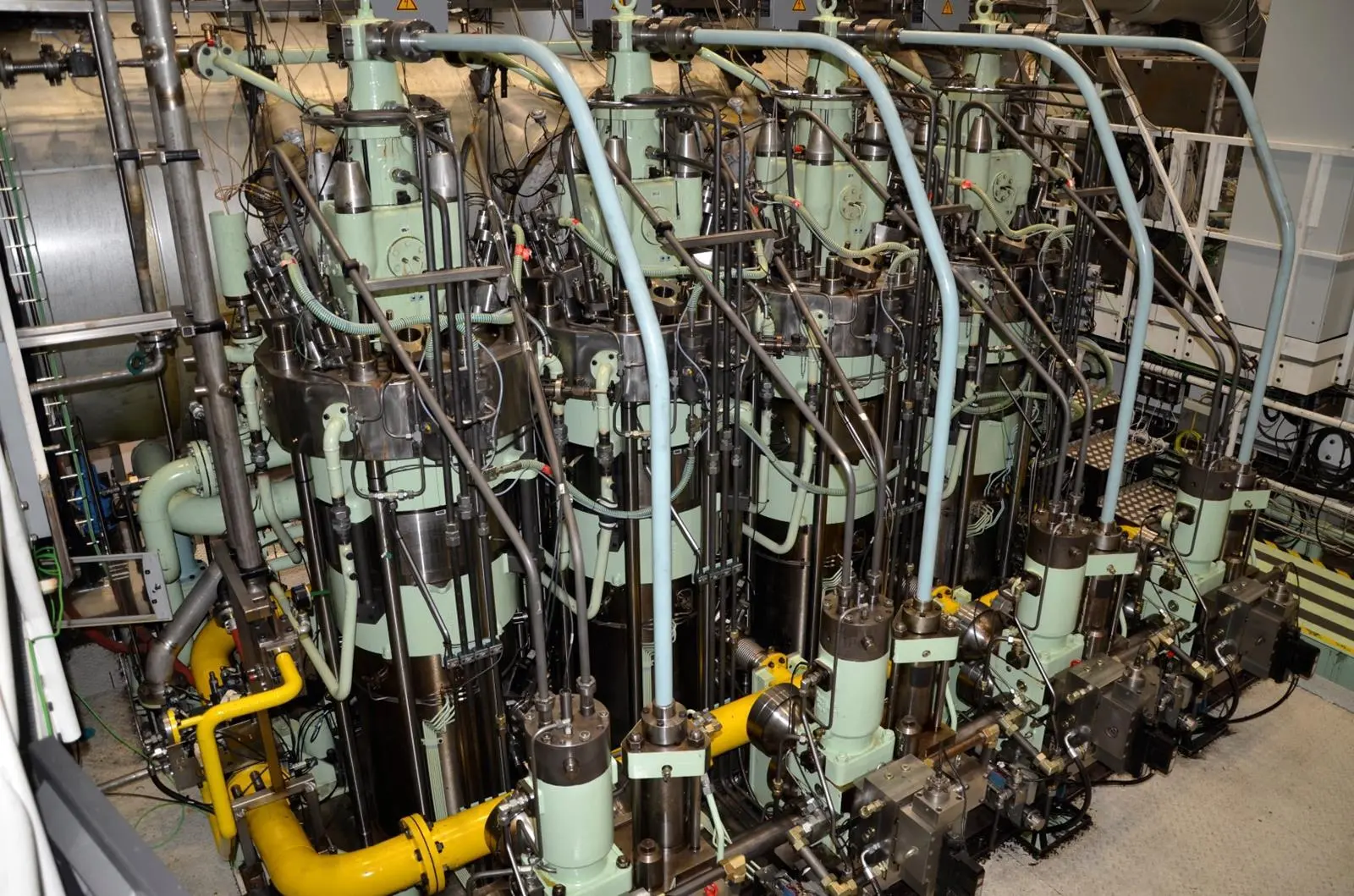
The comnfirmation of the introduction of a 60-bore variant mean that MAN ES would be able to cover the entire layout points for ship designers to include an ammonia engine in very large gas carriers (VLGC), pure car and truck carriers (PCTC), container feeders, Panamax and Newcastlemax bulkers and LR1 and LR2 tankers.
“It will allow a wide range of ship segments to start pioneering ammonia as a fuel for shipping,” Thomas Hansen, Head of Promotion of 2-stroke engines at MAN Energy Solutions told a customer presentation attended by The Motorship in June.
The announcement that the company was planning to launch a second engine size was made by Peter Kirkeby, Business Development and Promotion Manager for Dual-fuel engines at MAN ES 2-stroke.
The decision about the additional ammonia engine bore size will be taken in response to customer demand, Kirkeby said, adding that MAN had seen customer interest in using ammonia as a fuel across a range of vessel types.
Mitsui E&S parallel testing
Kirkeby revealed that the company had signed a cooperation agreement with MAN ES licensee Mitsui E&S, which will make its test engine available for parallel testing. The full engine tests of the dual-fuel ammonia-burning engine are scheduled to take place in 2024.
As a result, MAN ES expects to carry simultaneous full scale engine testing conducted at MAN ES’ four cylinder 50-bore Test Engine 1 at Research Centre Copenhagen (RCC) and on Mitsui’s 7S60ME-C test engine in Japan from 2024.
To support the conversion of Test Engine 1 into an ammonia-fuelled engine configuration, Kirkeby noted that Test Engine 2 at RCC would be rebuilt to support the testing of MAN ES’ ME-GA engine, its new low-pressure, low-speed Otto Cycle dual-fuel engine. This conversion was expected to be completed by Q3 2022.
1st engine confirmation test
Before full-scale engine testing can begin, MAN plans to conduct a first single-cylinder engine test in Copenhagen. The test is expected to be carried out “in the next few months.”
While MAN has not yet fully completed the ammonia fuel supply and auxiliary system development work, as well as safety concept definitions and specifications, it expects the first confirmation test to answer a lot of questions.
Kirkeby noted that the engine test in itself would be a milestone achievement, as it represents “the first ammonia burning test on a large-bore two stroke engine”. The combustion of ammonia in a diesel cycle two-stroke low-speed engine is likely to be different from previous test results, which were conducted on four-stroke engines.
The test would confirm the engine concept, and permit improvement of the safety concepts, verify the pilot fuel ignition concept and also offer guidance about the engine efficiency.
Environmental emissions
While the engine’s expected output and efficiency is likely to be refined during the engine tests, MAN ES has previously told The Motorship that new engine products would only be launched if they were commercially viable. Kirkeby confirmed that the new engine was expected to exceed 50% efficiency after initial tests.
A similar process of product refinement was likely with regard to the pilot fuel percentage. The engine was expected to require around 5% pilot fuel. Substituting fuel oil with biodiesel was likely to improve the emissions footprint.
The pilot fuel proportion represents key parameter in the design of the engine’s injection system, as the engine designers seek to ensure compliance with Marpol Annex 6, while ensuring Tier II and III NOx standards are met.
Peter Kirkeby did share details about MAN ES’ emissions reduction strategy with regard to nitrous oxide, which The Motorship has previously identified as a potential obstacle to the introduction of the technology.
Kirkeby noted that MAN ES was focusing on combustion tuning to prevent the formation of nitrous oxide in the first place.
“This means that you either prevent the formation of nitrous oxide in the engine tuning by avoiding certain temperature pressure windows, or we make sure we get into temperature pressure windows where the N2O is decomposed before the exhaust valve opens.”
MAN ES is also investigating the development of an aftertreatment solution, although Kirkeby notes that “adding more systems and more complexity to the engine installation is never really favourable in a commercial environment”.
The Motorship has previously noted that one of the challenges for two-stroke engine designers is that existing commercial ammonia N2O abatement solutions require higher temperatures in the treatment of offgases than exist after two-stroke temperatures.
Related Articles
 2-STROKE & 4-STROKE
 2-STROKE & 4-STROKE
 2-STROKE & 4-STROKE