



MAN offers emulsification for ME-LGIM customers
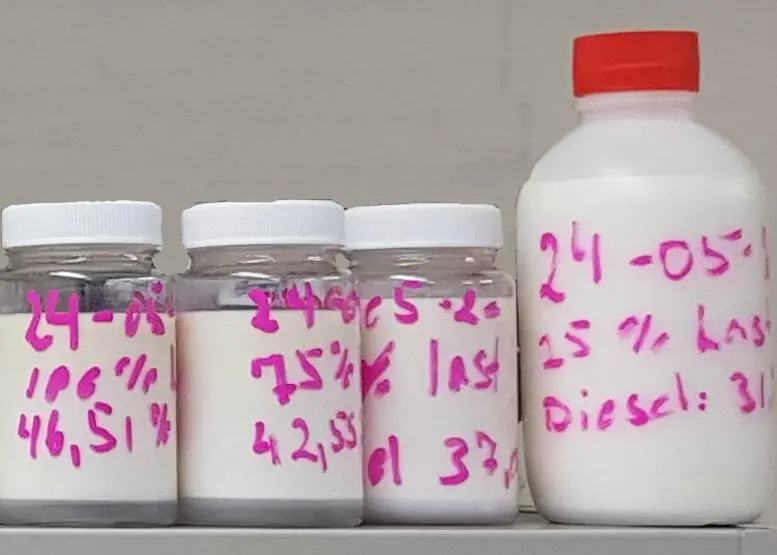
Development work on the solution is currently continuing, the company confirms. MAN plans to undertake sea trials on the ME-LGI methanol + water (ME-LGIM-W) engine aboard a vessel fitted with an ME-LGIM engine at the beginning of 2020.
The company confirms that it has received an uptick in customer enquiries from customers with ME-LGIM propelled vessels ahead of the introduction of NOx emission control zones in the Baltic Sea and North Sea areas in 2021.
Tier III NOx limits will be applied to vessels plying the new Baltic Sea and North Sea emission control areas (ECAs) for vessels with keels laid after 1 January 2021.
Emulsification solution
The development of the ME-LGIM-W solution follows the successful reduction of NOx emissions from a two stroke ME-LGIM diesel engine below Tier-III levels in 2018, during trials conducted on its test engine in Copenhagen and Mitsui’s engine in Japan.
MAN had been carrying out research into water injection and emulsion fuels as lower cost alternatives to existing NOx abatement technologies, such as SCR and EGR, for some years.
Stefan Mayer, Head of Engine Process Research, Process Development, R&D Two Stroke at MAN Energy Solutions told The Motorship “One of the challenges with using water-fuel blends is that water-fuel mixtures exhibit weaker ignitability. Other challenges include prolonged ignition delay, the risk of knocking and the even the possibility of complete misfiring.”
The ME-LGI platform, with its pilot injection concept, is able to handle fuels below the limit of auto-ignitability, such as methanol, which has an auto-ignition temperature of 470 degrees Celsius.
The successful tests were carried out using a homogenous methanol/water mixture, and subsequently by using emulsified diesel fuel at a single cylinder test engine in Copenhagen, as well as on a multi-cylinder test engine at Mitsui’s Tamano research centre.
The tests successfully combusted water and fuel mixtures of up to 1.7:1 water to methanol, or 5:1 for water and fuel. For the four-cylinder tests, NOx emissions of below 3.4g/kWh, the limit for Tier III compliance were observed.
Results of tests
The fuel penalty for using emulsified methanol was just 2-6g/kWh, and the company believes that the SFOC could be improved further during subsequent development work. The key to the solution was for the LGIM-W engine to make use of higher in-cylinder pressures to increase efficiency, and then use the emulsified fuel mixture to lower the emissions below the Tier III thresholds.
The proportion of water that needed to be added to the methanol to bring the engine below Tier III limits was limited: only 20-40% water is needed to be added to methanol for the mixture to reach Tier III, depending on the engine load. The rather low water addition is due to the colder methanol flame, relative to diesel, that gives a 30% reduction in NOx emissions, even without adding water.
As a result, the water tank required is smaller while the absence of miscibility issues between methanol and water did not require the addition of a surfactant, which was an additional cost in the diesel-water prototype.
The GHG emission reduction benefits of the solution extended beyond NOx emissions. Lower emissions of soot and carbon monoxide were also achieved.
System modifications
The technical modifications required to introduce emulsification into LGIM engines are rather limited. The existing cylinder head, fuel block and fuel delivery systems do not require significant modification, although the injector nozzles need to be modified to increase the fuel mixture flow without extending the length of the injection.
The limited increase in emulsified methanol mixture volumes also means that the changes to the LGIM layout are relatively limited, both in terms of compression volumes, and for turbocharger matching.
MAN expects that the smaller footprint of the LGIM-W system is expected to be an additional advantage compared with SCR solutions, while operational costs are also likely to be competitive with EGR systems.
The operational costs of running such a system are likely to be lower than an SCR system, and competitive with EGR systems for methanol/water mixtures, which unlike diesel/water mixtures do not require emulsifiers.
Related Articles
 ALTERNATIVE FUELS & LUBRICANTS
 ALTERNATIVE FUELS & LUBRICANTS
 ALTERNATIVE FUELS & LUBRICANTS