



MAN readies for pilot testing of its first ammonia engine
Imabari Shipbuilding has announced it will install an MAN B&W 7S60ME-A engine with SCR on a 200,000dwt class bulk carrier for a joint venture between K Line, NS United, and Itochu Corporation. The business represents one of the first projects for MAN’s ammonia-powered engine which is currently under development at MAN’s Research Centre Copenhagen.
MITSUI E&S will build the engine in Japan, and it is expected to be installed at the shipyard early next year. The vessel is expected to be operational in H1 2026.
This first 60-bore engine is suitable for a broad range of vessels including bulk carriers, feeder container, PCTCs and product tankers. Other bore sizes will follow, each introduced in separate pilot projects. The engine is expected to be formally introduced to MAN’s marine engine program as soon as positive sea going experience is achieved. Thereafter it is expected to have fast uptake of ammonia-fuelled engines towards the end of the decade, says MAN promotion manager Hrishikesh Chatterjee.
MAN expects that 2030 will be the year that ammonia will become one of the most preferred fuel types for maritime shipping in newbuilding projects. Blend in Blue ammonia can be used until around 2045 to meet international regulations, but e-fuels are the only fuels that are truly scalable and can be used to comply with emissions regulations from 2045 onwards, says Chatterjee. MAN expects ammonia to comprise around 35% of fuel used onboard large merchant vessels by 2050 due to its carbon free composition and its lower production cost compared to other e-fuels. Methanol is expected to account for 26% and LNG 16%.
Chatterjee expects many shipowners to combine their ammonia engine with PTO as a way of further reducing fuel costs and emissions. “It may not make sense to have biofuel as a pilot oil for the 2-stroke and also use it also for conventional gensets to produce electricity when the you can use the PTO from the main engine at sea.”
Diesel Cycle
MAN already has over 1,400 dual-fuel engines ordered, and around 40% are already operational. The Diesel cycle liquefied gas injection (LGI) ammonia engine looks and performs like the company’s other Methanol and LPG dual-fuel engines, says Chatterjee. This is despite ammonia having a lower calorific value of 18.6MJ/kg, an auto-ignition temperature of 649 degrees Celsius and a laminar flame speed of 7 cm/s. The auto-ignition temperature is higher than MGO’s 260 degrees Celsius and the flame speed much lower than MGO’s 80 cm/s.
Compared to methanol, ammonia’s flame speed is six times lower, and its auto-ignition temperature is 33% higher. “Two stroke slow speed diesel cycle engines however manages these properties very well,” says Chatterjee.
While initially it was envisaged that an Otto Cycle engine could be considered, Chatterjee says this is not the case, at least for now. “Diesel cycle is the most robust and has the best efficiency. It also gives us a lot of control over the combustion characteristics, because ammonia is difficult to burn – at least that was our fear in the beginning, that it would take a lot of effort and energy to break the chemical bonds and release the energy. But the more we tested, the more confident we were that Diesel was the right direction to take.”
MAN is targeting performance levels identical to a conventionally fuelled diesel engine in both ammonia and fuel oil mode. Past research work on other dual-fuel engines has played a strong role in the success achieved to date. Ammonia combustion is displaying good stability behaviour and acts like hydrocarbon fuels: compression and expansion curves are robust, and mean statistical analysis indicates very good combustion stability on a cycle-to-cycle pressure variation.
Engine testing has included the propeller curve and both light and heavy running points for each given load. A PTO effect has been simulated and tested, and the tests also include operational screening. Combustion has been confirmed to be stable on all test points.
Emissions abatement
For the Diesel cycle ammonia engine, N2O emissions can be handled with engine tuning. However, a high-pressure SCR will be included to control ammonia slip and NOx emissions to ensure Tier III performance when required. The ammonia in the exhaust gas will be used to augment the urea required for the SCR.
MAN’s in-house SCR design for initial 7S60-ammonia engine at Mitsui engine builder in Japan features a double-layered, honeycomb reactor making it a metre longer than a standard SCR. Like the standard SCR, control systems are integrated into the overall engine-control system and adapted to the fuel-injection system and turbocharger, enhancing the efficiency and reliability of the entire system.
Pilot fuel
The test engine has demonstrated operation with low pilot fuel amounts on a single cylinder, and the aim is to have it at 5% energy fraction at 100% engine load. This will be tested during full-scale testing with four cylinders, and Chatterjee is confident it will be achieved. “We have proven that to complete its combustion on each cycle once ignited with the pilot flame, co-firing is not required, because the 2-stroke combustion chamber is so optimised and so efficient with high peak pressures and temperatures that from around 10% load, the ammonia combustion can be started.”
Injector developments
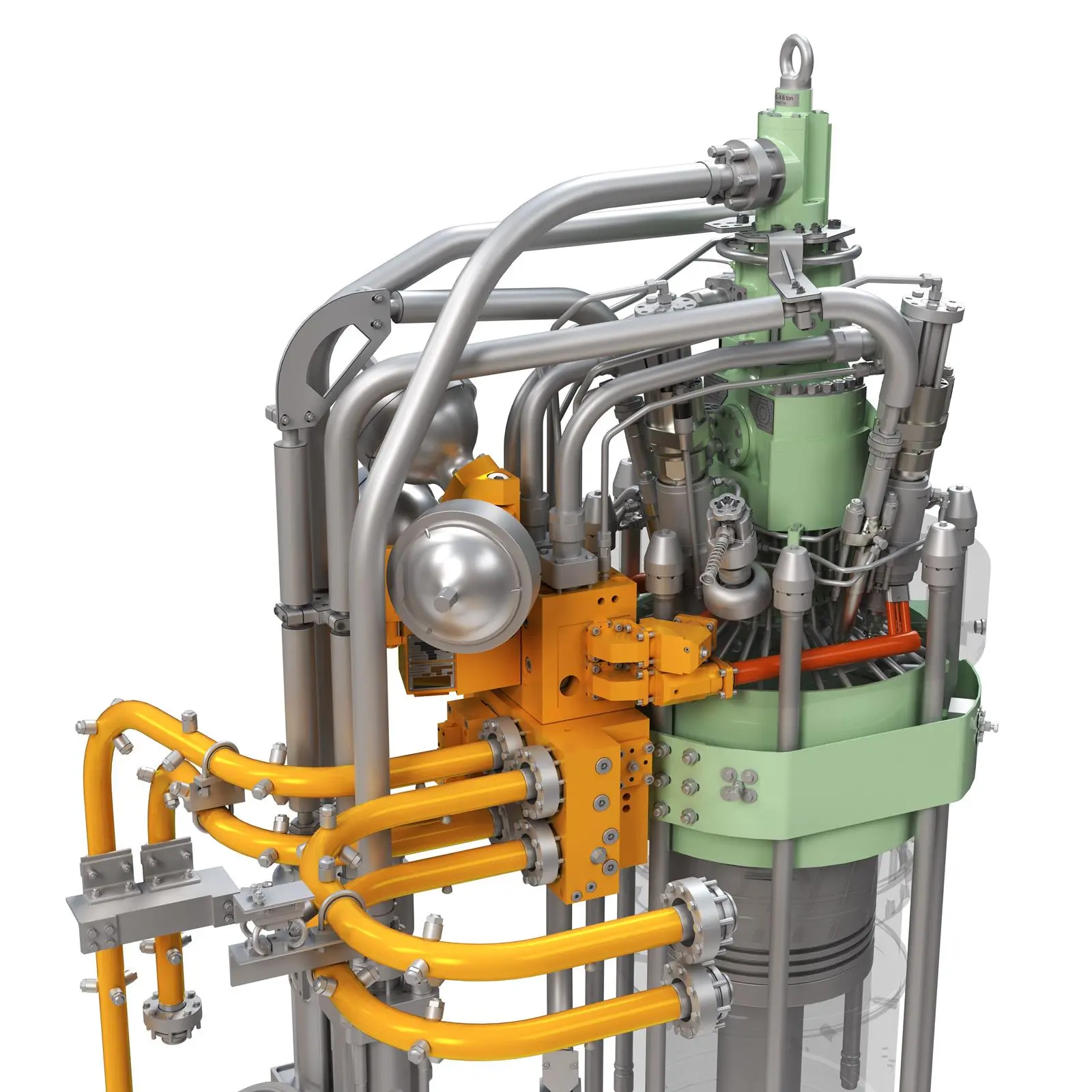
Injector development will be on-going. The basic design concept is similar to MAN’s methanol and LPG fuelled engines with high pressure hydraulic oil acting on top of a piston to increase ammonia pressure. Ammonia is supplied via lance in the cylinder cover and sleeve to the injector.
“Diesel cycle combustion is so efficient that it basically burns everything in the chamber. Slip can occur when the ammonia in the SAC volume of the injector remains at the end of combustion cycle. SAC volume can be reduced to reduce this, but we have to find the right balance between slip and efficiency,” says Chatterjee.
More ammonia is required to be injected than diesel or methanol, so either the pipe dimensions or the injector dimensions can be increased, but the fuel is still injected from a very small hole. There is also the need to mitigate material stress from the cyclic hot and cold temperature variations that the injector experiences. Here, experience with MAN’s methanol and LPG engine development has informed research and development.
The ammonia will be maintained at up to 45 degrees Celsius and pressurised to 83 bar before it is increased to around 650 bar for injection. This supply pressure ensures that the ammonia remains a liquid, but on-going research may see the pressure or temperature dropped to reduce the cost of the fuel gas supply system.
In January 2024, MAN Cryo announced that its design for an ammonia fuel supply system has been awarded an Approval in Principle from classification societies DNV and Bureau Veritas. MAN Cryo developed the system in cooperation with Chinese company Yada Green Energy Solutions with whom the company has previously cooperated to provide equipment for LNG and methanol marine fuels.
Lubricant requirements
MAN’s May 2020 Service Letter SL2020-694 defined a new category of higher performance cylinder oils (Cat II) for MAN B&W Mark 9 engines and subsequent generations that set a special focus on piston cleaning ability. Cat II BN 40 lubricants will meet the requirements for the new ammonia dual-fuel engine, says Chatterjee, so it shouldn’t create any complication.
So far engine oil also remains the same as MAN’s other dual-fuel engines, but the sealing oil that creates a barrier between the ammonia and the hydraulic oil is still being monitored in testing. “We have not seen any challenges there so far,” says Chatterjee.
On-going development
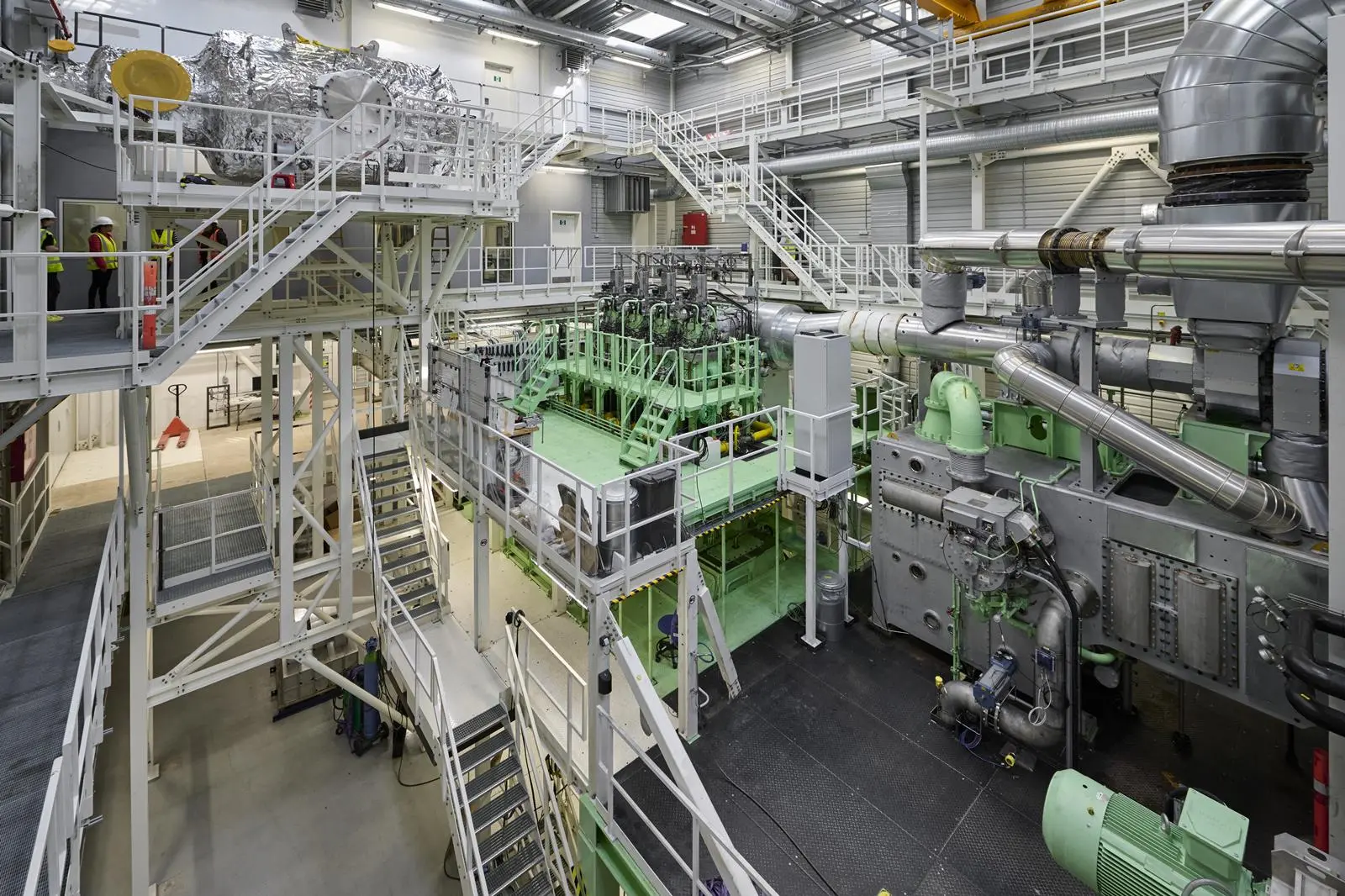
MAN has now completed over 100,000 person hours of development work on the ammonia engine, with 37 patent applications filed, four more on the way, and six already granted. More than 4,000 of the development hours have been spent on failure modes and effects analysis (FMEA), HAZID, and HAZOP studies. “The level of safety measures required for ammonia engine and auxiliary systems are unlike anything we have ever worked with before,” says Chatterjee. These measures include double wall ventilation, an ammonia catcher designed to only release vapours of ammonia up to 5 ppm and nitrogen purging at the research centre in Copenhagen.
Development work will continue, with the operational experience of the various pilot projects feeding back into further enhancement of the engine and its supporting systems. For now, though, Chatterjee is dealing with a flurry of excitement and interest from shipowners wanting to lead the way with ammonia. It’s not too soon, he says, even for fence-sitters to consider how ammonia might help them meet the IMO’s challenging decarbonisation goals.
Related Articles
 AMMONIA
 AMMONIA
 AMMONIA