



MAN’s 95-bore LGIM engine ready for Maersk newbuildings
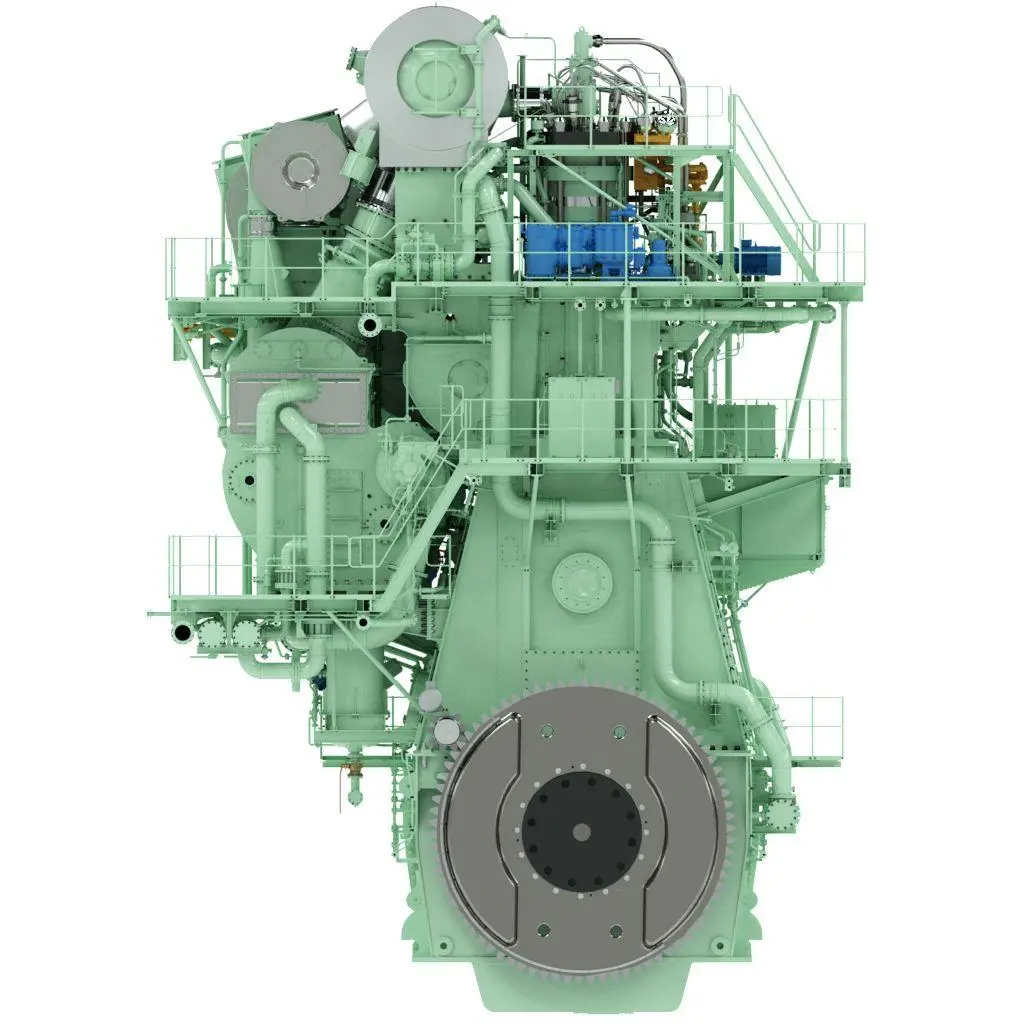
Maersk’s string of methanol-fuelled newbuilding orders has seen the demand for methanol engines skyrocket, and MAN introduced a 95-bore version of its LGIM engine, after the initial 50-bore engine, to cater for the larger vessels being ordered. Maersk has now ordered 19 vessels with the ME-LGIM engines design, the first being a 2,100 TEU container feeder to run on methanol using a G50ME-C9.6-LGIM engine.
Methanol engine technology for the smaller 50-bore LGIM engines has been in operation since 2016, and there are now more than 20 of these engines in service Maersk’s initial order for the feeder vessel was followed by 16,000 and 17,000 TEU vessel orders requiring a larger bore engine.
Development of the G95ME-LGIM required more than just scaling. Differences in injection pattern and engine component sizes were required to ensure high efficiency, adequate power and Tier III NOx compliance in both methanol and fuel oil modes. This engine requires injection of methanol of 1.8m3/hour per cylinder which is about twice that required for diesel mode due to its lower calorific value. This required increased supply of high-pressure hydraulic oil and a power supply that was approximately 66% higher than the 50-bore engine. This in turn required an upgraded chain drive delivering the power, and the design had to allow for engine vibration.
The new 95-bore LGIM engine has similar combustion chamber components to the G95ME-C10.5 standard design except that the injection system includes a hydraulic power supply, control block for liquid gas injection, diesel fuel injection valve and fuel booster injection valves for methanol. The control block includes high-speed analogue control valves for regulation the methanol injection pattern and timing. The cylinder cover is also similar to the G95ME-C10.5 except that there are channels and holes for the extra valves.
Specific fuel oil consumption (SFOC) is optimized. This was possible because methanol’s lower flame temperature means intrinsically lower NOx production in the jet flame – NOx emissions are approximately 30% lower on MAN’s two-stroke B&W engine when compared to fuel oil under the same engine performance adjustments. The late cycle heat release attained for methanol also increased thermodynamic efficiency with respect to engine load.
Methanol use also results in lower exhaust gas temperatures, although this is countered by increased mass flow and the increased specific heat capacity of the exhaust gas. Therefore, turbocharger speed remains very similar to that required for diesel. The same matching can be used without compromising cylinder boundary conditions such as scavenge air pressure and temperature.
CO2 exhaust emissions are around 10% less for methanol than fossil fuel oil. Particulate matter and SOx are also reduced significantly
According to MSC.1/Circ.1621, the interim guidelines for the safety of ships using methyl/ethyl alcohol, methanol must always be handled using the double-barrier principle. The fuel pipe system is therefore double-walled and similar in concept to that used for all MAN dual-fuel engines. The design ensures that methanol cannot escape directly to the engine room and that potential leakages are detected within the double wall piping system.
Any equipment used to prepare the methanol before injection must be placed outside the engine room, and fuel tanks must have cofferdams towards the engine room and cargo spaces. High capacity ventilation, gas and leak detection systems are required anywhere where there is a risk of methanol leaking, and firefighting systems must be capable of handling methanol fires.
However, MAN says that these requirements stem from safety assessments of LNG, and some need reconsideration. Liquid methanol is supplied to the engine at 13 bar, and a leak would slowly evaporate. Even a very large leak and pool of methanol would not be detected by the systems called for in the guidance – gas detection at 20% of the lower explosion level of methanol or 10,000ppm. Detection levels were therefore reduced.
Having overcome the design challenges, MAN now has over 50 orders for the G95ME-C10.5-LGIM. Maersk is increasing its commitment, and in June, it signed a contract with MAN PrimeServ for the retrofit of the main engines aboard 11 container vessels equipped with MAN B&W 8G95ME-C9.5 prime movers. They will be retrofitted to dual-fuel MAN B&W 8G95ME-LGIM10.5 engines. The first vessel will be retrofitted in mid-2024.
Related Articles
 2-STROKE & 4-STROKE
 2-STROKE & 4-STROKE
 2-STROKE & 4-STROKE