



Massterly explores shipping’s automated future
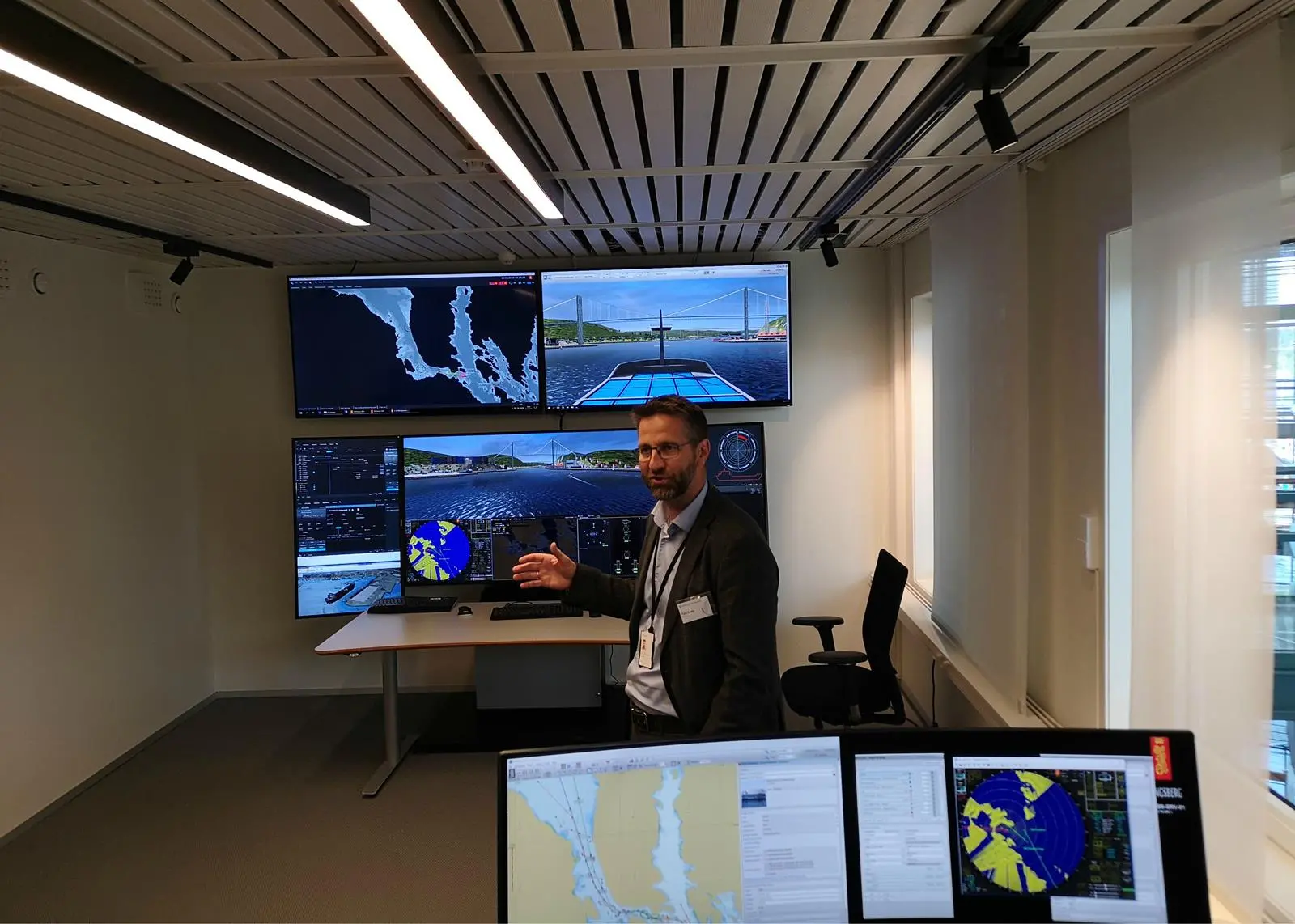
“The simulated area on screen shows the environment that the Yara Birkeland will be sailing in,” Massterly CEO Tom Eystø told The Motorship. “The beauty of this is that this simulation will become the digital twin when the real vessel sets sail.
“Yara Birkeland is to be a fully autonomous ship, although it will sail with a skeleton crew for the first two years. Every function you have on board will be available from the control centre.”
The vessel will be equipped with cameras and a live-stream linked to the control centre, as well as low-light and infrared camera equipment for sailing at night. All conventional readouts, such as radar and ECDIS are also provided.
While the politics of autonomous vessels still has not been adequately explored, WSM Head of HSEQ Erik Lyngnes indicates, tentative consensus is beginning to emerge, at least on a domestic Norwegian level. “We needed to limit our focus to a domestic setting initially,” he explained. “At the moment, we are not sure if we need a Document of Compliance for autonomous ships. It is a type of operation rather than a type of ship. We think we can run these ships under existing DOCs with some kind of additional permit or license.
“From a short term perspective we see autonomy being a mode of operation rather than a type of vessel, meaning that a new type of DOC would not be required.”
Eystø lays out WSM’s vision for its command centres and fleet control capabilities. “There will be two of these stations per ship, but also a supervisor,” he says. “There have been various studies done on this, and we estimate that one operator can handle 6 or 7 ships, possible as many as 10.
“If you were to have two vessels berthing at the same time and wanted to be on top of it, you might divide these ships between the two operators. If you have three, maybe you would delay one.”
The availability of human control is supplemented with a range of ‘fall-back positions’, which are undertaken by the vessel itself without any requirement for shoreside intervention. “The vessel is not dependent on interfacing with shore; some projects entail direct remote-control, but we are not pursuing that approach,” Eystø explains. “Our role would be in terms of exception-handling.”
These responses include continuing as-is; triggering the dynamic positioning system to allow for emergency manoeuvring; going to ‘safe-harbour’, a series of pre-defined positions along the vessel’s route; or, it can drop anchor and come to a stop until an operator is available to take command.
In the intervening stage, there are various options for partial shoreside involvement; Eystø suggests that shoreside personnel could take over a night shift from an otherwise crewed vessel, or deal with engineering alarms. He anticipates that with greater levels of automation the role of ship operators will change, becoming more long-term and ultimately realising greater operational benefits. “They will have tasks related to daily management, of course; but we see much more of an emphasis on cargo and voyage planning,” he says.
Related Articles
 ENERGY SAVING DEVICES
 LNG
LNG
 ALTERNATIVE FUELS & LUBRICANTS