



Methanol at a glance

Beyond its central role in the chemical industry, methanol is also an energy carrier used in shipping, road transport, and power generation and it’s rapidly emerging as a renewable fuel option. Airlines are now also actively exploring methanol-to-jet pathways, adding to its growing cross-sector appeal.
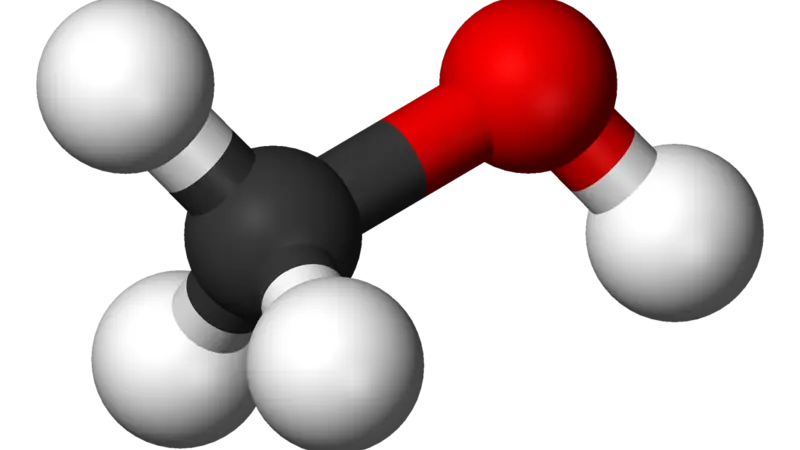
Chemically, methanol (CH₃OH) is the simplest alcohol, made up of four hydrogen atoms, one carbon atom, and one oxygen atom. It’s water-soluble, biodegradable, and clean-burning; qualities that make it increasingly attractive for decarbonizing hard-to-abate sectors.
Key physical properties of methanol:
- Liquid at ambient temperature and pressure
- Density: 0.7918 g/cm³
- Melting point: –97 °C
- Boiling point: 64.7 °C
- Flash point: 11 °C
- Stored at atmospheric pressure (non-cryogenic)
Being a liquid at room temperature means methanol is far easier and less costly to store, transport, and handle compared to fuels that require extreme cooling or high pressures. In many cases, ports can adapt existing tanks, pipelines, and bunkering systems instead of building entirely new infrastructure.
A brief history of methanol
Methanol has been known for centuries. The ancient Egyptians unknowingly used it in embalming, producing it by heating wood without oxygen. In 1661, scientist Robert Boyle distilled it from boxwood and called it “spirit of box.”
The modern methanol industry began in 1923, when BASF chemist Matthias Pier developed a method to synthesize methanol from synthesis gas (carbon oxides plus hydrogen). Early production required extremely high temperatures and pressures, but modern catalysts have made methanol production far more efficient and scalable.
Methanol gained fresh attention during the 1970s oil crises for its availability, low cost, and potential as a transport fuel. Today, it remains a vital building block for the chemical industry and is becoming a serious contender in the global clean energy transition.
Perspectives on methanol: today and tomorrow
Most methanol today is made from natural gas, but it can also be produced via renewable and low-carbon pathways, giving it a clear route to deep decarbonization.
Low-carbon and renewable production pathways:
- Low-carbon methanol (blue methanol): Produced from natural gas with carbon capture to reduce lifecycle emissions—an important transition step to scale clean supply.
- E-methanol (green methanol): Made from captured CO₂ (biogenic or direct air capture) and green hydrogen produced with renewable electricity.
- Biomethanol (green methanol): Made from biomass-based feedstocks such as forestry and agricultural residues, biogas from landfills, sewage, municipal solid waste (MSW), and black liquor from paper production.
Over 240 renewable and low-carbon methanol projects are currently in development worldwide (July 2025), tracked in real time through a global project database developed by the Methanol Institute and Gena Solutions. We expect commercial volumes to start ramping up by 2027–2028, with significant growth toward 2030.
Methanol’s chemistry also allows blending of renewable, low-carbon, and conventional methanol, enabling greenhouse gas reductions now while scaling green supply, and avoiding costly fossil lock-in under measures like FuelEU Maritime after 2030.
Methanol in maritime
The shipping industry’s methanol journey began in 2015, when the Stena Germanica became the first commercial vessel converted to run on methanol, using Wärtsilä 4-stroke engines. A year later, the first methanol 2-stroke engines completed successful sea trials.
Until 2022, methanol-fueled ships were rare; only 21 had been ordered. That changed when Maersk placed a landmark order for methanol-powered container vessels, sparking rapid interest across shipping segments.
Today:
- 409 methanol-propelled vessels are on order
- 710 methanol-powered auxiliary (gen-set) engines are also on order
- 100+ retrofit projects are underway to convert existing ships to dual-fuel (methanol-ready) engines
- Bunkering is already available in over 16 ports worldwide, with at least 24 more actively preparing to offer it
Why methanol for shipping?
- Non-cryogenic and stored at atmospheric pressure
- Liquid at room temperature, simplifying tank design and onboard fuel systems
- Compatible with existing port and bunkering infrastructure
- Tanks can be made from standard coated steel or dedicated alloys
- Nitrogen blanketing enhances safety for this low-flash-point fuel
- Established handling procedures make HAZID/HAZOP investigations straightforward
- Significantly lower system costs compared to cryogenic fuels (e.g., LNG, ammonia, hydrogen)
- Strong safety record in marine use since 2015
- Low environmental impact in case of spills as methanol is readily biodegradable and disperses quickly
In summary
Methanol is a proven, versatile chemical and fuel that supports decarbonization across multiple sectors. Its simple storage and handling, global availability, expanding bunkering network, and scalable renewable production pathways position it as one of the most practical solutions for the energy transition, especially for shipping, one of the hardest sectors to decarbonize.
Read more about the Propulsion and Future Fuels event featured in the image here.
Related Articles
 METHANOL
 METHANOL
 2-STROKE & 4-STROKE