



Modelling of methanol combustion confirms performance tradeoffs
Operational experience for how to control NOx emissions when burning a high proportion of methanol fuel in four-stroke dual-fuel methanol engines is currently limited. To address this knowledge gap, researchers from the University of Strathclyde have modelled the combustion of fuel containing up to 90% methanol (10% diesel fuel) to identify how combustion efficiency can be optimised without leading to excessive NOx emissions.
Drs Panagiotis Karvounis and Gerasimos Theotokatos undertook the research in response to the increased need for technologies that have lower environmental impact. “There is a wide discussion regarding the various alternative fuel options, and we needed to discuss the options for the engine of the future,” said Dr Karvounis.
Methanol has a higher molar expansion and therefore in-cylinder pressure increase potential, than diesel. It also has a high octane number, low cetane number, and high laminar flame velocity which means it is not well suited to compression ignition. It’s lower in-cylinder reactivity leads to reduced maximum in-cylinder temperature and pressure which can cause misfiring at low and medium loads with high diesel substitution rates. Conversely, at high loads, the increased laminar flame speed can lead to extensive knocking and impacts NOx formation and overall brake thermal efficiency.
The researchers developed CFD models which were validated against experimental data for diesel and dual-fuel operation to identify injection settings that maximised thermal efficiency whilst maintaining stable combustion and reduced NOx emissions.
They varied fuel injection method and timing, compression ratio and after-treatment conditions on a Wärtsilä 9L46C with a power output of 10,500kW. After initially determining that direct injection offered greater thermal efficiency than pre-mixed port injection, the researchers set out to determine the optimal injection settings for both methanol and diesel that would optimise thermal efficiency and minimise NOx emissions across a range of engine loads.
Good timing
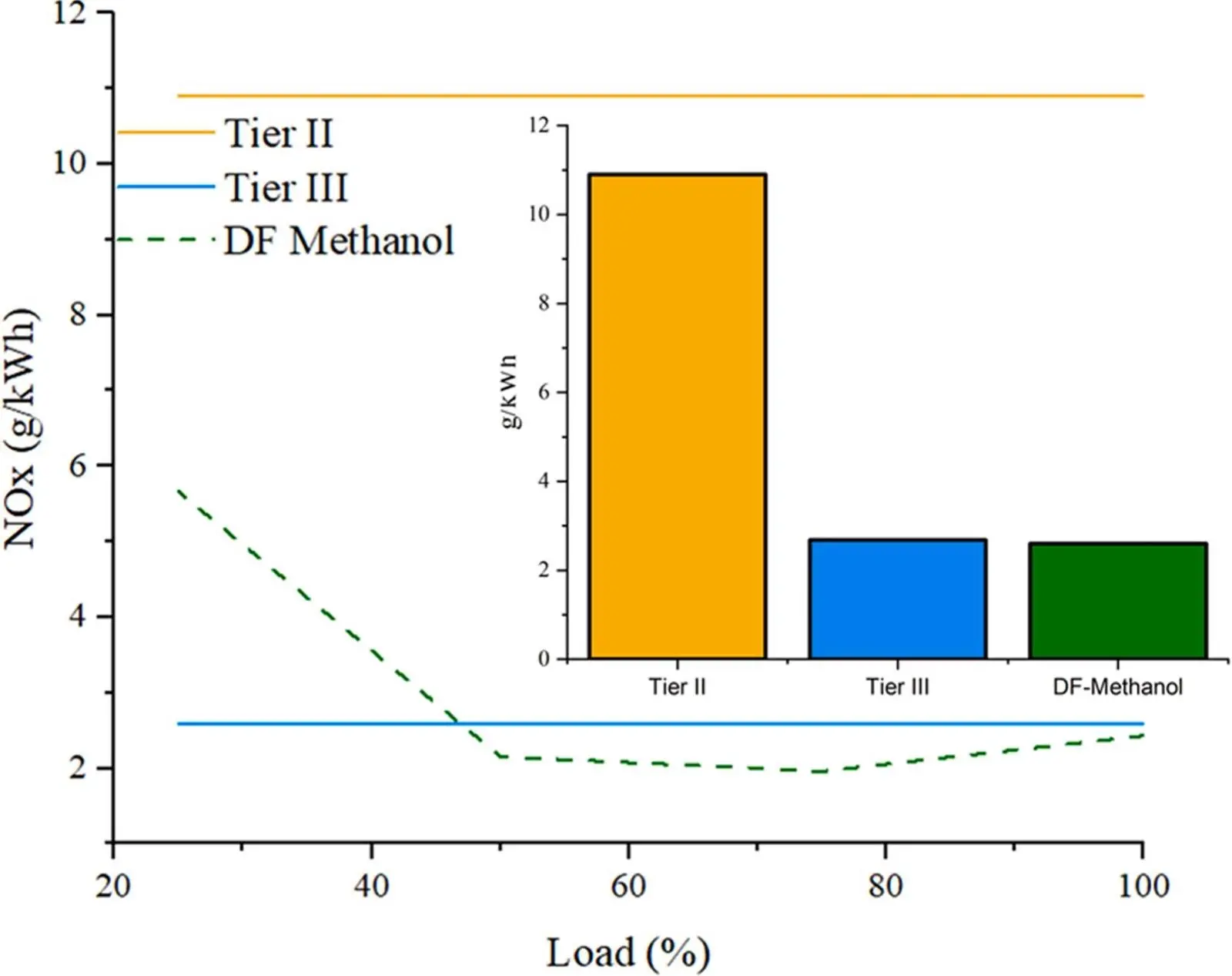
Optimal injection timings on the compression stroke for minimising unburnt methanol and NOx emissions were 80◦CA before top end dead centre (BTDC) for methanol and 12 ◦CA BTDC for diesel. This achieved combustion efficiency of up to 99% and indicated thermal efficiencies of 46%, 45%, and 43% for high, medium, and low loads. It ensured effective mixing of methanol and air and therefore reduced peak temperatures so that NOx emissions remained within IMO Tier III requirements without the need for SCR (see figure).
However, they also found that further knock mitigation techniques were required to broaden the injection timing envelope at high loads and avoid knocking at high load. In a further modelling exercise, they studied variable compression ratio (VCR) settings for the direct injection of fuel with 90% methanol content. VCRs offer the flexibility to adjust compression ratio based on engine load to achieve higher thermal efficiency for a wider range of operating envelope compared to fixed compression ratios.
The researchers developed CFD models for an engine operating in diesel, gas, or methanol dual-fuel under different compression ratio settings. They experimented with engine loads of 20, 55 and 90% load and compression ratios ranging from 11 to 19 and determined the optimal compression ratio values that optimised engine performance whilst ensuring stable combustion and compliance with IMO Tier III limits. Their results indicate a 20% improvement in environmental performance using VCR rather than fixed compression ratios, without the need for exhaust gas recirculation (EGR) to achieve Tier III NOx compliance.
The engine, with VCR, could effectively mitigate knocking at high loads and misfiring at low loads. The compression ratio reduction at high load resulted in lower indicated thermal efficiency due to the decreased the expansion ratio and lower NOx emissions caused by the resultant in-cylinder reactivity decrease.
However, there are potential challenges associated with the mechanical complexity and the cost effectiveness of VCR systems, so future studies could focus on optimising the engine designs of VCR technologies. Further research is also needed on engines of different sizes to assess the scalability of their findings.
“From our point of view, we work in close collaboration with engine manufacturers and we discuss the current state of the art, the challenges they face and the market needs,” says Dr Karvounis. “However, our research is focused on beyond-the state of the art. We do also research that feeds the current industrial needs, however a great part of our work is focused on novel ideas and technologies that we expect could be commercially viable in the future.
“At this point we are conducting further research on alternative fuels uptake from the shipping industry along with technologies for AI-powered engine health monitoring. We try to address further challenges in methanol combustion such as low load ignition and identify the operating envelope for hydrogen-diesel combustion.”
Related Articles
 METHANOL
 METHANOL
 2-STROKE & 4-STROKE