



MODULARITY BRINGS EFFICIENCY TO HYBRID FUEL CELL CONCEPT
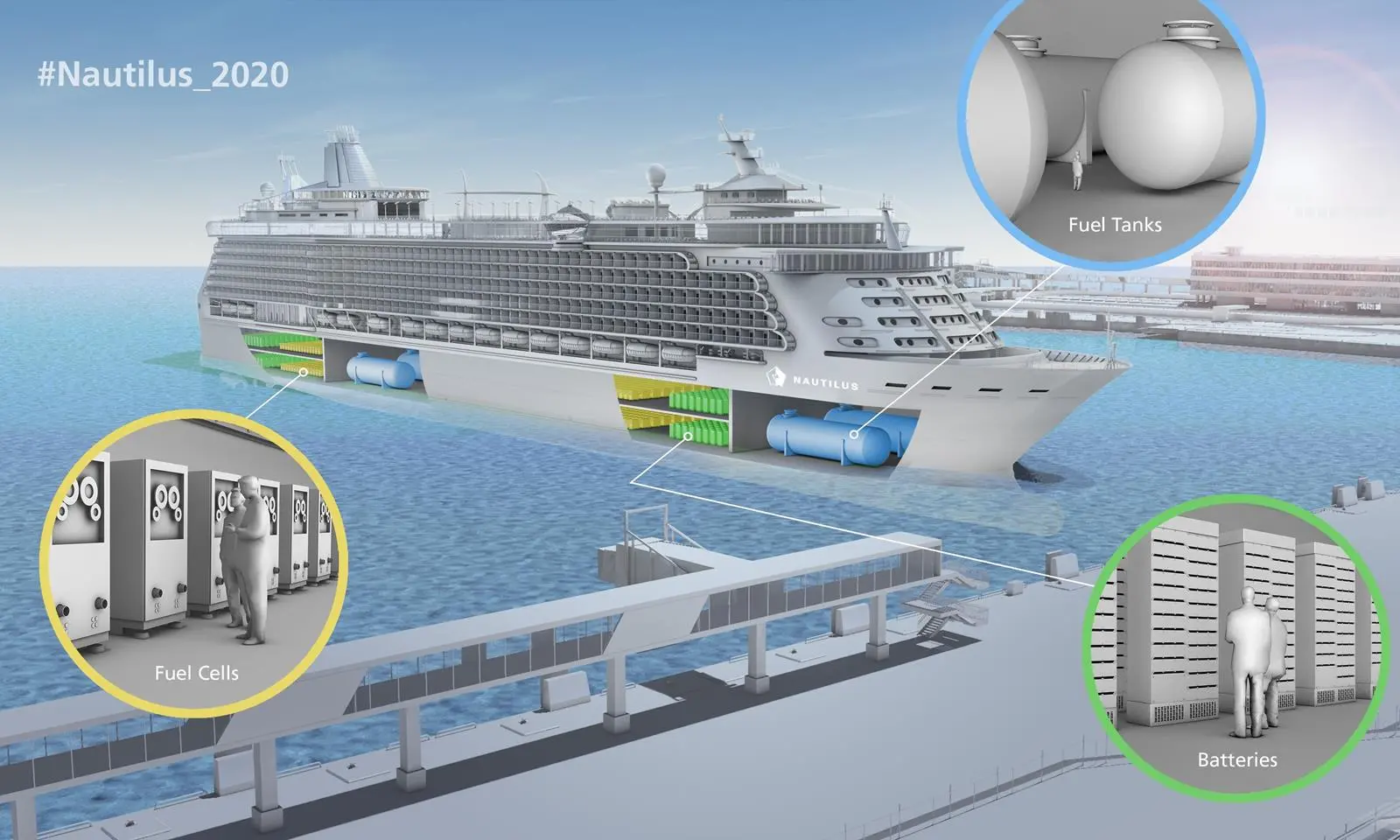
Participants in the Nautilus (Nautical Integrated Hybrid Energy System for Longhaul Cruise Ships) project are developing a genset that consists of an LNG-fuelled solid oxide fuel cell (SOFC) and a lithium-ion battery system which will initially be hybridized with the internal combustion engines already typically used to meet the power and hotel needs of passenger vessels. The concept allows a stepwise scale-up that would ultimately enable all the traditional internal combustion engine gensets to be replaced by the electric hybrid system.
An integrated design and digital-demonstrator of a 5-60MW onboard energy system is under development, and an actual 80kW demonstrator will be built and marine certified. It will then be validated by the German Aerospace Center (DLR) and by the participating shipyards. The project will also address the regulatory framework, emissions analysis and lifecycle assessment of the technology.
Overall, the system has the potential to reduce CO2 emissions by at least 40% and particulate emissions by 99% in a vessel meeting the targets of 2030, says project leader Dr Asif Ansar, Head of High Temperature Systems and Processes group at DLR. The project will focus initially on a system suitable for 1,000 and 5,000+ passenger ships, but cargo ship applications are also envisaged.
“The system will be modular,” says Ansar, “and rather than having three, four or five gas engines taking care of the energy needs of the ship, we will have many smaller modular systems working in parallel with a new modified energy management system that will be developed by MAN Energy Solutions. This will bring two things: firstly, we can fluctuate the load much more in line with the demand of the ship, ad secondly, the installed capacity on board of a ship can be reduced. For example, a typical ship that needs around 14MW of installed capacity could go as low as 8MW, because the installed capacity is not always the use capacity. There are safety margins, but to go smaller with gas engines, the cost becomes very high. That’s not the case with fuel cells and batteries, and this allows us to benefit from the use of smaller, modular systems.”
While each of the components used are existing technologies, part of the research undertaken will look at ways of ensuring that this increased modularity does not come with a large volumetric space penalty, so one of the key performance indicators for the project is to increase the volumetric energy density of these systems. Ansar believes that repacking components will bring positive results, but as part of more fundamental research, the project aims to increase the energy density of the fuel cells as well.
To achieve emissions targets beyond 2030, the system will be designed to be fuel flexible. This will be achieved by modularising the reforming step that converts the fuel to hydrogen for use by the SOFC fuel cell. Initially, this will involve reformation of the LNG fuel. “The shift from diesel engines to gas engines is already happening,” says Ansar, explaining the choice of LNG as fuel for both the fuel cells and the internal combustion engines. “We want to increase the energy efficiency as part of the second phase of this transition.”
As new fuels become available, the LNG will be blended with bio-methane and e-methane and then potentially a complete transition towards synthetic sustainable future fuels could occur. The genset design will ultimately facilitate the use of other fuels such as methanol, hydrogen or ammonia, although fuel storage, distribution and management systems will need to be changed to support the transition from gaseous fuels.
The first phase of the Nautilus project has an overall budget of €7.89 million over four years from the EU’s Horizon 2020 funding program. After completion of the first phase in 2024, Ansar envisages two more phases of around three years each to scale up and test the system which he says should be ready for adoption by 2030. Project partners include DLR, Chantiers de l’Atlantique, Carnival Maritime, Ecole Polytechnique Fédérale de Lausanne, GRANT Garant, Lloyd’s Register, MAN Energy Solutions, Meyer Werft, Royal Caribbean Cruise Line, RWTH Aachen University, SOLIDPower, Technical University of Delft, Lund University, Teknologian tutkimuskeskus VTT and SOLIDPower.
Related Articles
 ALTERNATIVE FUELS & LUBRICANTS
 ALTERNATIVE FUELS & LUBRICANTS
 ALTERNATIVE FUELS & LUBRICANTS