



MR2 TANKER DESIGN FEATURES THREE 100-TON SAILS
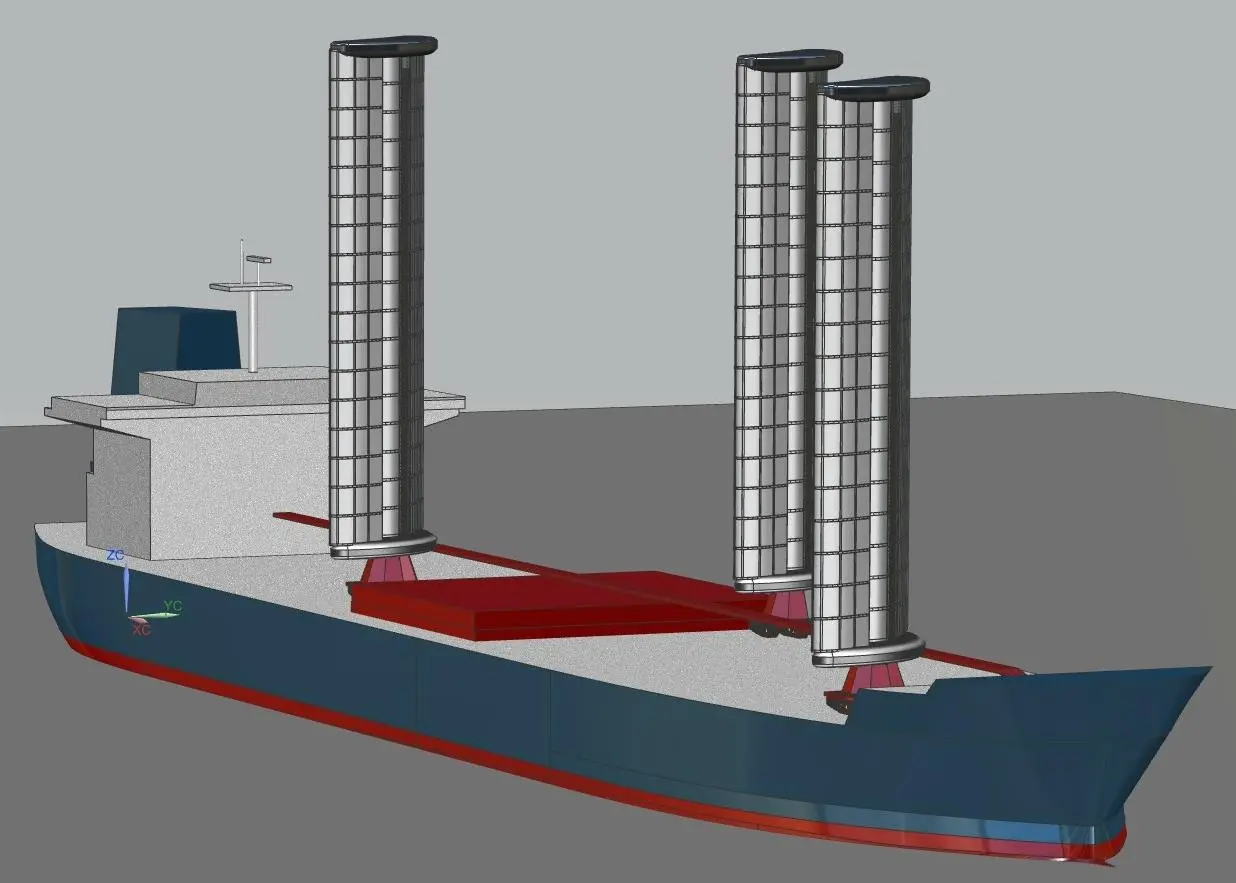
The WindWings technology and the newbuilding design are still being finalised, but the consortium expects to reduce CO2 emissions by as much as 30% on newbuilds with hull optimisation whilst still ensuring a relatively standard vessel design that can be accommodated in existing terminals and waterways.
The anticipated savings have been modelled using realistic routings and real-world weather, says John Cooper, CEO of UK-based BAR Technologies, noting it is higher than the 7-11% claimed for competing technologies using Flettner rotors. “The basic concept of WindWings is the same as any other wing. What sets it apart is the way that it has been optimised for use on large ocean-going vessels. Instead of designing a wing and then applying it to a vessel, BAR Technologies designed the wing as a part of a complete system.”
The company is a spin-off from Ben Ainslie Racing (BAR), the British team formed by Olympic and World Champion sailor Sir Ben Ainslie. The technology company was formed in 2016 with the aim of making the design knowledge, technical skills and intellectual property developed for America’s Cup yacht racing available to the commercial world. The sails have been modelled using advanced CFD, simulation and machine learning techniques developed from this America’s Cup heritage.
“We believe that this modelling is more advanced and accurate than others that we have seen,” says Cooper. “The BAR Technology team have always achieved near perfect correlation between digital results and reality, be it final vessel or model size.”
The company’s motivation is the maritime industry’s challenge of reducing average CO2 emissions by 40% by 2030 and working towards 70% by 2050, compared with 2008 levels.
Cargill Ocean Transportation
US-based agribusiness Cargill is one of the shipping industry’s largest players, chartering a fleet of more than 600 vessels at one time. The company formed the project in recognition of its responsibility to accelerate decarbonization progress and has brought the necessary vision and scale to convert BAR Technology’s inspiration into measurable efficiency savings.
“Through this partnership we will bring bespoke wind solutions to customers who are actively seeking to reduce CO2 emissions from their supply chain,” said Jan Dieleman, president of Cargill’s Ocean Transportation business. “Changing regulations and uncertainty about future greener marine fuels makes choosing the right vessel to charter with a long-term view complicated. With the WindWings technology, Cargill will be able to offer customers a solution that improves vessel efficiency, independent of the fuel or type of engine used.”
Cargill has already partnered with a number of organizations to drive decarbonization progress, including the Global Maritime Forum and its Getting To Zero Coalition, the Sea Cargo Charter, a recent initiative to cut and track emissions from chartered ships to reduce the maritime industry’s carbon footprint, and the Maersk McKinney Moller Center for Zero Carbon Shipping. Last year, Cargill announced a collaboration with Maersk Tankers and Mitsui & Co. to provide over-the-shelf solutions for maritime actors looking to explore new technologies to reduce their emissions.
Dieleman says that Flettner Rotors may currently be slightly cheaper than the initial WindWings. “But we think our solution offers a better return on investment (ROI) due to the far superior fuel savings. Payback is still longer than some of the short-term solutions we at Cargill are currently trialling and testing on our fleet (use of Mewis Ducts, installation of LED lighting, specialised paints etc.) However, we believe that the long-term savings potential of WindWings makes the upfront investment more interesting. Plus, as fuel prices rise and we scale up production, we believe that the payback will go down.”
Around 10 years ago, Cargill installed a kite system on one of its vessels. That didn’t work, but we’re not giving up, said Dieleman.
A second retrofit project
DNV GL will ensure the design meets all necessary safety requirements, and building is expected to get underway next year with the vessels and the WindWings technology tendered globally. In parallel, the consortium is working on a retrofit solution anticipated to reduce CO2 emissions by as much as 25%. A project is anticipated next year, and the consortium also has plans for a dry bulk carrier newbuilding design which is likely to be Kamsarmax size.
Each WindWings is about 18 metres wide and up to 45 metres high. The three structural spars on each WindWing will be made of steel, and the fairings on each spar will be made from a composite material. They will resemble movable airplane wings and will provide forward thrust to the ship, automatically rotating and altering configuration to make the most of as many wind directions as possible.
The WindWings will be hydraulically ram driven and controlled by software developed by BAR Technologies called Ship System Efficiency Analysis Tool (ShipSEAT). This software is also being used at the design stage. ShipSEAT combines accurate simulation and interaction of complete hydrodynamic and ship propulsion systems with bespoke optimising to reduce drag. Hydrodynamics inputs such as upright resistance, added resistance waves, trim and displacement, sea keeping, together with appendages, rudders and bilge boards are used alongside aerodynamic inputs such as vessel windage, auxiliary wind prop devises and cargo loading. Models are created with further variables for engines, propellers and other machinery together with operational constraints.
Intelligent trimming
The sails provide thrust in a manner similar to that of a propeller, so they can speed up the vessel, going faster with the same engine load, or reduce load from the propeller. ShipSEAT’s voyage routing capabilities could see the vessel make slight course changes to take advantage of wind conditions for optimum energy efficiency.
Esa Jokioinen, Director, Sales & Marketing at Deltamarin says the plan so far is for the ship to have a slow speed engine to limit the number of new technologies implemented at the same time. “We believe that we can make the two-stroke engine work very efficiently if we look at load optimization and particularly the propeller and shaft line design.” It is yet to be decided whether the tankers will have a fixed or a controllable pitch propeller.
The consortium decided to start with MR product tanker design because the cargo loading and discharge operations presented fewer issues for the positioning of the sails than bulk carriers. The tanker design will have conventional MR dimensions, general arrangements and cargo tank configuration, and the vessels are expected to carry edible oils, biofuels or ethanol. They will have three WindWings installed, and the bulk carrier design, expected to carry grains and oilseeds, will have four.
The location of the wings on the tanker’s deck maximises windage and avoids interference with cargo deck equipment. The supports for the sails are roughly similar in size to those needed for deck cranes, and they will be located on the intersection of bulkheads, so they won’t be as massive as one might think, Jokioinen says.
Heeding heel angles
A maximum heel angle of two degrees has been set before the WindWings are depowered to keep within that client driven constraint. “We need to ensure high performance with varying levels of wind assistance, as the thrust gained from the wings changes depending on the wind speed and direction. For example, propeller thrust at any given speed can vary quite a lot, which has implications on the propeller optimization as well as with the steering arrangement. With reduced flow to the rudder, the steering forces will reduce, but at the same time we need to ensure good course stability for the vessel,” says Jokioinen.
“With these additional parameters, the hull form and propulsion optimization becomes much more complicated than for a conventional vessel. We are working on the details of the steering system which combines the propeller, rudder and potential hull appendages that will ensure that the course stability of the vessel is managed.”
Jokioinen says Deltamarin has been designing ships to actual operation profiles for decades. “Taking the weather/wind/wave pattern into account in CFD optimization is something we have had significant focus on over the last years. Currently we are using our in-house developed DeltaSeas tool in most of our design projects, but these capabilities become really vital when we design a vessel with the significant wind assistance that WindWings can provide. BAR Technologies has also very impressive modelling capability which ensures we will optimize the complete vessel with the sails. We believe this joint capability and experience from both wings and ship design is really unique in the industry at the moment.”
The first tankers are expected to be on the water in 2022.
Related Articles
 PROPULSION
 GENERAL NEWS
 HYDROGEN