



New developments expand hydrogen carrier cracking concepts
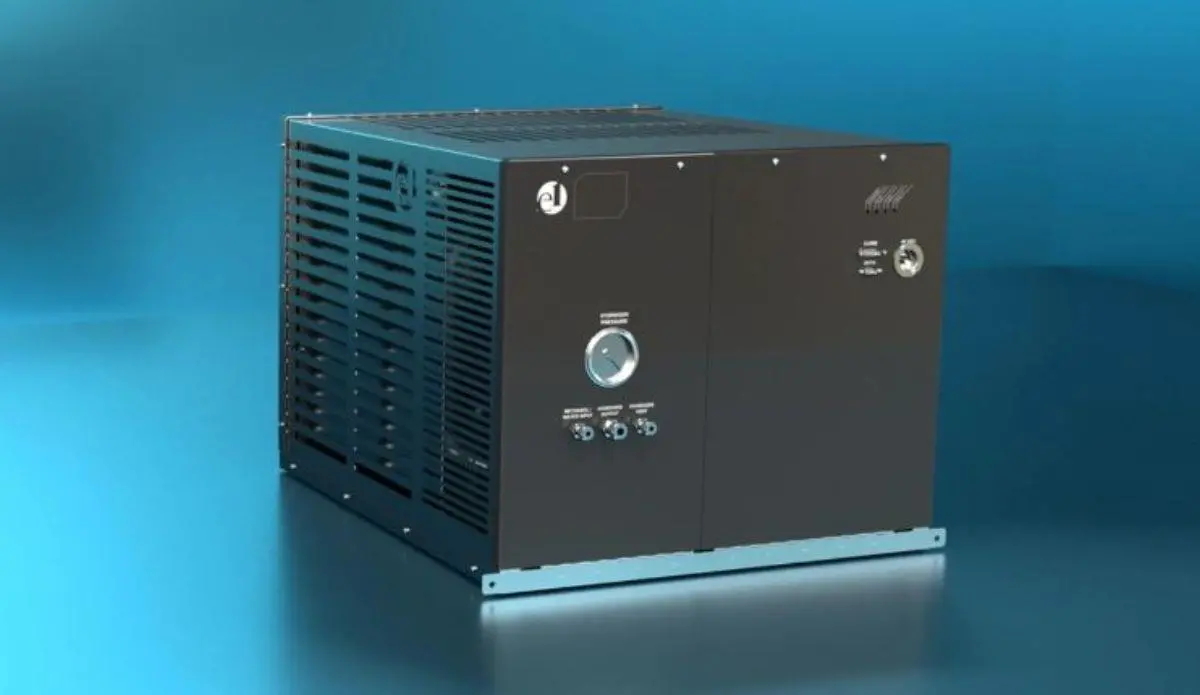
Element One, founding company of e1 Marine, recently announced its new M Series M30 methanol to hydrogen generator, a high-density model for multi-MW scale marine applications. First sales are expected in Q1 2024. The M30 is a scaled-up version of the earlier M18 model and has increased hydrogen density relative to its footprint. The Hydrogen One towboat included 10 M18 hydrogen generators, and the next vessel in the line will require six M30s, bringing space savings of nearly 40%.
The M-Series includes a port to provide the operator with the option to efficiently capture CO2. “The M-Series provides superior conditions for carbon capture with an impressive 50% of H2 depleted syngas stream, with the H2 generator future-proofed for carbon capture and a zero-emission profile possible with green methanol. As a result, CO2 emissions after carbon capture will be 20% – 50% reduced in comparison to the previous iteration,” says Robert Schulter, managing director, e1 Marine.
Element One is working with Saudi Aramco to perform testing and a sensitivity analysis of its carbon capture solution to determine the cost relative to the carbon capture rate. This analysis should be complete in Q3 2023. “Typically, we see in this type of analysis that the cost will quickly escalate at some point relative to the carbon capture rate. We anticipate that we will be able to economically capture carbon somewhere in the range of 50% to 80%,” says Schulter.
e1 Marine has also been commissioned to build an S Series 130 methanol to hydrogen generator by Current AG for the development and evaluation of techniques to capture waste heat and CO2 from the exhaust stream created during the reforming process. The S Series S130 Hydrogen Generator is a modular system designed for ease of use on board vessels as part of a quiet, low vibration, low emission power solution for luxury boats or as a range extender supporting battery-centric power solutions on workboats. The technology can integrate with PEM fuel cells.
If the lab-based tests are successful, the additional heat and reduced CO2 emissions will improve the overall economy and environmental footprint of the methanol to hydrogen reforming process. This knowledge will then be incorporated into existing plans to construct commercial vessels with methanol to hydrogen reformers so that hydrogen can be used to power fuel cells for generating electricity on e-vessels or hybrid vessels.
“Our methanol to hydrogen generators are already providing an accessible, safe and commercially viable low emission power solution for use in ports and on a range of vessels,” says Schulter. “The technology is already proving to be effective to slash total emissions, including the full removal of particulate matter, SOx and NOx. Although our generators already enable vessel owners to meet the incoming carbon reduction regulations, we are delighted that companies like Current AG are working to explore how we can help customers get closer to zero carbon emissions.”
Element 1 is also preparing to announce a new containerised, integrated fuel cell power solution for ports supporting e-vessel charging, cold ironing, and port electrification.
Ammonia and hydrogen mix means less pilot fuel
Pherousa Green Technologies (PGT) has developed an ammonia cracker to enable deep-sea shipping to use hydrogen as a fuel. Pherousa Green Shipping (PGS) is preparing to order up to six Ultramax dry bulk carriers, designed by Deltamarin, incorporating the technology. PGT will deliver the plug-and-play ammonia crackers to PGS for installation onboard the newbuildings which are intended to service the worldwide copper industry.
PGT’s ammonia cracking technology allows the ship’s engines to be operated with a minimal amount of pilot fuel, instead using enriched ammonia and hydrogen as fuel. The system also enables the use of pure hydrogen in PEM fuel cells for electric power production. “The only fuel that is truly zero emission is hydrogen, but hydrogen storage is the biggest challenge for deep-sea shipping. Ammonia is the only readily available hydrogen carrier that has no carbon in its molecule, therefore the only truly zero-carbon hydrogen carrier. The ammonia cracking technology developed by PGT is a game changer that could become a major contributor toward the realisation of the world´s zero-emission shipping,” says the PGT Group Chairman Hans Bredrup.
Related Articles
 AMMONIA
 HYDROGEN
 HYDROGEN