



New ducted propeller design offers fuel savings
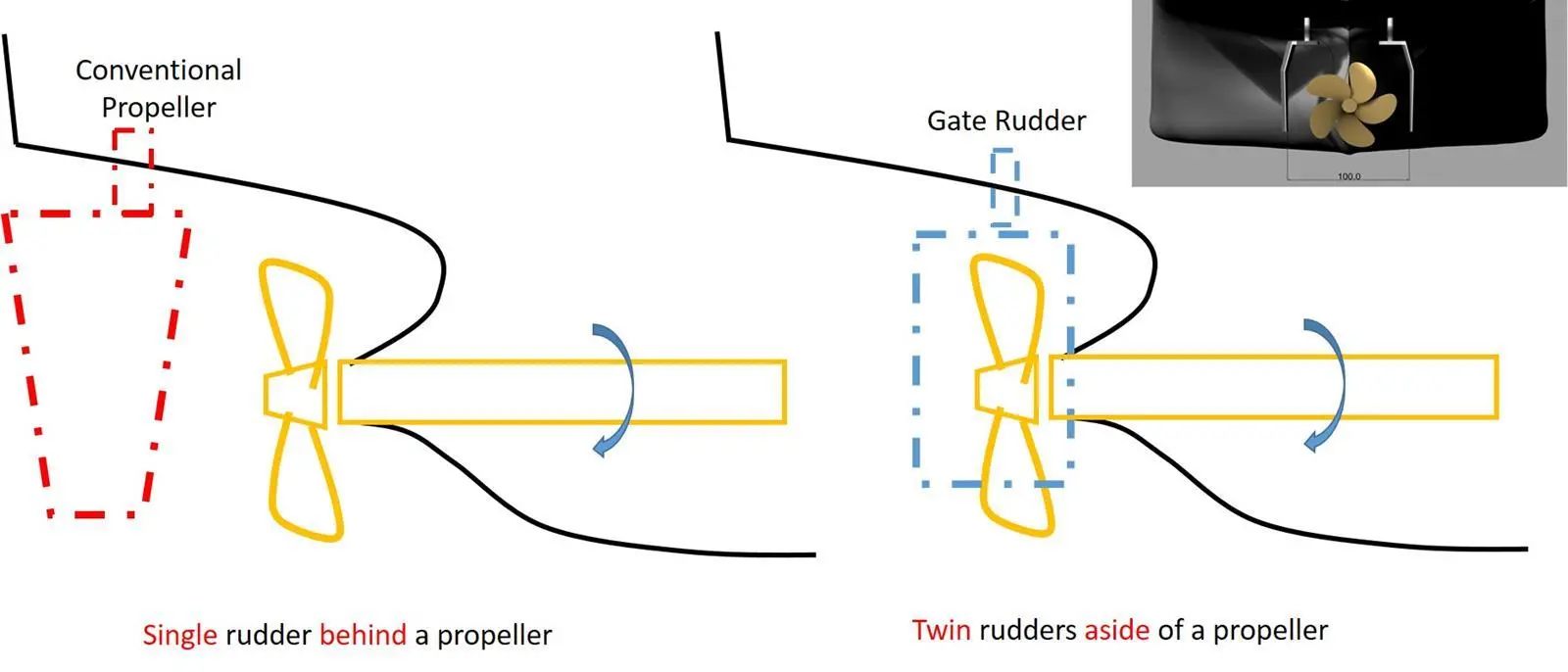
The world’s first Gate Rudder system was fitted to the container ship Shigenobu, which entered service in 2018. The voyage data from the vessel’s first nine months of service reveal that this recently patented system could provide energy savings of as much as 30 percent, compared with the voyage data of an identical container ship Sakura, fitted with a flap rudder. The results suggest the innovative Gate Rudder arrangement holds significant potential to replace the conventional propeller-rudder systems to achieve a step change in EEDI compliance.
Commenting on the results, Sadatomo Kuribayashi, chairman of Kuribayashi Steam Co. said “This is a rudder for the propeller age”. Mr. Kuribayashi came up with the original idea for the gate rudder along with Noriyuki Sasaki, a visiting Professor at the University of Strathclyde (and formerly, senior research director of NMRI Japan). Sasaki and NMRI are also patent holders of this innovation.
Gate Rudder Concept
The rudder is one of the main drag sources contributing to the total ship resistance, while innovative designs to offer superior manoeuvrability such as flaps or fish tail wings can reduce energy efficiency due to their additional drag. The Gate Rudder system replaces existing rudder systems with a completely new ducted propeller system, which produces additional thrust rather than additional drag. This is a new type of ducted propeller, distinct from Closed Type Ducted Propeller systems or Front Type Ducted Propeller systems, such as the Mewis Duct, or the earlier Sumitomo Integrated Lammeren Duct (SILD).
“The Gate Rudder system can be categorized as an Open Type Ducted Propeller, which is completely different from other ducted propeller systems” Sasaki said. “It is a huge Ducted Propeller and a huge Stern Thruster.”
The first model test of the gate rudder system was conducted by Sasaki in the the 400m towing tank of NMRI Japan in 2013.
The gate rudder system concept is very simple: simply substituting a conventional rudder with a rudder blade fitted on each side of the propeller.
The results speak for themselves: the Shigenobu recorded energy savings of 14% (at sea trial) and 33% (in service) compared with the Sakura.
Lower propeller thrust
Sasaki explains how the Gate Rudder has such an effect on performance. “The propeller of the gate rudder system requires much smaller propeller thrust than that of the conventional rudder system because the rudder is changed from a resistance device to a device generating thrust. This also reduces the hull interaction force which is known as a thrust deduction factor.”
A second factor is also at play. “The gate rudder also works like the sails of a sailing ship in the water. The propeller increases this sail performance using so-called USB (Upper Surface Blowing) technology like an aeroplane wing, while the conventional rudder works in the deflected flow of a propeller slipstream which deteriorates the sail performance,” Sasaki said. “We can expect the same effect of the gate rudder for a rolling motion.”
When asked why nobody noticed this simple idea before, Sasaki noted that conventional modelling techniques were unsuited to unconventional propeller-rudder configurations.
Sasaki added “It is not easy to say, but it strongly relates to the model test technology and the analysis procedure. The gate rudder was out of the scope of the existing model test technology. For example, the resistance of the gate rudder measured in the towing tank is quite high and 5-10 times, relatively, compared to full scale (scale effect). This will give the wrong conclusion for the model test result.”
Commissioning
In fact, the decision to develop the gate rudder was taken despite the fact that the test results achieved from existing model testing methodologies were unsupportive. Nobuhiro Asaumi, the chairman of Yamanka Shipbuilding Co. decided to install the world’s first gate rudder on a container ship, Shigenobu, regardless, and asked Hiroshi Itazawa, the president of Kamome Propeller Co. Ltd., to manufacture the gate rudder and propeller.
Itazawa commissioned Tokyo Keiki Inc. to develop a new autopilot system adapted to the gate rudder. The vessel was delivered in December 2017.
The Sakura is one of the best container ships designed by Yamanaka shipyard who developed the hull form not only based on numerous model tests but also based on the recent CFD technology. The Shigenobu was built one year later than Sakura with the same hull form and the same engine, a Hanshin LH46LA (low speed four-stroke 6 cylinder) diesel engine. The difference between the two vessels is only the rudder system, including the propeller.
Operational Experience
Upon entering service in January 2018, the Shigenobu mainly operated along the same Tokyo-Tomakomai route along the north-east coast of Japan as a near-identical sister vessel, Sakura. This permits analysis of the Gate Rudder’s performance based on comparisons between the two vessels’ performance in identical conditions. This is quite different from most other cases.
The results showed a difference of almost 30%, well above the difference recorded in the sea trials. This reflects the gate rudder’s superior performance in heavier weather, especially in head sea conditions. The energy saving is remarkably different from the Sakura.
Takayuki Imoto, the president of Imoto Lines Ltd., said, “I heard of several very interesting advantages of Shigenobu from the captain. Shigenobu is very strong against wind and waves such that the vessel can enter and berth in a stormy port even when the wind is blowing at over 20m/sec, while other vessels waiting for calmer conditions.” Shigenobu also had lower vibration and noise compared with Sakura: such that no troubles were observed with navigation lights as on other ships. Extremely stable stopping and astern motion are also experienced with the gate rudder system on Shigenobu.”
Design advantages
The results also indicate improvements in manoeuvrability, with the Shigenobu reporting better course keeping at lower speeds, as well as faster turning speeds.
One particular advantage of the gate rudder system is that it can eliminate the requirement for a stern thruster. Kuribayashi added “The crabbing mode of the gate rudder system can replace the stern thruster by this simple system. This brings us not only cost savings but also wider design capability”. The system is extremely good for coastal vessels which need frequent berthing.
However, the principal advantages of the Gate Rudder’s increased thrust remains the possibility of derating the main engine size, without impacting on operational performance. This would also permit the use of lighter propeller shaft systems.
New orders
Three new Japanese projects to install Gate Rudder systems to newbuilding projects have recently begun. The projects involve a large containership and two small coastal vessels. This means we will see another three ships equipped with gate rudder systems enter service in the next year. In addition to these projects, some customers in Europe are also studying the feasibility of installing gate rudder systems, said Sasaki.
PRINCIPAL PARTICULARS— Shigenobu
Length overall 101.90m
Breadth, moulded 17.80m
Depth 8.50m
Speed (maximum) 16.20 knots
Deadweight 3,850t
Main engine power 3,309kW
Class ClassNK
Related Articles
 PROPULSION
 GENERAL NEWS
 HYDROGEN