



New ECS System Keeps ME-GA Close To ISO Conditions
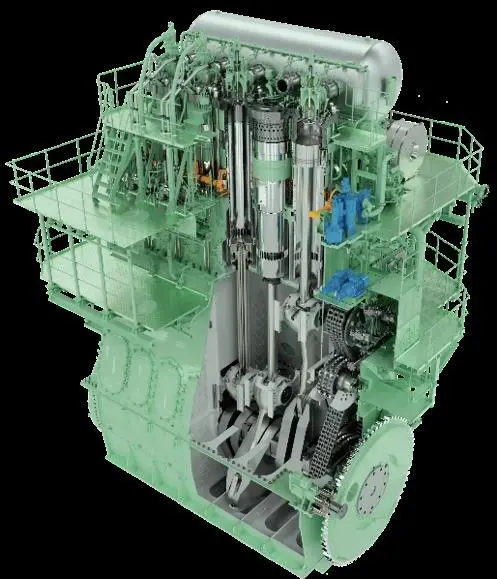
Typically, the combustion process in Otto cycle engines isn’t as stable as Diesel cycle, but it allows for the intake of low pressure gas, which is a good match for the use of boil off gas (BOG) from LNG carriers as a fuel. It has therefore become a popular choice for LNG carrier newbuilds. The ME-GA is also touted to have lower capex, opex and NOx emissions than current-generation Diesel engines, for many contemporary LNG carrier designs, when the overall cost, consumptions and emissions for the vessel are considered.
However, there are potential challenges to its performance at sea. The combustion process can be affected by variations in charge gas delivery or pressure pulses that may affect some cylinders differently to others. Additionally, when not running under ISO conditions, fuel consumption may be sub optimal, and this can occur, for example, in adverse weather conditions.
These drawbacks do not show in shop tests, says Thomas S. Hansen, Head of Promotion and Customer Support, MAN Energy Solutions, where the combustion control parameters are manually tuned for ISO conditions. This also means that MAN’s new improvements as part of its ME-GA-opti control system aren’t really apparent during shop trials either.
Still, Hansen is confident that in-service results for the ME GA-opti will demonstrate lower fuel consumption, lower NOx and lower methane slip than the standard ME-GA engine. Additionally, the engine will be much less likely to slip into fuel oil mode – another cost saving, as charterers, while happy for BOG to be used, are unwilling to pay for fuel oil as well.
ME-GA Otto cycle combustion
In the standard ME-GA Otto-cycle combustion process, scavenge air enters into the cylinder around bottom dead centre when the piston uncovers the scavenging air ports. Next, the gas admission valves admit fuel gas as the piston travels upwards in the cylinder. Pilot oil ignites the premixed air/fuel gas mixture, and the combustion starts.
As fuel gas and air mixes in the cylinder during the compression stroke, it increases the risk of misfire and/or pre-ignition (knocking) of the air/fuel gas mixture. The risk of pre-ignition increases when fuel gas is mixed into the entire swept volume of the engine, where the pressure and temperature can support ignition.
To increase the combustion stability significantly, a narrow engine-operating window has been introduced. The operating window gives a reliable control of the combustion process and, in particular, of the air/fuel gas ratio. The window reduces the compression ratio and the mean effective pressure to avoid pre-ignition, which results in a lower thermal efficiency compared to the Diesel cycle. Combustion and maximum pressures will be reduced, and, thermodynamically, this influences the maximum power output and the engine efficiency.
However, as the peak temperature of the combustion is lowered, this in turn lowers NOx formation enough so the engine is IMO Tier III compliant in dual-fuel mode without NOx abatement technology. Even so, for MAN’s Otto-cycle engines, EGR is an integral part of the engine tuning to improve performance and lower methane emissions.
In dual-fuel mode, the EGR has proven to have a considerable and beneficial impact on the methane slip and the specific gas consumption, thus becoming a standard for this engine type. It efficiently suppresses pre-ignition, reduces excessive combustion rates, and reduces the maximum heat load on combustion chamber components.
The ME-GA engine, in addition, is suitable for driving shaft mounted power take-off devices with a large power output. This means that even a ship with high power consumption, for example an LNG carrier, can be designed to trade without the need for generators to be running to provide onboard power production. Further, the new control interface between engine and power take-off device maximizes the output at any given time thus achieving maximum financial and environmental benefit for the owner.
MAN initially introduced the ME-GA range with a 70-bore engine aimed at the LNG market. Hansen highlights that the engine has unique gas admission components. The gas regulating unit, safe gas admission valves, and N2 purging block were all developed in-house to ensure a safe and reliable fuel gas supply to the ME-GA engine. The ME-GA engine also has a simple LNG supply and purging concept, low fuel gas supply system maintenance costs, cost-optimised BOG handling and a well-known engine room design similar to those for the ME-C, ME-GI, and ME-LGI engines. These benefits are maintained with the ME-GA-opti which adds the new and unique AI-like engine control system.
The Opti development
There are no hardware changes involved in the ME-GA-opti development. It only involves changes to engine control software and input parameters designed to improve efficiency and performance under real-world conditions.
If humidity or ambient temperature is high or low compared to the ISO conditions, compression moves away from the optimal point – due to the higher combustion pressure in the case of higher temperatures or lower combustion pressure due to lower temperatures. While the EGR can ameliorate the conditions and provide a wider operating window to prevent knocking or misfiring, the ME-GA-opti engine control system works to keep the combustion conditions of each cylinder much closer to ISO, operating independently for each of the engine’s cylinders.
“It’s an on-going process, revolution to revolution, where we adjust the exhaust valve closing time,” says Hansen. “That way, we regulate the relationship between scavenge air pressure and compression pressure in each cycle in each cylinder revolution.” This enables the engine to respond to and counteract any differences in ambient conditions that might affect combustion.
Traditionally, the control system will have a set off parameters which controls the opening and closing of the exhaust value, the injection time and other parameters. “Here we shift to another way of working where the exhaust valve closing time is floating. It’s not on a fixed degree crank angle. It is happening at the closest time possible to get back to ISO conditions and therefore back to optimal. Now the engine is able to run in the same condition as it was when tested, referenced and guaranteed – not just during trials, but during the whole life of the engine.”
The solution has the capacity to match ideal running conditions for the engine even in the harshest weather conditions and without oil activation. Oil activation is still a feature, but its usage is expected to be significantly limited with the new engine control system. The system will benefit the engine most days, says Hansen, not just in adverse weather conditions.
Test results have been positive, and he expects that as well as leading to better fuel efficiency, the new system will reduce NOx formation and methane slip. “ME-GA-opti can reduce the average gas consumption up to 2% in service, depending on the fluctuations in the ambient conditions, and reduce the use of FRC dramatically and thus lower the fuel oil consumption as well,” says Hansen. “ME-GA-opti can also reduce the average methane slip by up to 10% in service, depending on the fluctuations in ambient conditions, mainly due to the reduced use of FRC where methane slip can increase.”
For NOx: “The engine is certified as a Tier III engine so ME GA-opti is keeping the values well within the limits. The fact that the algorithms are maintaining the optimum operating conditions for the engine is a guarantee that the limits are kept, and will in many cases even have a positive impact in the emissions,” he says. Having better control of combustion will also reduce wear and tear on the combustion chamber components that can come with high temperatures.
“The higher the temperature that metal components are running at shortens their lifetime, and here we can shave off the peaks, where they get too hot too early, and this will influence the lifetime of the components. We expect to demonstrate that when we have some field service experience,” says Hansen.
Testing and Implementation
The first gas trial for MAN’s ME-GA engine was completed in September 2022 on the vessel Gordon Waters Knutsen at Hyundai Samho shipyard. The two 5G70ME-C10.5-GA engines tested were built by HHI-EMD.
The experience gained was then applied to trials in June on the Celsius Geneva at Samsung Heavy Industries, the first in a series of LNG carriers currently under construction at the yard. Again, the trial was performed on 5G70ME-C10.5-GA engines, this time built by HSD Engine.

The ME-GA-opti feature was successfully validated during this trial with performance measured at 25, 50, 75, NCR and MCR engine load points. Fuel Ratio Control (FRC) was rarely activated in either of the tests, and occurred less often with the ME-GA-opti engine control system in operation. For example, FRC was not activated when heavy rudder activation was requested while the engine was at 80% load.
The ME-GA-opti technology will become standard on all new ME-GA deliveries. It will also be retrofitted on the few ME-GA engines already in service. “ME-GA-opti is the latest and most advanced control feature for the ME-GA engine and significantly improves its operation, maintaining its position as the best-in-class technology,” says Hansen. “It comprises an advanced and intelligent network of control algorithms that have been developed to optimise the combustion process on an individual-cylinder basis, and which ensure optimal operating conditions. I’m certain it will be received well by the market.”
Related Articles
 2-STROKE & 4-STROKE
 2-STROKE & 4-STROKE
 2-STROKE & 4-STROKE