



New-generation icebreaking supply vessels for Sakhalin duty
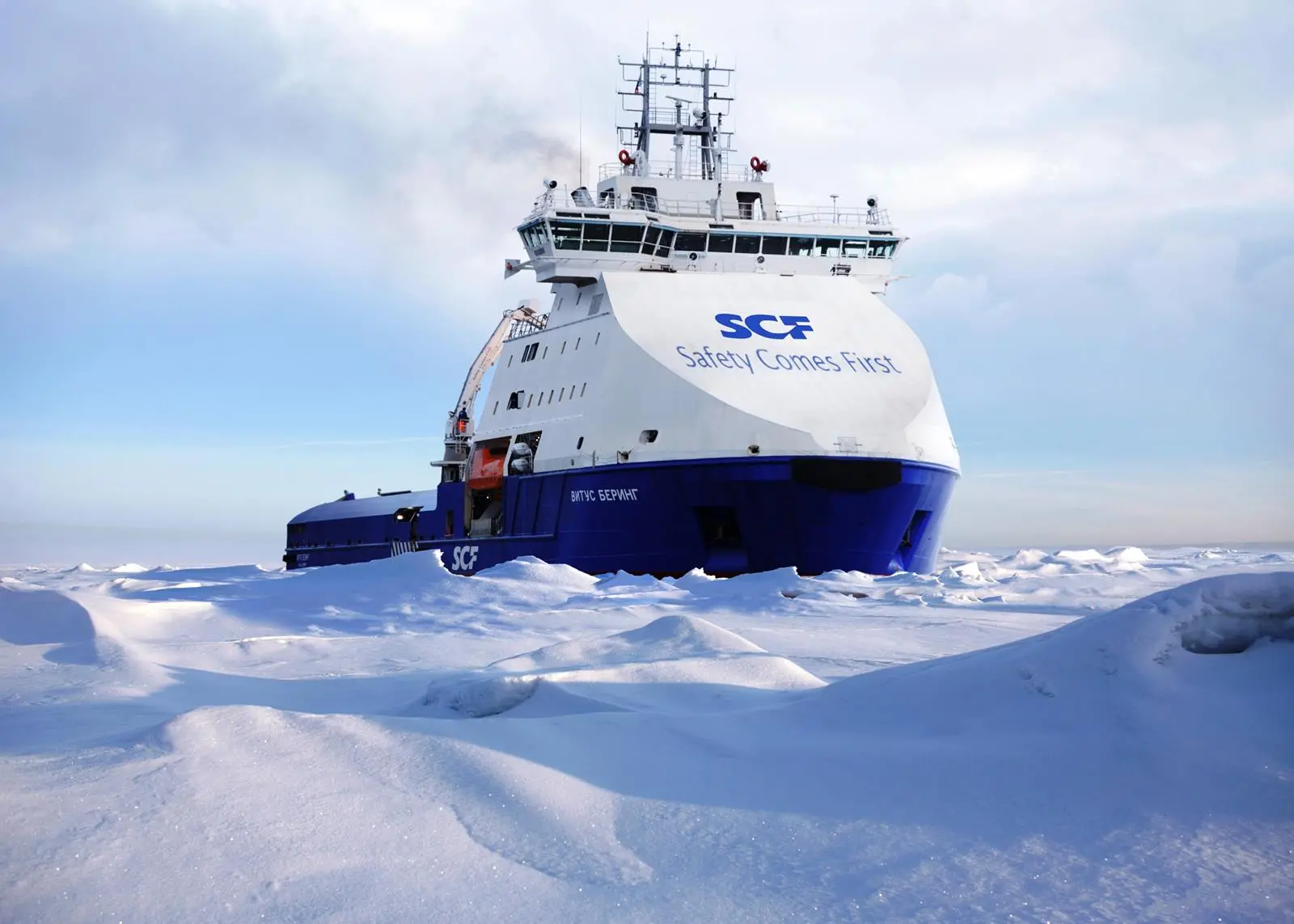
Built to the exacting requirements of operations in harsh Arctic and sub-arctic Arctic climes, the icebreaking platform supply and offshore rescue vessel Vitus Bering is testament to Sovcomflot’s further expansion in upstream services, complementing the group’s primary oil and gas transportation activities.
With the capability to operate independently in 1.7m-thick level ice and penetrate consolidated ice ridges, the Russian ship heralds a new generation of multifunctional icebreaking support vessels. Vitus Bering and second-of-class Aleksei Chirikov were ordered on the strength of long-term charter assignments in the extreme environmental conditions of the Sakhalin area, off Russia’s eastern coast, where temperatures can be as low as -35°C.
The $200million Sovcomflot contract was the first to have been signed by Arctech Helsinki Shipyard immediately following the latter’s formation in December 2010 as an equal-share joint venture of STX Finland and the Russian enterprise United Shipbuilding Corporation. The bulk of the hull production for both vessels was subcontracted to Vyborg Shipyard, with Arctech’s activities focused on project management, design, hull assembly, outfitting and implementation.
Measuring just under 100m in length overall and 21.7m in breadth, the Finnish-developed design encapsulates podded electric propulsion technology and provides versatile transport capacity for materials and equipment on a deadweight of around 4,000dwtt. In line with an emergency response role, there is provision for 195 evacuees as well as accommodation for up to 50 crew and specialised personnel. The multi-task capability of Sovcomflot’s new assets is underscored by the bollard pull rating of 128t-plus.
In 2009, Exxon Neftegas had announced a tender for the long-term charter of two icebreaking supply vessels to serve the Sakhalin-1 gas production platform on the Arkutun-Dagi offshore field in the Russian Far East. Sovcomflot was successful in winning the tender, and accordingly signed an agreement with Exxon Neftegas to secure the requisite newbuilds from Arctech Helsinki.
In addition to meeting the year-round, multifarious re-supply needs of the platform, the specified range of capabilities that had to be encompassed by the design included firefighting, ice management in the sense of protecting the platform structure from ice, oil spill response, standby, rescue services, and towing.
The Sakhalin-1 project, operated by ExxonMobil subsidiary Exxon Neftegas, comprises Russian, Japanese, Indian and American participants, and ranks as one of the largest single international direct investments in Russia. It includes the Chayvo, Odoptu and Arkutun-Dagi oil and gas fields, located off the northeast coast of Sakhalin Island. The hostile Arctic climate and difficult geographical conditions have required the use of unique technologies on the part of the field developers.
The two new supply vessels were originally to be delivered to the customer together in April 2013. The fact that Vitus Bering was completed four months ahead of time affords an especially positive opening reference for Arctech Helsinki and attests to the effectiveness of the production input by the Vyborg yard. Aleksei Chirikov followed as expected in April. Commercial and technical husbandry has been entrusted to the Sovcomflot Group company Unicom Management Services in Cyprus.
The ships are upgraded versions of a similar vessel built for Russia in 2005 at Helsinki, in the days of Aker Finnyards. Delivered as FESCO Sakhalin, the icebreaking platform supply ship was purchased by Sovcomflot from Far Eastern Shipping Company in 2010 and renamed SCF Sakhalin. While the main dimensions and hull form of the Vitus Bering type are nearly identical to the earlier vessel, the various modifications have included the addition of a fourth Wärtsilä-engined main genset and a covered foredeck, to better protect the mooring gear and the crew from the elements.
With its prominent track record in diesel-electric applications and the Arctic vessel market at large, ABB was contracted to deliver the complete electrical system and propulsion package for Vitus Bering and Aleksei Chirikov. For each of the ships, this encompasses the power generation and distribution systems, thruster motors, and two 6.5MW propulsion lines featuring Azipod podded electric drive propulsors.
The four main gensets in each vessel are driven by two 12-cylinder and two-six-cylinder models of the Wärtsilä 32-series medium-speed diesel, for respective generator ratings of 5,530kWe and 2,765kWe. With the 12V32 producing 6,000kW and the 6L32 turning out 3,000kW, total diesel power is 18MW. By contrast, the SCF Sakhalin has three examples of the 8L38B engine as the genset prime movers.
As with the earlier ship, the double-acting facility conferred by the podded azimuthing propulsors and related hull design, is pivotal to overall icebreaking performance, enabling ice forcing both astern and forward. For extra manoeuvrability and position keeping, two Berg 650kW tunnel thrusters are fitted in the bow.
Sovcomflot has experience of Azipod installations in extremely low temperatures and very difficult ice conditions by way of the Vasily Dinkov-class Arctic shuttle tankers, which transport crude oil from the offshore Varandey Terminal to Murmansk. These vessels have maintained operations without the need for icebreaker escort in the tough environment of the Novaya Zemlya region, where the drift ice thickness exceeds 1m and pack ice gets as thick as 2.5m.
The Helsinki yard is reckoned to have produced 60% of all icebreakers operating today. In taking that legacy forward, the Finnish/Russian joint venture Arctech Helsinki Shipyard’s contractual performance on the Sovcomflot vessels has no doubt provided a stronger platform for the company’s further endeavours in the wider Russian and ice-going vessel markets.
Around the time of the early completion of Vitus Bering, and in conjunction with Vyborg Shipyard, the company landed an order from the Russian Ministry of Transport for a 16MW icebreaker, to be delivered in 2015. This ensures a good baseload of work at Helsinki through 2013 and 2014, providing continuity beyond the current construction of an innovative, icebreaking rescue vessel booked by the same ministry in 2011 and due to be completed in December 2013.
The multipurpose emergency and rescue icebreaker in hand represents a completely new type of vessel, since it incorporates the patented oblique design concept, featuring an asymmetric hull and three azimuthing propulsors. The configuration and engineering allows operation ahead, astern and obliquely (sideways). The hull is being built in Russia at United Shipbuilding Corporation’s Yantar yard, and will shortly be transferred to Arctech Helsinki’s premises for outfitting and completion.
The design is based on the Aker ARC 100 type, which has been further developed in co-operation between Aker Arctic Technology and Arctech Helsinki Shipyard. The diesel-electric plant will deliver power to triple, azimuthing-type propulsors at each ’corner’ of the oblique hull. The vessel will be able to proceed in 1.0m-thick level ice both ahead and astern and in oblique mode, and will be able to open a 50m-wide channel in 0.6m level ice.
Besides icebreaking in harbour areas and adjacent waters and towage of ships and floating facilities, the vessel will be fitted with an advanced oil spill recovery system suitable for operation in heavy seas, and will be equipped to undertake salvage and rescue assignments.
Principal particulars–VITUS BERING
Length overall 99.9m
Length waterline 94.0m
Breadth overall 22.1m
Depth 11.0m
Draught, maximum 7.9m
Draught, design 7.6m
Deadweight, design draught 4,158dwt
Gross tonnage 7,487gt
Propulsion system Diesel-electric
Main generators 2 x 5,530kWe + 2 x 2,765kWe
Main genset diesels 2 x 6,000kW + 2 x 3,000kW
Total main genset power 18MW
Electrical propulsion drives 2 x 6.5MW
Propulsion power 13MW
Speed 15 knots
Bollard pull >128t
Bow thrusters 2 x 650kW
Endurance 30 days
Flag Russia
Class Dual LR/RMRS
Related Articles
 PROPULSION
 GENERAL NEWS
 HYDROGEN