



New injector and turbocharger systems ready for methanol retrofits
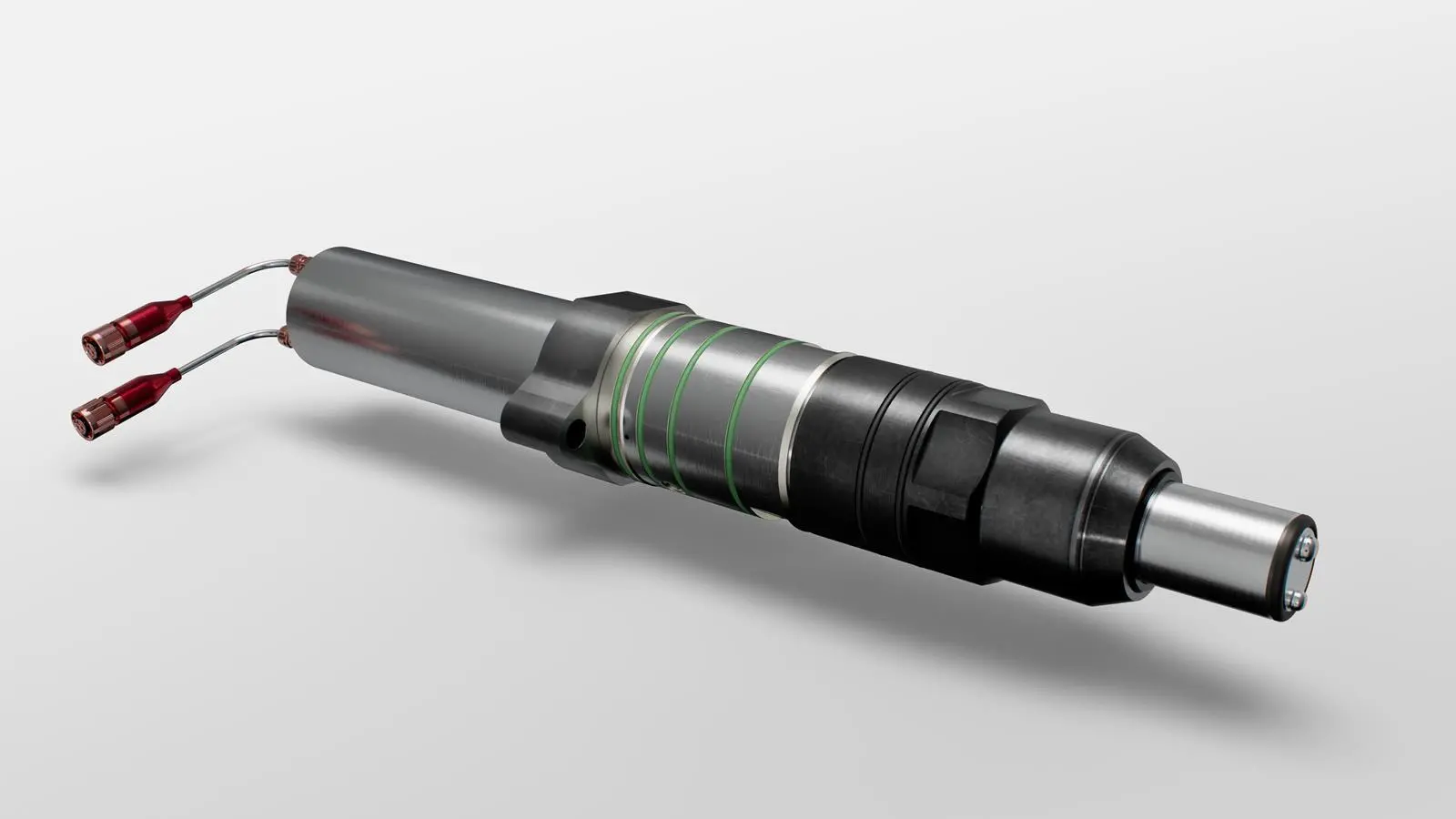
For a methanol engine retrofit, the goal is to ensure dual-fuel performance while limiting conversion costs. This means keeping engine modifications to a minimum, and OMT R&D manager Marco Ferro presented details of a port fuel injection (PFI) system that can achieve this for medium-speed marine engines.
The low-pressure (10-50 bar) fuel injector sprays methanol into the intake manifold to create a homogeneous mixture that burns according to the Otto cycle, with pilot diesel fuel injected at high pressure to ignite the main fuel. This allows engines to be converted to methanol operation with simpler and cheaper modifications than might otherwise be needed, says Ferro.
The PFI has a solenoid-actuated, outward opening conical poppet valve which produces a conical sheet of fluid that breaks up within a short distance from the nozzle. It is suitable for engines of up to 1,200kW/cyl, with each cylinder fitted with an injector. Solenoid actuation was chosen to eliminate the need for fuel return or control oil feeding and return lines, which simplifies the installation.
Its design ensures that all potential leakages are directed towards a dedicated line with a low positive pressure of nitrogen or in vacuum, making the injector ATEX-compliant. It also has an inbuilt flow fuse to limit the injected quantity in case the injector malfunctions.
After extended testing on dedicated performance and endurance test rigs, the injectors were also installed on a multi-cylinder laboratory engine, and the injectors have accumulated 350 running hours in up to 95% methanol operation without showing performance drifts or abnormal wear.
High-pressure injection
Claudio Negri, predesign & fluid dynamics analysis team leader at OMT, presented their newly-developed high-pressure fuel injectors which can deliver methanol and diesel fuel for pilot ignition or just diesel alone for full diesel power in the same space as a conventional single-fuel injector.
High-pressure fuel injection enables higher cylinder compression ratios than low-pressure injection, making it more fuel efficient. Furthermore, introducing the main fuel at the end of the compression stroke reduces the presence of unburnt fuel near the combustion chamber walls. This reduces emissions and minimizes contamination of engine oil.
High pressure injection is therefore poised to be a fundamental technology that will be essential to future-proofing marine engines, says Negri.
The new high-pressure injectors are designed to accommodate both mechanical and electronic diesel stage technology. The latter provide maximum engine tuning flexibility, while the former enable easier retrofit of engines using pump line nozzle systems.
With challenging fuel properties as well as demanding size and space specifications for each engine design, there will be no off-the-peg solutions for making the best use of new fuels, says Negri. OMT has therefore taken a tailor-made approach, working closely with each engine designer to deliver injection solutions customized to the unique requirements of their engines.
Turbocharger flexibility
Simon Ma, product manager at Accelleron, presented details of the company’s on-going qualification of its new ACCX300-L series turbochargers for 2-stroke applications. This series features a platform-based design that makes the turbochargers easier to adapt to lower vessel speeds, easier to service, and ready for the uptake of carbon-neutral fuels such as methanol.
The series features an advanced compressor and axial turbine stage designed to increase specific volume flow capacity, an exchangeable cartridge containing all rotating components for service flexibility and currently comprises the ACCX365-L and ACCX370-L frame sizes.
To serve higher engine power needs, Accelleron has developed the TWIN concept – parallel combinations of smaller and lighter turbochargers in various unconventional pairings of the ACCX365-L and/or ACCX370-L models.
The ability to provide high efficiency at part load and at full load points up to pressure ratio 5.0 means the series is well suited to a broad range of ship power configurations, says Ma. Combining this with Accelleron’s turbocharger cut-out system, FiTS2, presents the potential for further efficiency gains at part load.
Physical verification has been an important part of testing to ensure the final product achieves high power densities safely and reliably, so Accelleron’s qualification process has included thermo-mechanical integrity testing and performance checks for high and low cycle fatigue.
First deliveries of the ACCX300-L series are expected later in 2026.
Read about VDMA, the machinery and equipment manufacturing industry lobby group here, which is also attending this year’s Propulsion and Future Fuels event.
Related Articles
 METHANOL
 METHANOL
 2-STROKE & 4-STROKE