



NEW JV FURTHERS ADOPTION OF HYDROGEN DUAL-FUEL ENGINES IN JAPAN
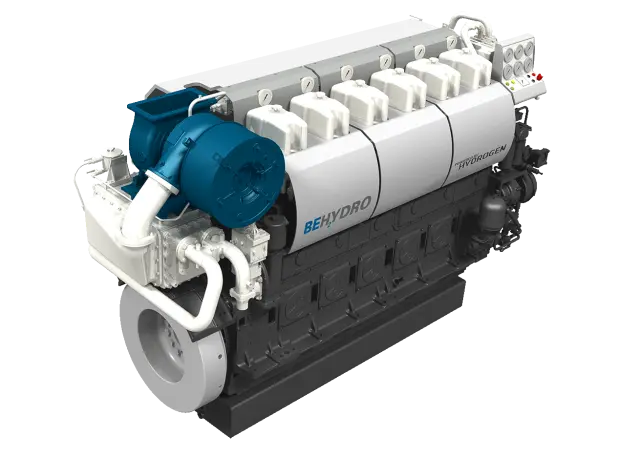
CMB developed a 1MW dual-fuel hydrogen engine (BeHydro) in a joint venture with ABC Engines last year, and is ready to scale the technology up to produce engines up to 10MW for a wide variety of industrial, maritime and port applications. Additionally, a mono-fuel hydrogen engine will be available by the second quarter of 2021.
CMB has been active in Japan for 40 years and is already building a hydrogen-fuelled ferry with partner Tsuneishi Facilities & Craft that is expected to start operation in April in the Setouchi area. With dual fuel hydrogen engines, the HydroBingo will be the world’s first hydrogen-powered ferry.
Alexander Saverys, CEO of CMB, anticipates more dual-fuel and mono-fuel hydrogen vessels being built in Japan including tugboats, ferries and crew transfer vessels. In port, hydrogen-powered trucks, excavators and straddle carriers are also anticipated.
“The collaboration in Japan is a first important step in the development of hydrogen applications in Asia,” says Saverys. “There are many more projects in the pipeline that will be announced in the coming weeks and months.”
In Japan, hydrogen is seen as the key technology for becoming carbon-neutral. Especially in the shipping industry, the practical application of engines that can directly burn hydrogen and ammonia is considered a pressing issue. Compared to fuel cells, hydrogen-powered dual fuel engines can reduce initial investment costs and be introduced without compromising performance and reliability, the partners say.
Nippon Coke & Engineering owns a production plant in the Kyushu region and initially anticipates providing 500,000 kilograms of hydrogen per year for local use. General trading company ITOCHU has a strong business relationship with steel mills and power plants, which the partners believe will be consumers of hydrogen in the future. Using its networks in Japan and other countries, ITOCHU aims to introduce the local production, local consumption hydrogen business model to other regions of Japan and also overseas.
CMB’s hydrogen vessel developments in Antwerp
CMB’s first hydrogen-powered vessel is the shuttle boat, Hydroville, which currently transports passengers between Kruibeke and Antwerp. Up until now, the Hydroville has been supplied with hydrogen from a tube trailer, but to be able to supply larger ships with hydrogen, a refuelling station is being built which will also allow for refuelling of cars. At the station, an electrolyser converts electricity and water into hydrogen. The hydrogen is compressed and transferred to various buffers that enable a car, truck or ship to refuel. In addition to the refuelling station, the site houses two trailer docks that can be used to transport the green hydrogen produced to other destinations. Various ultra-fast charging points for electric cars are also included and integrated into the site’s smart grid.
Following on from the Hydroville is the company’s dual-fuel Hydrocat design, the result of a joint venture between CMB.TECH and Windcat Workboats. The vessel is designed to provide crew transfer and to support maintenance activities for offshore wind parks.
CMB’s first hydrogen-fuelled tug, HydroTug, is expected to become operational in the Port of Antwerp this year. HydroTug will be powered by two 2MW BeHydro dual-fuel engines and will feature 396 Type I, 350 bar hydrogen storage cylinders for a total storage capacity of 405.5kg of hydrogen.
Saverys says: “BeHydro reinforces the recently announced EU vision on hydrogen and proves that the energy transition for large-scale applications is possible today. These include main engines for coastal shipping, inland shipping and tugboats, auxiliary engines for deep-sea vessels, but also trains and electricity generators for hospitals and data centres. In theory, any large diesel engine can be replaced by a BeHydro engine.”
A 1MW BeHydro engine produces as much energy as one 3MW wind turbine or 36,000 solar panels.
Related Articles
 2-STROKE & 4-STROKE
 2-STROKE & 4-STROKE
 2-STROKE & 4-STROKE