



New ORC heat recovery systems boost energy efficiency of dual-fuel engines
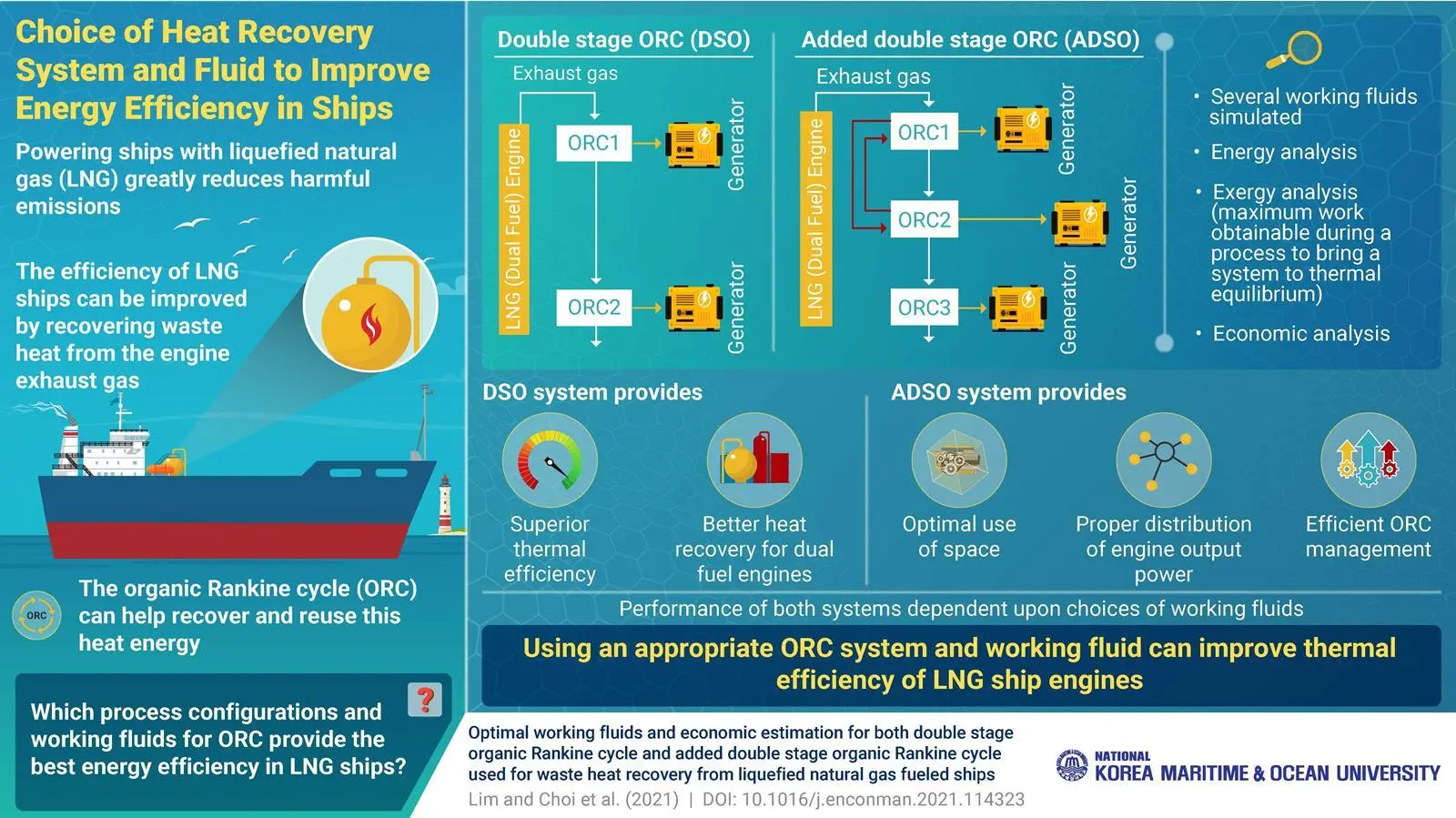
In a recent study published in Energy Conversion and Management, the team, led by Dr. Yeong-Seok Choi, describe their development of two novel heat recovery systems. Their aim is to improve the environmental performance of LNG-fuelled ships which can lose up to 25% of their input heat through the engine’s exhaust gases. The recovered heat can be used to pre-heat the LNG fuel (stored at -160°C) before combustion.
The research team developed two heat recovery systems. The first, double stage ORC system, uses the heat from the engine exhaust gas to run two ORCs with connections to two generators. Cycle 1 and cycle 2 are connected in parallel.
The second, added double stage ORC system, features a third ORC, and two of its ORCs exchange heat with each other. In this case, cycle 1 and cycle 2 are connected in two stages and cycle 1 and cycle 3 in parallel.
The team examined the performance of the designs using a range of different organic fluids. They then performed energy, exergy (maximum work derived from a heat exchange process), and economic analyses on the systems.
Overall, the new designs achieved substantial improvements in energy efficiency. The first system achieved a power, heat transfer area and payback period of 1760kW, 2108.9m2 and 4.2 years using the best performing organic liquids. The second added double design achieved a payback of 6.2 years. While first double-stage system had better overall energy efficiency, the second added-double system was more suitable for cramped engine spaces.
“Although our research is focused on shipping, this work can be applied to several other industries and cryogenic hydrogen research as well,” says Choi.
Related Articles
 ENERGY SAVING DEVICES
 ENERGY SAVING DEVICES
 AMMONIA