



New Railship For Sicilian Link
Tailored to the established terminal infrastructure at both ends of the route in Villa San Giovanni and Messina, the Iginia was constructed by the Genova Industrie Navali (GIN) Group to the order of the Italian State Railways’ operator Rete Ferroviaria Italiana (RFI).
Ranked now as Italy’s largest private shipbuilder, GIN used production sites in different parts of the country to realise the project. The home industry is understood to have subsequently lost out to overseas competition for RFI’s latest railship requirement, reportedly placed in recent weeks with Spanish yard Hijos de J. Barreras. The ship which began the fleet modernisation programme just over eight years ago, the Messina, had been built by Nuovi Cantieri Apuania, and was the last commercial vessel from the Marina di Carrara yard.
As with the NAOS-designed Messina, loading and discharge of rail passenger carriages and rail freight wagons is effected on Iginia through the single-track bow opening to the main deck, fitted with four lines of embedded track. The ferry also has a stern entrance available for drive-through handling of cars and trucks when the vessel is not transporting trains.
The propulsion layout is similar to that of the Messina, on which three Schottel azimuthing thrusters are powered by Wartsila 26-series medium-speed engines. One of the thrusters is on the centreline, and the two others are set slightly forward on each side. The arrangements provide for transits at up to 18 knots. The troika of rudder propellers plus two bow thrusters and bow rudder ensure the very high level of manoeuvrability demanding in berthing.
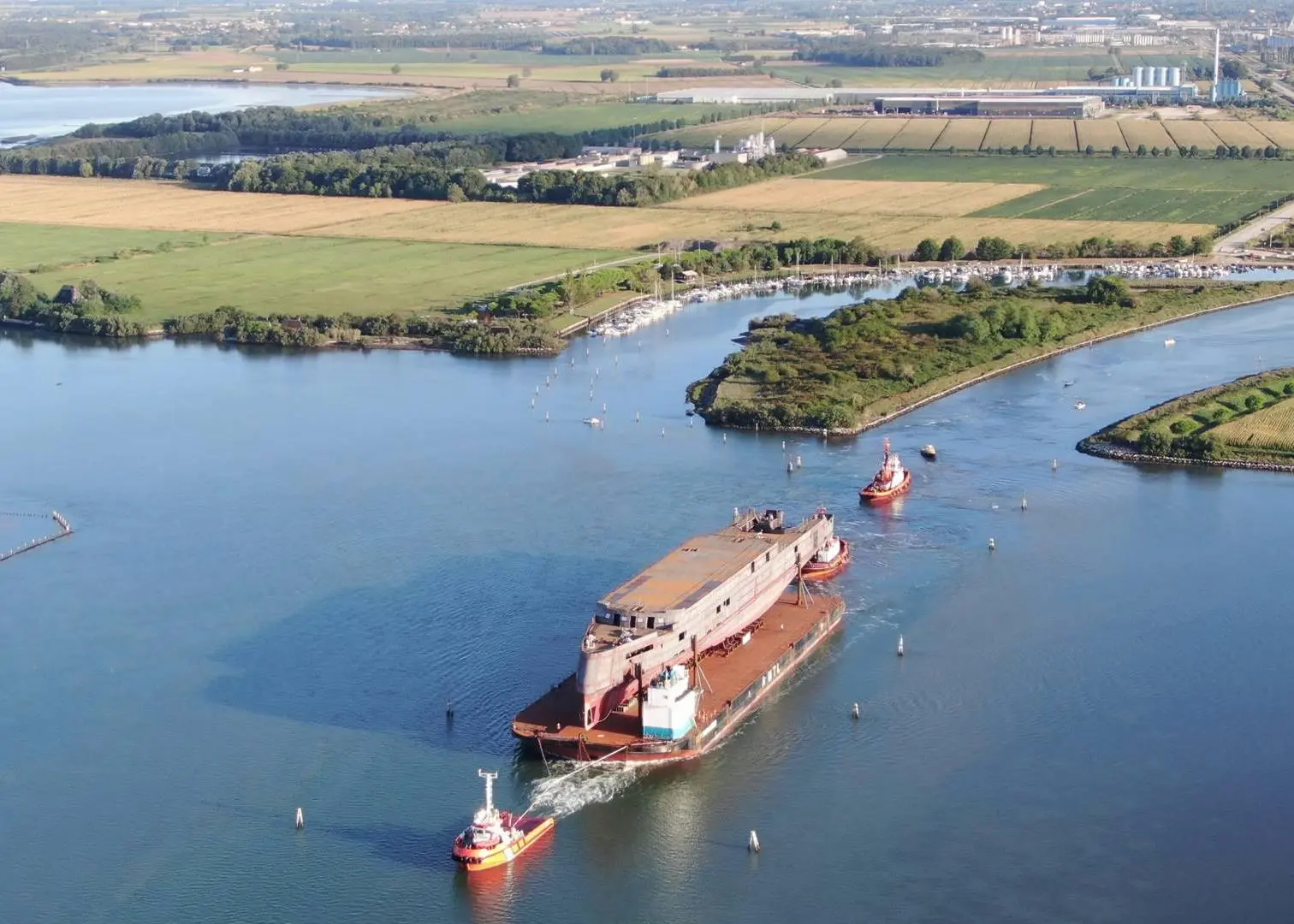
The project has exercised the logistical as well as technical capabilities of the contractor. Having secured the EUR48 million order (US$55m at current rates) from RFI in 2019, GIN Holding’s Genoese founder member yards T.Mariotti and San Giorgio del Porto assigned hull fabrication and most of the machinery and equipment installation to another member of the group, CIMAR, located in north east Italy.
The launch and float-out from CIMAR’s yard at San Giorgio di Nogaro, on the Corno River south of Udine, was accomplished using a semi-submersible, sea-going deck barge. The hull was subsequently taken in tow by the tug Gianemilio C for the passage down the Adriatic, through the Strait of Messina, and up the Tyrrhenian coast to the Ligurian port of Genoa. There, installation of funnels, top superstructure, railway equipment and final outfitting has been carried out at the facilities of T.Mariotti and San Giorgio del Porto.
RFI’s follow-on order in Spain calls for a slightly longer vessel, at 150m, conceived with a hybrid power arrangement, allowing zero emission operation in port. A grant of EUR9m ($10.3m) has reportedly been approved under the Next Generation EU programme towards the project’s contract price. The ship is due to be delivered in 2024.
Related Articles
 PROPULSION
 GENERAL NEWS
 HYDROGEN